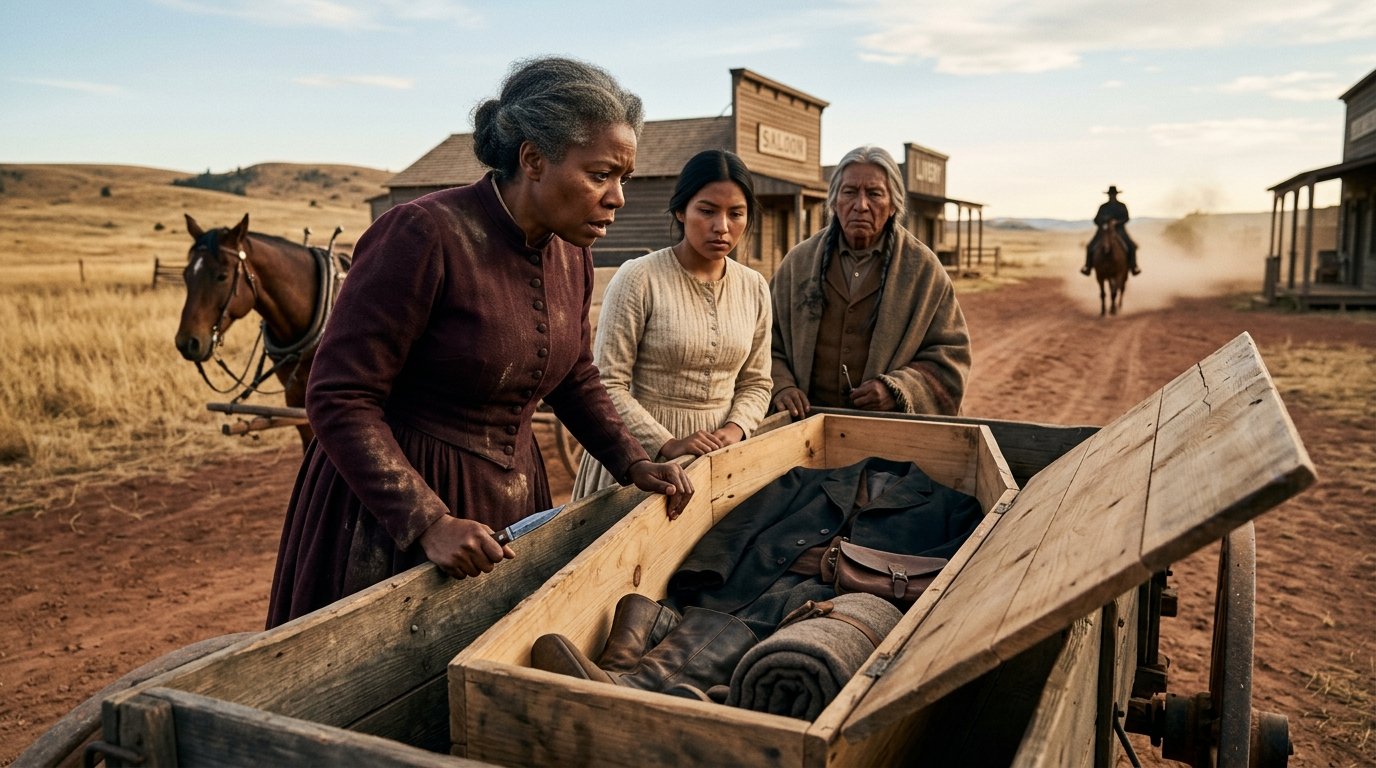
Ruth Carter froze with her hand still hovering above the half-open coffin. The stranger’s voice had carried clearly across the dry road: “Mrs. Carter! Step away from that coffin!” For one long second, no one moved. Mara stood beside the wagon with both hands empty. Thomas stared past Ruth toward the approaching rider. Ruth could hear only the restless breathing of the horses and the wooden coffin lid creaking softly in the wind. She tightened her fingers around Samuel’s old folding knife. Whoever was coming down that road knew her name, knew the coffin was there, and had arrived at the exact moment she discovered that her son was not inside it.
The rider finally came into view. He was a broad-shouldered man in a dusty frontier coat with a small metal badge pinned to his chest. He stopped his horse several yards from the wagon but did not reach for his revolver. “My name is Deputy Harlan Voss,” he said. “I was told to find you before you crossed the county line.” Ruth did not step away. Instead, she looked down at the name burned into the wooden plate: SAMUEL CARTER. “They told me my son was dead,” she said. “They put his name on this box. So you’re going to tell me why he isn’t in it.”
Voss climbed down slowly and removed his hat. His expression changed when he saw the lid already open. “You weren’t supposed to open that here,” he said. Thomas immediately stepped closer. “That sounds less like concern and more like an order,” the elder replied. Voss looked toward him but did not argue. Ruth noticed something then: the deputy was frightened. Not frightened of Ruth, Mara, or Thomas. He kept glancing over his shoulder at the road behind him as if he expected someone else to appear. “Who told you to stop me?” Ruth asked. Voss hesitated. That hesitation told her more than any answer could have.
Ruth turned back to the coffin. Inside were Samuel’s dark railway coat, his worn work boots, a rolled blanket, and the leather pouch he always carried when he traveled. Every object looked real enough to convince a grieving mother that the man who owned them must be gone. Yet there was no Samuel. Mara moved closer and pointed toward the corner beneath the coat. “That was what you were reaching for,” she said. Ruth carefully lifted the heavy fabric. Underneath it was a small oilskin envelope, tied shut with thin cord. Across the front, written in dark ink, were two words: RUTH CARTER.
Voss immediately said, “Don’t open it.” Ruth looked straight at him. “You’re about three days too late to start telling me what I’m allowed to know.” She broke the cord. Inside was a folded railway ledger page and a short handwritten note. Ruth recognized Samuel’s handwriting before she even read the first sentence. The letters were hurried and uneven: “Mama, if this reaches you, do not believe the accident report.” Her knees nearly gave way. Mara caught Ruth gently by the arm while Thomas steadied the coffin lid. Ruth read the next line aloud: “I saw something on the northbound train that I was never supposed to see.”
The deputy closed his eyes for a moment. Ruth looked up. “You knew.” Voss shook his head. “Not all of it.” Samuel’s note continued. Three nights earlier, he had been working near a freight train when he noticed several locked crates being transferred after midnight. The paperwork listed farm equipment, but Samuel had helped load enough freight to know the crates were too heavy and too carefully guarded. Then he saw a railway accountant changing the cargo numbers in the station ledger. Samuel copied the altered entries onto the page now in Ruth’s hand. Before he could leave, one of the men realized he had seen too much.
Samuel escaped the station before dawn and headed west instead of returning home. The story about the railway accident appeared the following day. According to the notice delivered to Ruth, Samuel had supposedly been identified among the missing. But Samuel’s note explained that no one had identified him at all. His coat, boots, and travel pouch had been taken from the bunkhouse where he slept. Someone had used his belongings to make the story believable. “They don’t need me dead,” Samuel had written. “They only need everybody to think I am.” Ruth read that sentence twice before lowering the page.
Mara quietly said, “That explains why he wouldn’t tell us his full story.” She told Ruth what had happened the previous morning. Her younger brother had tried to cross a swollen section of river on horseback when the animal lost its footing. Samuel, who had been hiding nearby, jumped into the water and dragged the boy toward the bank. He was exhausted and bruised but alive. Mara’s family gave him dry clothes and food. He stayed less than an hour. Before leaving, Samuel handed Mara the folding knife. “If you see a woman named Ruth Carter traveling east,” he had told her, “give her this. She’ll know I’m alive.”
Ruth stared at the knife in her palm. It had belonged to her late husband, Elijah, long before Samuel was old enough to work the railway. Samuel would never have given it away unless he needed to send a message that could not be mistaken. “Where did he go?” Ruth asked. Mara looked toward Thomas. Thomas answered carefully. “North. Toward the old mission road. But he believed someone was following him.” Ruth immediately started toward the wagon bench. Voss stepped into her path. “If you ride after him without knowing the rest, you may lead the wrong people directly to him.”
Ruth stopped. “Then tell me the rest.” Voss looked again toward the empty road. He finally admitted that he had been sent by Sheriff Calder in the neighboring county. Calder had received a railway telegram ordering local lawmen to stop Ruth’s wagon and recover the coffin before it traveled any farther. The telegram claimed the coffin contained property connected to an official investigation. That alone had bothered Voss. “A grieving mother taking her son home isn’t railway property,” he said. He decided to ride ahead and find Ruth before the other deputy assigned to the same order could reach her.
Thomas asked the question no one else had considered. “If they wanted the coffin back so badly, why give it to Ruth in the first place?” Voss looked toward the open box. The answer suddenly seemed obvious. They had expected Ruth to carry it far away without opening it. Once the coffin was buried, Samuel’s disappearance would become permanent in everyone’s mind. Anyone asking about him could be shown a grave. But Samuel had somehow managed to hide his note and copied ledger page among his belongings before the coffin left the railway yard. Whoever prepared the coffin either failed to find them or never knew they were there.
A distant sound interrupted them. Hooves. More than one horse this time. Voss turned sharply toward the road. “We have company.” He told Thomas to close the coffin but not to move the wagon. Ruth tucked Samuel’s note and the copied ledger page inside the front of her dress while keeping the folding knife in her hand. Mara moved toward the settlement, but Ruth caught her wrist. “If they know you helped Samuel, don’t stand beside me when they arrive.” Mara shook her head. “Samuel went into that river for my brother. I’m not leaving his mother alone now.”
Two riders appeared through the dust. One was another deputy. The second wore a clean dark coat and no badge. Voss muttered the man’s name before they reached the wagon: Edwin Pike, a railway security supervisor. Pike dismounted with the calm confidence of someone who believed the situation already belonged to him. His eyes moved from Ruth to the coffin and then to Voss. “You were instructed not to let anyone open it,” Pike said. Voss answered, “I was instructed to find Mrs. Carter. I found her.” Pike’s expression hardened when he saw the coffin lid had been disturbed.
Pike approached Ruth with a soft voice that made her trust him even less. He explained that a mistake had been made and offered to return the coffin to the railway at no cost. Ruth asked him what mistake could put her living son’s name on an empty coffin. For the first time, Pike had no immediate answer. Then his gaze dropped toward Ruth’s clenched hand and the folding knife. His expression changed. “Where did you get that?” he asked. Ruth felt Mara stiffen beside her. She answered, “It belonged to my husband.” Pike stepped closer. “That is not what I asked.”
Thomas quietly moved between Pike and the two women. “You have your answer.” Pike ignored him. “Mrs. Carter, your son is involved in a serious theft from the railway.” Ruth nearly laughed from disbelief. “A few minutes ago he was dead. Now he’s a thief?” Voss looked directly at Pike. “What exactly did he steal?” Pike said Samuel had taken confidential company records. Voss nodded toward the coffin. “Interesting. Your telegram never mentioned records.” For the first time, the second deputy shifted uncomfortably in his saddle. It was becoming clear that even the lawmen had not been told the same story.
Ruth understood what Samuel had done. He had not stolen money or cargo. He had taken information. The ledger page hidden inside the coffin showed freight numbers, dates, destinations, and initials. Pike wanted the page badly enough to invent Samuel’s death and retrieve the coffin before anyone opened it. Ruth kept her face still. “If Samuel stole something, then arrest him,” she said. “Show me the warrant.” Pike answered that a warrant was being prepared. “Then you don’t have one,” Thomas said. The silence that followed seemed to stretch across the entire settlement.
Another sound came from behind them. A young boy from Mara’s community ran toward Thomas carrying a folded piece of paper. He had found it wedged beneath a stone near the northern trail. Mara recognized Samuel’s handwriting immediately. Thomas handed it to Ruth. The message was only one sentence: “If Pike reaches my mother before I do, tell her the numbers point to Black Hollow.” Pike’s face lost all color. Voss saw it. So did Ruth. Whatever Black Hollow was, Pike had not expected Samuel to leave its name behind.
Pike suddenly ordered the other deputy to take the coffin. The man did not move. Voss placed himself beside the wagon. “Not without lawful authority.” For several seconds no one spoke. Pike realized he no longer controlled the scene. Too many people had now seen the empty coffin, Samuel’s belongings, and his reaction to the message. He climbed back onto his horse. Before leaving, he looked directly at Ruth and said, “If your son is alive, Mrs. Carter, finding him may be the worst thing you can do for him.” Then Pike and the second deputy rode away in a cloud of dust.
Ruth watched until they disappeared. Then she turned to Voss. “What is Black Hollow?” The deputy answered that it was an abandoned mining settlement roughly fifteen miles north, close to an old freight spur that had supposedly been unused for years. Yet Voss had heard trains moving through that region after midnight. Thomas looked toward the lowering sun. There were only a few hours of daylight left. Mara said Samuel had been traveling north when she last saw him. Every clue now pointed to the same place.
Ruth closed the coffin lid herself. She no longer saw it as her son’s coffin; it was evidence of how carefully someone had tried to erase him. She removed the wooden plate bearing Samuel’s name and placed it inside her handbag, then climbed onto the wagon seat. Mara mounted a small horse while Thomas remained behind to preserve a copy of Samuel’s note. Voss led Ruth toward a shorter trail to Black Hollow. Less than two miles later, dark smoke rose beyond the northern ridge. When they reached the top, an abandoned railway building was burning below. Near the old track stood a lone figure waving desperately toward them. Ruth could not see his face, but she knew the way he moved. “Samuel,” she whispered. Then a second figure stepped from behind the burning building, raised a rifle toward him, and the story Ruth thought had ended with a coffin was suddenly only beginning.


