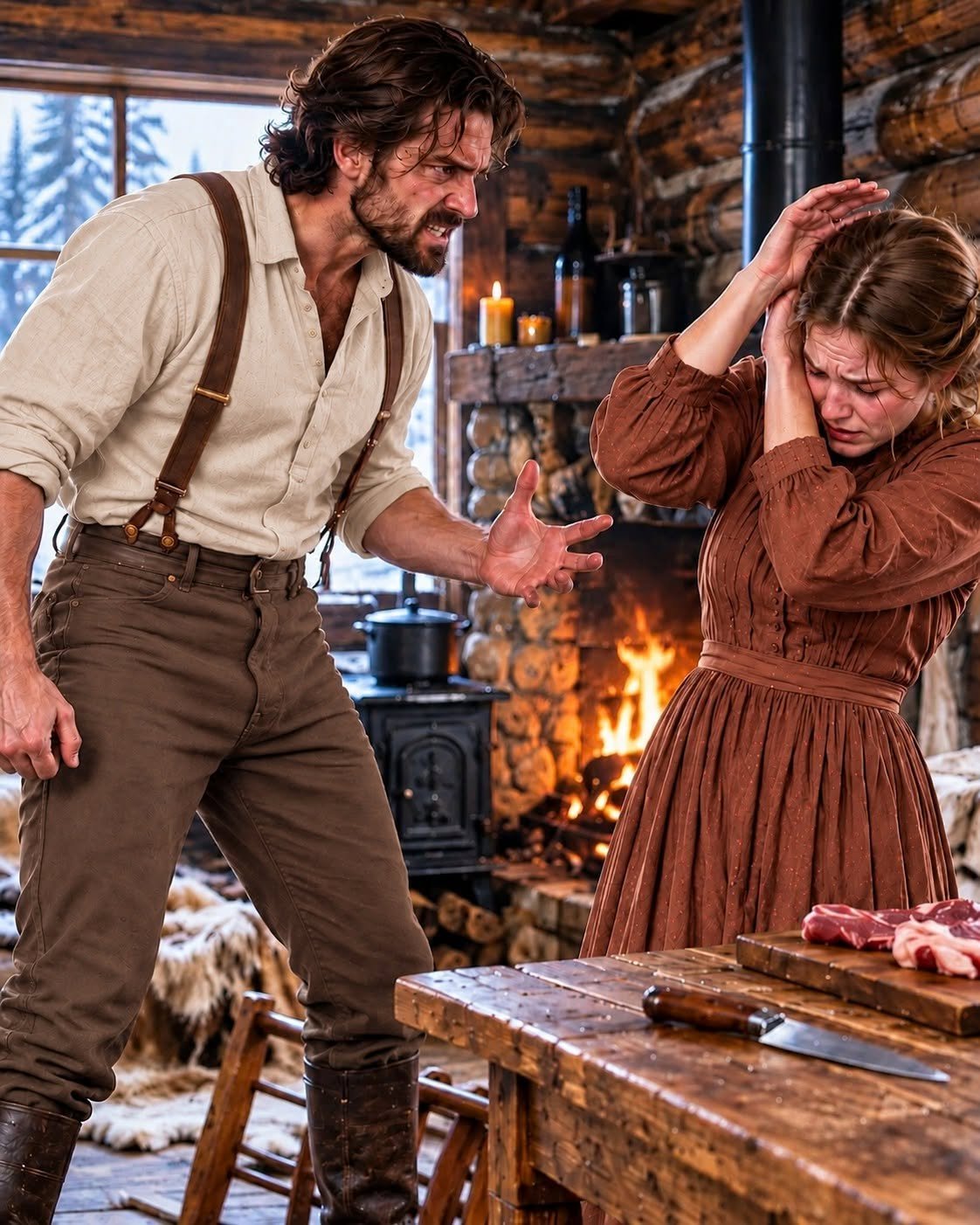
The Bruises On His Quiet Wife’s Side
The stagecoach had lumbered into the depot on a gray morning thick with sleet, and Gideon had watched a pale woman step down so quietly she seemed more ghost than flesh. Mave, thirty-one, widowed, willing to relocate. That was all the marriage agency had told him. One look into her hollow eyes told him the rest of her story had been left out on purpose.
Gideon had not sought a romance. His cabin sat alone in a mountain valley where winter arrived like a fist, and he needed a partner to cut firewood, cook meals, and endure the long dark. He called it survival. The agency had called it destiny. But the moment Mave recoiled from a brush of his shoulder in the wagon — nearly throwing herself into the sleet — Gideon understood he had brought home a woman running from something far worse than weather.
The cabin was small: one room, one fireplace, one stove, one bed. Mave stood in the center of it as though waiting for permission to exist. When Gideon handed her venison and a knife, the blade slipped and pricked her thumb. A single drop of blood. Mave gasped, dropped the knife, knocked over a chair, and threw her arms over her head, babbling apologies to a man who had not even moved.
Gideon righted the chair. He laid the knife flat on the table and spoke in a voice just above a whisper. “A marriage paper doesn’t make you owe me anything.” That night he slept on the floor and gave her the bed. For five days, a savage blizzard locked them inside together, and Gideon learned the shape of her fear: she washed cups before he finished drinking, folded blankets the instant he stood, and flinched when the logs cracked in the fire.
On the sixth morning, the storm broke. Gideon spent hours digging through drifts and chopping ice from the woodpile. When he finally stepped inside, the cabin was warm and smelled of soap. Mave stood by the wash tub, her dress partly unfastened, hurrying to finish. He should have turned away. But he saw them.
Old yellow stains across her ribs. Dark purple bands beneath her corset. And against her side, the unmistakable outline of a man’s hand — four fingers, one thumb, pressed in bruise-purple. Mave spun around, all color draining from her face, and began fastening her dress with shaking hands, apologizing as though the bruises were her fault.
Gideon sat down slowly. He placed both empty hands flat on the table where she could see them. Then, more gently than anyone had spoken to her in years, he asked, “Who did this to you?”
Mave gripped the chair until the wood groaned. For one long moment, only the fire answered. Then, in a voice barely louder than the wind, she said, “My husband. His name was Silas Crowe.” The words came out one by one, like stones lifted from a grave. Silas Crowe of the Dakota Territory — a blacksmith with a roaring temper and a drinking habit that turned his fists into weapons.
She told Gideon how Silas had charmed her father into a quick wedding, then began the slow work of breaking her. How he beat her for burnt supper, for a dress he disliked, for speaking too loud and for speaking too soft. How the last winter, in a rage over a lost poker hand, he had struck her so hard she lost the child she was carrying. The handprint on her side was from that night. She had run in the spring thaw with a battered travel bag and never looked back.
“I told the agency I was widowed,” she whispered. “It’s true enough. I buried who I was in a snowbank outside Yankton and kept walking.” Gideon’s jaw worked. His own hands curled on the table, then flattened again. “Is he coming after you?” he asked. Mave shook her head. “He thinks I’m dead. I left my coat and bag by the river ice. He’d believe the spring took me.”
Something loosened in Gideon’s chest. “Then he’s gone,” he said. “And I want you to hear something clearly, Mave. No one under my roof is struck. Not ever. Not for mistakes, not for anything. My word on it.” She stared at him, searching for the lie, the price, the trap. She found none.
From that day, the winter changed. Gideon made a point of announcing himself before entering the room. He never raised his voice. He asked her opinion about the woodpile, the trap line, the salt pork. Small things — but to a woman who had been told her thoughts were worthless, they were mountains. Mave began to eat without flinching. She began to sleep through the night. One morning Gideon found her humming as she kneaded bread, and he stood in the doorway smiling until she caught him.
Spring came late to the valley, but it came. The snowmelt turned the creek into a roaring ribbon of white water, and the first green shoots pushed through the mud. Gideon and Mave walked the trap line together, and for the first time she laughed — a real laugh, startled out of her at a raccoon stealing bait. She clapped her hand over her mouth. Gideon said, “Don’t you dare take that back.”
In May, trouble arrived on horseback. A man rode into the valley asking after a pale, dark-haired woman. Gideon met him at the edge of the property with a rifle in his hands and his heart pounding. The man described Silas Crowe — said the blacksmith was dead, killed in a saloon brawl in Bismarck that winter, and that his kin were searching for the runaway wife to settle his debts against her.
Gideon thought of Mave humming in the kitchen. He thought of the handprint fading from her ribs. He looked the stranger in the eye and said, “There’s no woman by that name here. Only my wife, Mrs. Gideon Alden.” The man rode on. Gideon burned the letter the stranger left and never told Mave about it. Some ghosts, he decided, were better left buried.
That summer they married properly, before a circuit preacher, with wildflowers Mave had gathered herself. She wore a blue dress Gideon had ordered from the catalog, and she did not flinch when he took her hands. “I thought I married you to survive a winter,” Gideon told her afterward, on the cabin steps, watching the sun sink behind the peaks. “Turns out you were the one surviving me.”
In October, when the first snow dusted the peaks, Gideon surprised Mave with a gift: a bolt of green calico from the trading post, enough for a proper dress. She held it against her cheek and cried — not the frightened tears he had first seen, but tears of a woman learning that kindness could arrive without a price.
That same month, a neighboring trapper named Elias Holt rode in with a haunch of venison and stayed for supper. He was a gruff old man who spoke ten words a day, but as he left he clapped Gideon on the shoulder and said, “You done good, boy. She’s got a good heart.” Mave, overhearing from the doorway, stood a little taller. It was the first time a stranger had called her anything but “wife” or “woman.”
By Christmas, the cabin had a braided rug Mave made from rags, curtains on the single window, and the smell of molasses cookies that Gideon declared the finest thing he had ever tasted. They celebrated quietly, exchanging carved wooden spoons — his for her, hers for him. “I used to dread the winter,” Mave said, watching the fire. “Now I find I mind it less.” Gideon squeezed her hand. “Best winter of my life.”
Years later, the valley held a little farmhouse with a proper garden and three children who knew nothing of bruises or blacksmiths — only of a mother whose laugh came easy and a father whose hands were gentle. Mave kept one thing from her old life: the battered travel bag, tucked in the attic. On the day their eldest daughter married, Mave opened it and showed her a faded wedding ring she had never worn. “This was the woman I had to be,” she said. “Your father taught me who I really am.”
Gideon never did learn the full measure of what she had endured. He never asked for it either. Some wounds, he knew, heal only when they are allowed to be the past. And so they lived out their years in that valley — two quiet people, one loud love, and a handprint that faded from her skin long before it faded from his memory.


