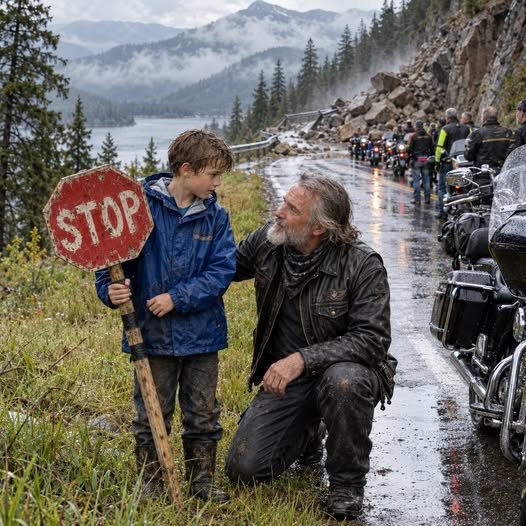
The little town of Cedar Bend, Montana, has known its share of quiet heroes, but the one nobody expected was nine years old and standing in the middle of a mountain road with a wooden stop sign raised over his head.
His name was Owen Gray, and the morning had started like any other crisp October Saturday — pancakes at the Willow Diner, his bicycle parked by the porch rail, the smell of pine drifting down from the mountains. But by mid-morning, the whole town would be holding its breath.
It began on Miller’s Turn, a sharp blind curve on the highway above Cedar Bend, where a rockfall had spilled across the far lane during the night. Nobody in town knew about it yet. And nobody had any idea that three hundred charity motorcycles — the Iron Mercy Run, raising money for the Shriners Children’s Burn Center — were thundering up the valley road at that very moment, riding straight toward it.
Owen had been riding his bicycle up the old logging trail that morning, chasing a red-tailed hawk the way boys do, when he heard the rumble. He climbed a rise and saw the pile of boulders and gravel choking the road on the far side of the curve — and then he heard the engines, growing louder, dozens of them, climbing the mountain from the other side.
His stomach dropped. There was no way to warn them. Cell service had been dead in the pass all week, and the diner’s old radio had quit years ago. The riders were coming fast, and the curve gave them no line of sight to what waited beyond it.
That’s when Owen remembered his grandfather’s sign.
Art Gray had been Cedar Bend’s school crossing guard for seventeen years, a retired road-crew worker with a slow smile and a habit of kneeling to talk to children at eye level. Every school morning he’d stand at the corner of 5th and Maple with a weathered wooden stop sign on a long pole, holding it high so the traffic would wait for the little ones to cross. After Art passed away that spring, Owen’s mother had hung the sign in the garage, and Owen had run his fingers over the worn paint more than once, thinking about him.
Owen pedaled down the trail faster than he ever had, cut across the switchback meadow, and reached the straight stretch of road just before Miller’s Turn. Then, his heart hammering in his chest, he walked out onto the yellow line and lifted the sign above his head.
The first motorcycle crested the rise less than a minute later — a big chrome machine ridden by a broad man with a gray beard and a small hard-hat pin on his leather vest. Owen’s arms were shaking, but he held the sign high and didn’t move.
The rider’s eyes went wide. He wrenched the handlebars, squeezed the brakes with everything he had, and the big bike skidded sideways on the wet pavement, sliding in a long arc that ended just inches from the boy’s shoes.
Behind him, the line of riders began to brake — one after another, the long thunder of the Iron Mercy Run dying into a sputtering, stunned silence.
The lead rider killed his engine, tore off his helmet, and stared at the boy. “Are you out of your mind?” he shouted — and then his voice broke. “Son, you could have been killed.”
Owen’s voice was small but steady. “There’s a rockfall around the bend, mister. You’d have gone right into it.”
The rider — Cal Rourke, road captain of the run — looked past the boy and saw the dust still hanging in the air where the rocks had slid. Then he looked back at the sign in Owen’s hands. And something changed in his face.
He knew that sign.
Hours earlier, Cal had stopped at the Willow Diner for coffee and pie, and he’d struck up a conversation with a quiet boy at the counter who told him the place used to be his grandfather’s favorite breakfast spot. Cal had shown the boy the small hard-hat pin on his vest — a faded brass pin he’d worn for thirty years — and told him about the old road-crew boss who’d taught him everything, a man who’d tied a blue cloth around Cal’s hard hat one freezing winter morning so he’d never get lost in the whiteout.
The boy had gone very still. “That was my grandpa Art,” he’d said.
Now, standing on that mountain road, Cal looked at the worn wooden sign and then at the boy’s face, and he understood everything. He dropped to one knee — the way Art Gray used to do when he talked to children — and asked, “You’re Art’s grandson?”
Owen nodded, tears cutting clean lines through the dust on his cheeks. “He said this sign means everybody stops. Everybody.”
Cal wrapped the boy in a hug that smelled of leather and exhaust and something like rain. Behind them, three hundred bikers were climbing off their machines, and one by one they began to understand what had just happened — that a nine-year-old boy with a dead man’s crossing sign had saved every one of them.
Word traveled down the line of riders like a current. Nobody had heard of Art Gray before that morning. By the time the last bike had shut off, every rider on that mountain knew his name.
What followed was the kind of thing that reminds you why small towns and motorcycle clubs get along so well. A few riders with tow straps and chains worked the slide while others directed traffic, and within the hour a path was clear enough for the county crew — called by a rider who’d ridden back into cell range — to finish the job. But the run was behind schedule, and Cal Rourke had other plans anyway.
“We’re not blowing past this town,” he told the riders over the CB, once they’d confirmed it worked. “We’re riding INTO it.”
So three hundred motorcycles — the whole Iron Mercy Run — rolled slowly down into Cedar Bend that afternoon, engines low, while word spread ahead of them. By the time they reached Main Street, half the town was standing on the sidewalks. Owen’s mother, Ellie, came running out of the diner with flour on her apron and tears in her eyes, and folded her boy into her arms so tight he could hardly breathe.
The riders didn’t leave that day. They took over the town park. Somebody fired up a grill. The Willow Diner ran out of pie by five o’clock and started making more. And when the sun started to sink behind the mountains, Cal Rourke climbed onto the flatbed of a borrowed pickup with Owen Gray beside him and made an announcement.
The Iron Mercy Run had raised over two hundred thousand dollars for the children’s burn center, he said. And from that day forward, a new scholarship would bear the name of Arthur “Art” Gray — the Owen Gray Fund, to buy books, bicycles, and school supplies for the children of Cedar Bend.
Ellie Gray covered her face with her hands. Owen just stared.
Then Cal did something nobody expected. He unpinned the small brass hard-hat pin from his vest — the one Art Gray had given him thirty years before — and pinned it on the front of Owen’s jacket. “Your grandpa gave this to me when I was a scared young man who didn’t know a thing,” he said. “I reckon it’s yours now. He’d want you to have it.”
The crowd went quiet. Somewhere in the back, an old-timer in a veteran’s cap took his hat off. Somebody’s grandmother was crying into a dish towel.
But the day wasn’t over. Because Cal Rourke had one more surprise — and he needed Owen’s help for it.
The next morning, the riders formed up in the park, three hundred strong, engines idling like a held breath. And at the head of the column, riding passenger behind Cal Rourke on the lead bike, was Owen Gray — wearing a helmet two sizes too big, grinning like the sun had come out inside him.
Art Gray’s wooden stop sign was mounted on the front of the lead motorcycle, polished and shining, tied at the top with a strip of blue cloth — the same blue cloth, Cal told the crowd, that Art had tied around his hard hat all those years ago.
The run rolled out of Cedar Bend that morning to the cheers of the whole town, and it finished its ride to the burn center that evening — a little late, but with a story that would be told for years.
Today, if you visit the Willow Diner in Cedar Bend, you’ll see the wooden stop sign hanging in a place of honor behind the counter, framed under glass, the blue cloth still tied at its top. Beneath it is a small brass plaque that reads: “Arthur ‘Art’ Gray — He taught us all to stop.”
And if you ask the regulars about it, they’ll tell you about the morning a nine-year-old boy walked out onto the yellow line of Miller’s Turn and held up his grandfather’s sign — and about the three hundred bikers who stopped, and never forgot.
Owen Gray is ten now. He still rides his bicycle up the logging trail. But these days, when he passes Miller’s Turn, the county has put up a proper warning sign — and underneath it, someone has painted two small words in blue, the color of a hard hat cloth: “Thank you.”


