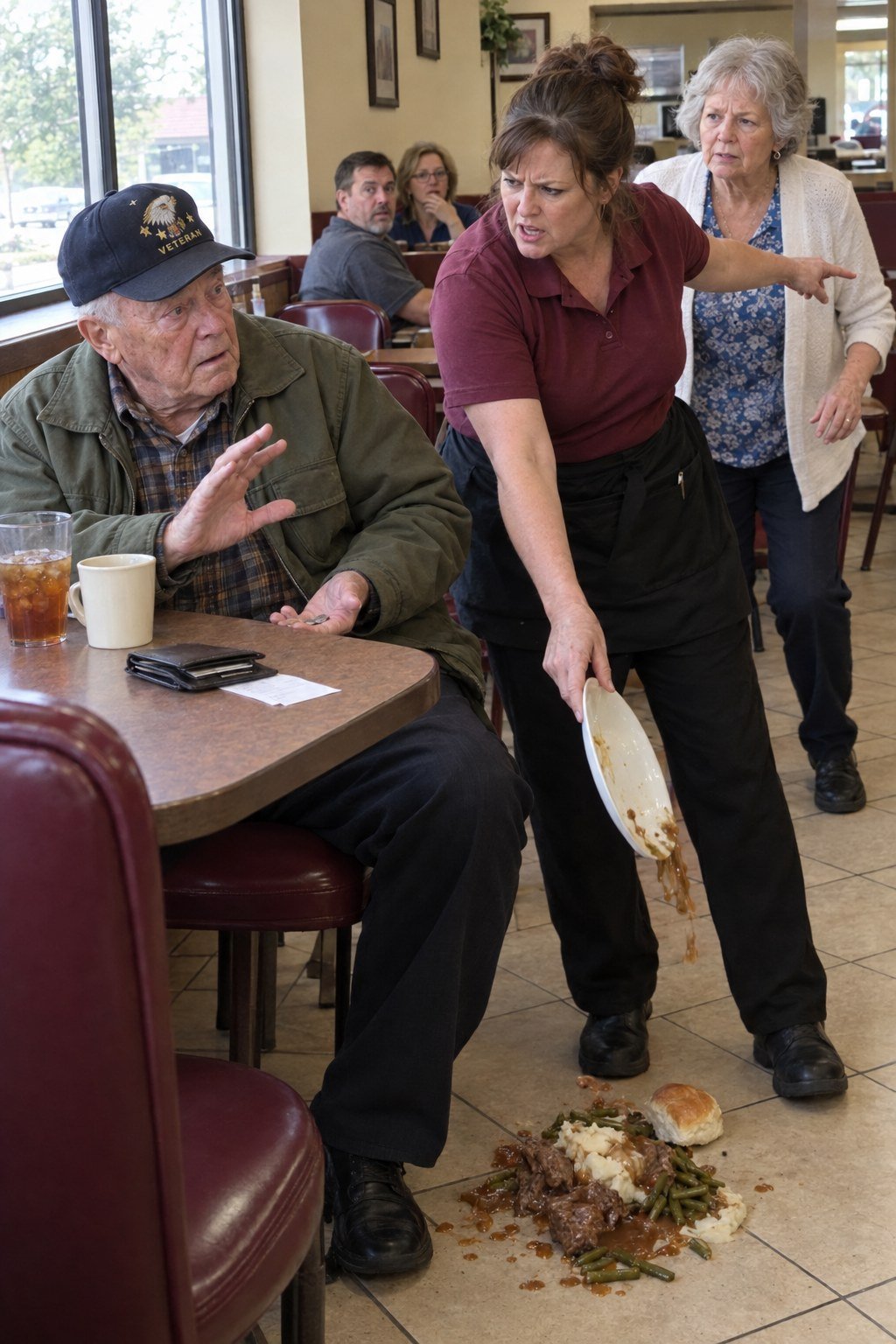
The plate was still falling when Frank Lawson raised his hand. Pot roast slid over the white rim. Mashed potatoes struck the tile beside his shoe, and the bread roll bounced beneath an empty chair. Across the table, the woman in the burgundy polo pointed toward the restaurant door as though the direction needed explaining. Frank remained seated, a few coins pressed into his other palm. At seventy-nine, he had learned how to keep his voice steady when a room turned against him. But he had never learned what to do when someone threw away his lunch while he was still trying to pay for it.
For a moment, nobody moved. A fork paused halfway to a man’s mouth. Someone near the windows whispered, “Did she just do that?” Behind the server, a gray-haired woman in a white cardigan stood so abruptly that her chair scraped across the floor. Frank looked from the scattered food to the woman pointing at the exit. His navy cap sat low above his watery eyes, its embroidered eagle worn pale at the edges. He wore an olive jacket over a plaid shirt, the same clothes he had put on carefully that morning. “I wasn’t asking you to give it to me,” he said. “I was asking you to check the bill.”
An hour earlier, Frank had stood at his kitchen counter deciding whether to go out at all. Since his wife, Nora, died, a meal could become something he postponed until hunger made the decision for him. He could still cook. He could still drive. What he could not do was make the empty chair across his own table feel ordinary. That Tuesday would have been their fifty-third wedding anniversary. They had never needed an expensive celebration. For years, they had chosen a little diner with burgundy seats, strong coffee, and a lunch special Nora said tasted almost like her mother’s Sunday cooking.
Frank tucked eighteen dollars into his wallet and slipped a small photograph behind the bills. In the picture, Nora stood beside him outside their first apartment, laughing at something he could no longer remember saying. The corners had softened from years of handling. He touched the photograph once before closing the wallet, then put on the veteran cap his daughter had given him. At the diner, a younger employee greeted him and asked whether he preferred a table or a booth. “A table by the window, if that’s all right,” he answered. He wanted to sit where the light fell, where Nora always liked to sit.
He studied the menu before ordering. The pot roast special was $11.95. With coffee, iced tea, and tax, he expected the total to stay below eighteen dollars. The tea was for him. The coffee was part of a habit he had not yet broken: Nora always ordered a cup before her meal, and on that particular day he wanted one there too. He did not explain that to the server. He simply thanked her when she set down both drinks. He placed his cap back on his head, folded a paper napkin across his knee, and watched a school bus pass outside the windows.
The meal arrived hot, with green beans along one edge of the plate and a roll tucked beside the potatoes. Frank had barely picked up his fork when another server approached with the check. Her name was Denise. She wore a burgundy polo and a black apron, and she held the slip against the tabletop with one finger. “Thirty-one forty-eight,” she said. Frank looked at the number, then at his plate. He read the items slowly. There were two lunch specials on the bill, extra drinks, and something he had never ordered. “I think this might be another table’s check,” he said. “I only had this one meal.”
Denise answered before he finished. “That’s what the register says.” Frank opened his wallet and counted the money onto the table. Three five-dollar bills. Two singles. Four quarters. He knew exactly what he had brought because he had counted it twice at home. He showed her the menu price and asked whether she would check with the employee who had taken his order. Denise glanced at his jacket, then at the coins. “If you couldn’t afford lunch, you should have said that before we made it.” The accusation carried farther than she needed it to. Frank felt people turn toward him.
He tried again, more quietly. “I can afford what I ordered. I don’t believe this check is mine.” That should have been an ordinary question in an ordinary restaurant, the kind resolved with a quick look at a table number. Instead, Denise pulled the slip away and said she did not have time for an argument. Frank reached for the menu, hoping the printed price would explain what his words had not. She mistook the movement, or chose to treat it, as defiance. “Then you don’t get to eat,” she said. Her hand closed around the edge of his plate before he could put down the menu.
She dragged the plate toward her, tipped it sharply, and sent the lunch onto the floor. Then she pointed at the entrance. “You can leave now.” Frank’s hand rose by instinct, too late to catch anything. There was no grand speech in him at that moment. There was only the shock of watching food he had been looking forward to become something beneath his feet. His coins felt suddenly foolish in his palm. He began gathering the bills, afraid that staying would bring more humiliation. Then the woman behind Denise spoke. “Put his money down,” she said. “And call whoever is in charge.”
The woman was Margaret Bell, seventy-four, and she had been eating at the next table. She stepped around the fallen food and placed herself beside Frank without touching Denise. “I heard him ask you to check a receipt,” she said. “I didn’t hear him ask for a free lunch.” Denise started describing Frank as difficult, but Margaret pointed to the slip still in her hand. “Then checking it should be easy.” A younger employee hurried toward the kitchen. Frank tried to stand and apologize for the mess. Margaret rested a hand on the back of his chair. “You didn’t make that mess, sir. Please don’t apologize for it.”
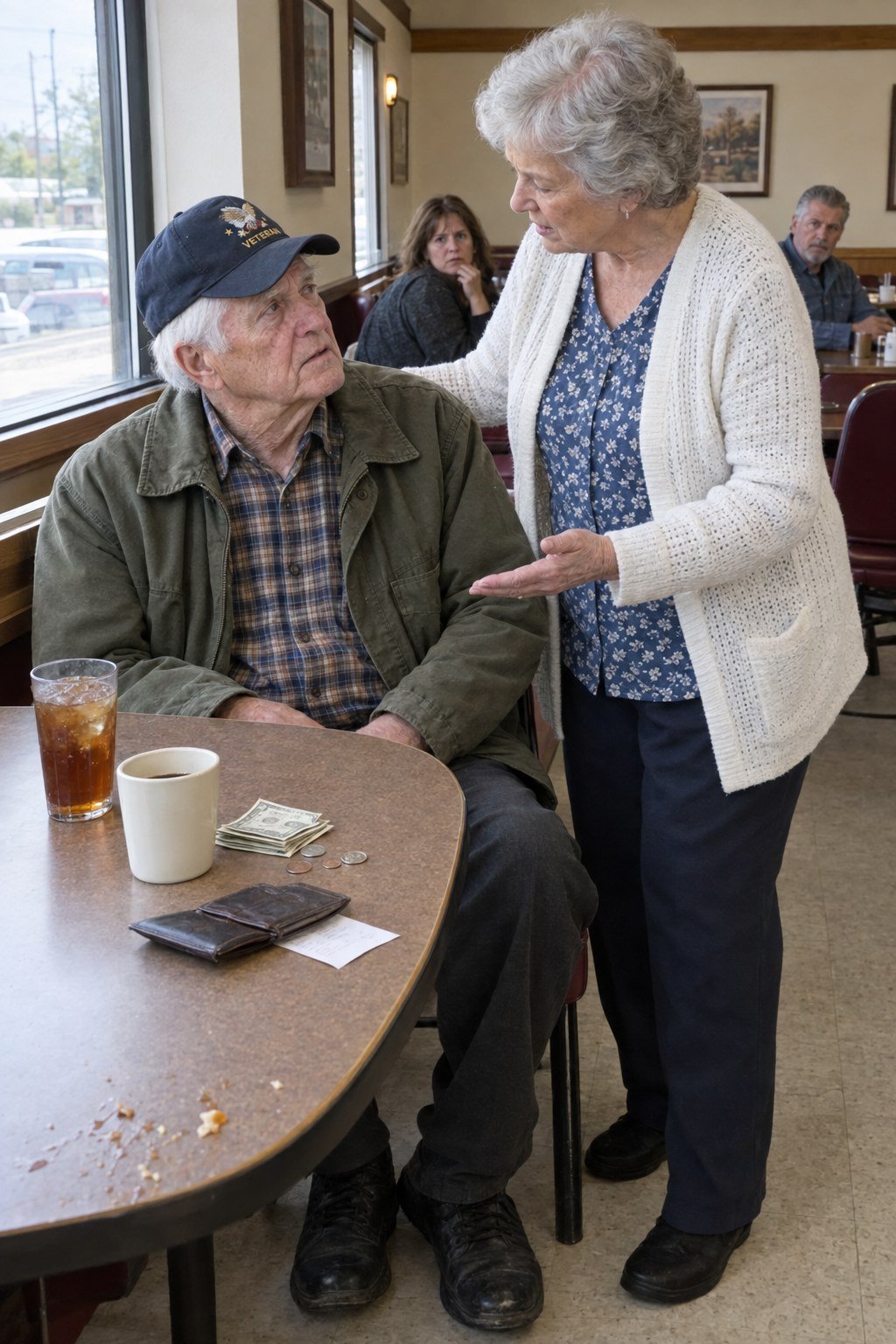
The diner owner, Daniel Hayes, arrived with the employee who had taken Frank’s order. He first asked whether Frank had been hurt. Then he told Denise to step away from the table while he examined the check. The younger employee recognized the problem immediately: orders from two neighboring tables had been combined under one open ticket. Frank’s lunch and drinks came to $17.23 with tax. He had enough money. He had been right to question the bill. Daniel placed the corrected slip beside Frank’s folded bills. “You were charged for food that wasn’t yours,” he said. “And you were treated shamefully when you pointed it out.”
Denise said it had been a busy shift. Daniel did not raise his voice. “A busy shift can explain a wrong check. It cannot explain throwing a customer’s food on the floor.” He asked her to go to the office with the shift supervisor while he looked after Frank. Another employee brought a dustpan and towels, and Daniel made sure the spill was cleared before anyone walked through it. Frank watched the activity with the stiff stillness of a man trying not to become the center of attention. “I don’t want any trouble,” he said. Daniel pulled out an empty chair. “You haven’t caused any. You came here for lunch.”
Only then did Margaret notice the small photograph partly exposed inside Frank’s open wallet. She leaned closer, then stopped. “May I ask who that is?” Frank slid the picture out carefully. “My wife. Nora. We used to come here on our anniversary.” Margaret looked at the younger woman in the photograph, studying her smile rather than the date on the back. Her own expression changed. “Nora Lawson?” she asked. Frank nodded, surprised to hear the surname. Margaret sat down beside him. “She used to volunteer at the library on Wednesday evenings, didn’t she?” Frank turned fully toward her. “For almost twenty years,” he said.
Margaret opened her purse and searched a small inner pocket. She brought out a folded card held together along its crease with clear tape. The message inside was written in careful, familiar handwriting: “One page at a time. You are doing better than you think. Nora.” Frank recognized the loops of the capital letters before Margaret explained. At fifty-eight, she had walked into the library and admitted something she had hidden most of her life: she could not comfortably read a letter from her own daughter. Nora had met her every week. She had never laughed, hurried her, or treated her embarrassment as something inconvenient.
“Your wife taught me to read my first book all the way through,” Margaret said. “She stayed late when I needed another try.” Frank looked at the card, then covered his mouth with one hand. Nora had spoken about her students carefully, without giving away anyone’s private struggles. He remembered her setting out simple books at their kitchen table and asking him whether a paragraph sounded encouraging. “She’d be pleased you kept that,” he said. Margaret smiled through wet eyes. “I keep it because some days I still need to hear her say it.” For the first time since the plate fell, Frank no longer felt that everyone was watching him for the wrong reason.
Daniel asked whether Margaret would like to move her lunch to Frank’s table. She looked to Frank before answering. He moved the empty chair a little closer and said, “I’d be glad of the company.” In the kitchen, a fresh meal was prepared. Daniel brought it himself, placing the plate gently in the space where the first one had been. He apologized again and told Frank there would be no charge. Frank unfolded a five-dollar bill, but Daniel asked him to keep it. “Let us replace what we ruined,” he said. “You shouldn’t have to purchase an apology.” Frank hesitated, then put the money back into his wallet.
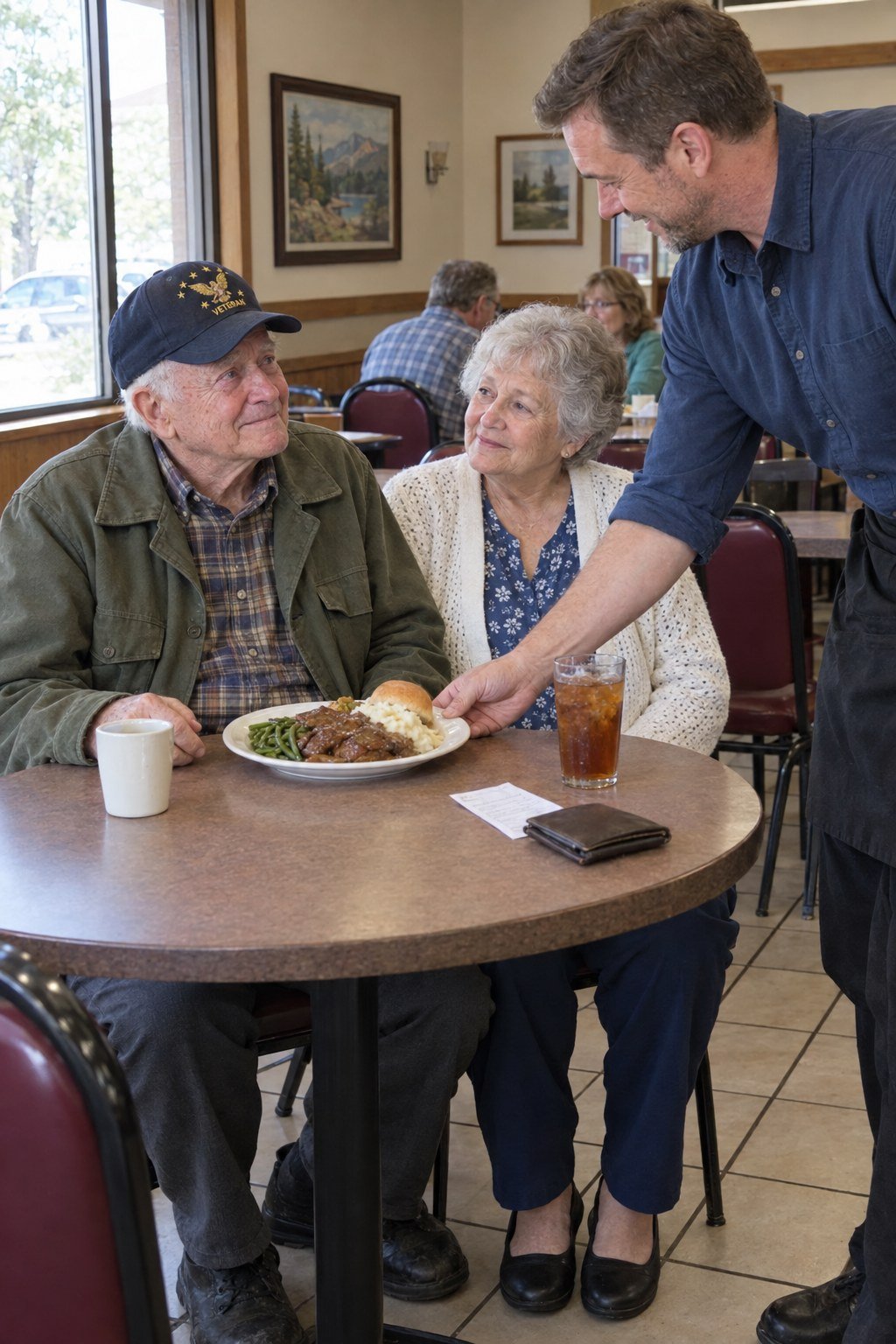
When Daniel mentioned the cap, Frank told him he had served in the Army many years earlier. Margaret thanked him, and he accepted her words with a small nod. But Daniel looked around at the customers close enough to hear and said something Frank appreciated even more. “That deserves respect. So does being a person sitting down to eat.” Frank did not need to produce a service record, an impressive rank, or proof that he had once done something heroic. The wrong bill had been enough reason to listen. His age, his old jacket, and his handful of coins had never been reasons to stop.
Denise did not return to the dining room that afternoon. Daniel told Frank that he would review the incident and speak with the witnesses, and that she had been taken off the shift. Frank accepted that without asking for a performance of punishment at his table. The next morning, Daniel contacted him with a further apology and said Denise would no longer be working at the diner. He also made a practical change: a disputed check would be reviewed by a supervisor before staff insisted on payment. Those steps could not erase what had happened. They could help make sure another customer did not have to experience it.
Before that afternoon ended, Frank and Margaret spent nearly an hour talking about Nora. Margaret remembered her bringing homemade soup to the library in a thermos. Frank remembered being sent back to the kitchen because he had forgotten to pack the spoons. They laughed at that, a small ordinary laugh that caught him by surprise. Margaret finished telling him about the day she had finally read her daughter’s letter without help. Frank listened with his fork resting on the plate. He had come to the diner hoping to feel close to his wife for a few minutes. A stranger had given him a piece of her life he had never known.
When Frank left, Margaret walked with him to the door. They agreed to meet again the following Tuesday, and he wrote the time on the back of his corrected receipt. Outside, he put Nora’s photograph safely into his wallet beside the money he had not spent. He still remembered the sound of the plate and the hand pointing him out. He would remember those things for a long time. But he also had another memory to carry home: a woman standing up before she knew his name, a fresh meal placed before him, and Nora’s handwriting saved in someone else’s purse. That evening, the next Tuesday was already marked on his kitchen calendar.


