She Had $11.42 and Found $50,000 — Then She Walked Three Miles to Give It Back
The hiring manager’s pen stopped moving, and I watched the job I had been perfect for disappear in real time.
“Maple House,” she said again, as if saying it twice might make it untrue. “The homeless shelter.”
“I’m there temporarily,” I said, keeping my voice steady. “My references, my work history — none of that changed this morning.”
She closed the folder. Not slammed. Closed. Gently, the way you close a door on a room you’ve decided not to enter.
“We’ll be in touch, Claire.”
I knew what that meant. I had heard it before.
I walked out of the medical center into the gray Columbus afternoon, and I stood on the sidewalk for a long moment, holding the application folder Wade had helped me print at the cycle shop that morning. Three hours earlier I had been sitting in Wade Harlan’s office with clean hair and dry socks, drinking his coffee, believing — actually believing — that today might be the day everything turned.
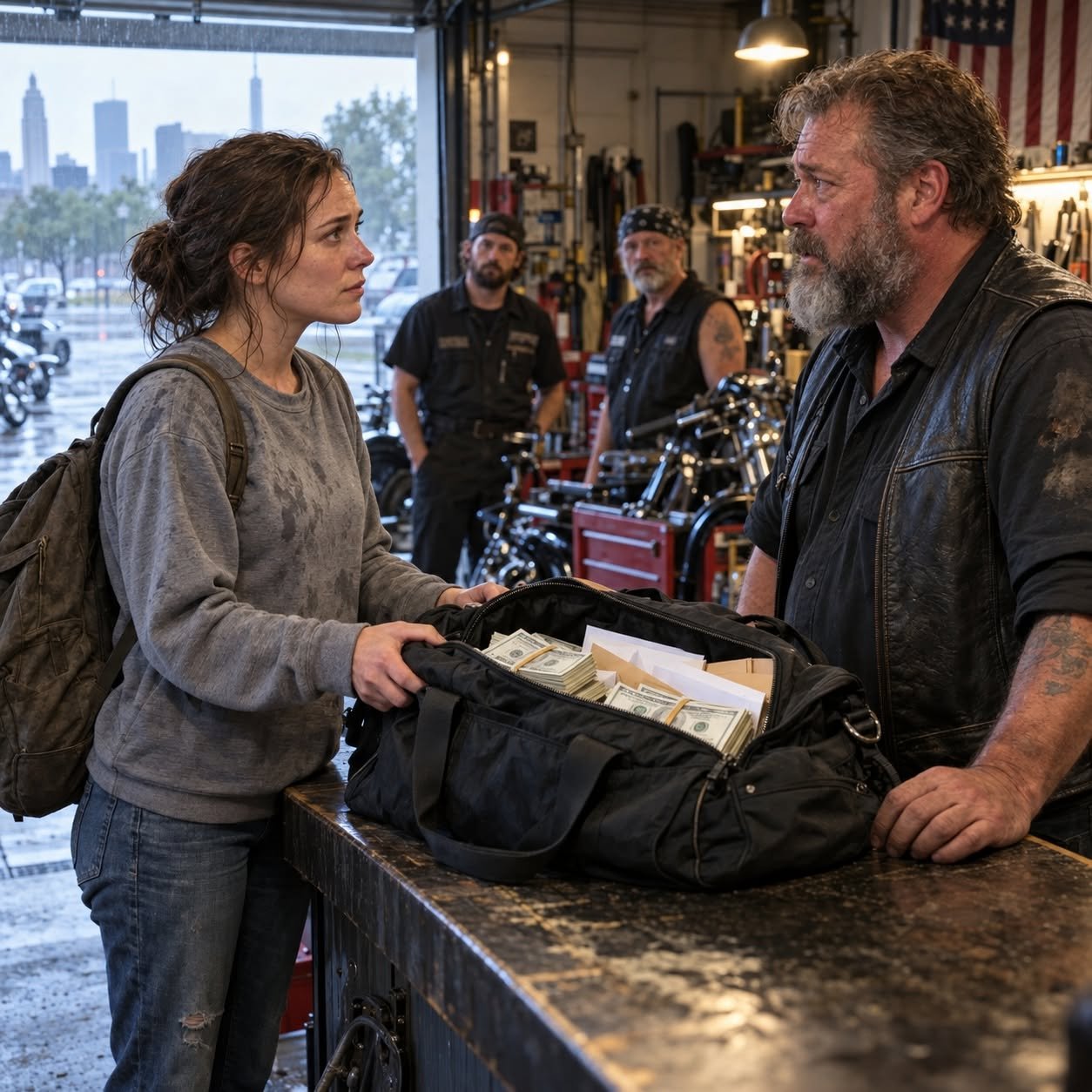
My name is Claire Dawson. That morning I had found $49,870 in a duffel bag outside a pharmacy and walked three miles through the rain to return it. By noon I had been offered three thousand dollars I refused to take. By two o’clock I had been rejected for a job I could have done in my sleep.
All I wanted was to sit down somewhere nobody would tell me to move.
I walked back to Harlan Cycle Works. I hadn’t planned to. My feet just went there, the way they had gone toward the garage that morning with someone else’s fortune on my back.
Wade was under a motorcycle when I came in, only his boots visible. He slid out, saw my face, and sat up.
“How’d the interview go?”
I tried to answer. What came out was a laugh that wasn’t a laugh. “She loved me right up until the address line.”
Wade wiped his hands on his rag. He didn’t say I’m sorry or that’s terrible or any of the things people say when they don’t know what else to say. He just looked at me for a long moment.
“Sit down,” he said.
I sat on the stool in his office. On his desk was the photograph I had found in the wallet that morning — Wade kneeling beside a little girl with missing front teeth, For Dad. Love, Sophie written on the back in a child’s careful handwriting.
“That’s my daughter,” Wade said, following my eyes. “She’s twenty now. Nursing school in Cincinnati. That photo’s ten years old and I still carry it every day.”
“She looks like she adores you,” I said.
“She does. And you know what she’d say if she heard what happened this morning? She’d say, Dad, that woman walked three miles in the rain with your money. What did you do for her?” He leaned forward. “So I’m asking you again, Claire. Not as a reward. As a question. What do you need?”
That was the question. The one that changed everything, and it had nothing to do with the money in that bag.
Nobody had asked me that in over a year. People had offered me things — a blanket, a sandwich, a bed for the night, a pamphlet. Offers are about what the giver wants to give. A question is about what you actually need. And the truth was, I had forgotten I was allowed to need anything specific.
“I need a job,” I said. “A real one. Not a handout. I did medical reception for four years. Scheduling, insurance verification, intake. I’m good at it. I was good at it.”
“You still are,” Wade said. “Here’s my problem, Claire. My shop manager quit last month. I’ve got four mechanics, a waiting room full of customers, and nobody who can run the front of this place. Phones. Estimates. Parts ordering. Scheduling. I need somebody who can talk to a scared customer the way you talked to that hiring manager about your mother — straight and honest.”
I stared at him. “Are you offering me a job?”
“I’m offering you an interview,” he said, and smiled for the first time that day. “It starts right now. First question: can you start Monday?”
I started crying. I hated crying in front of him — I had already cried in his shower that morning — but I couldn’t help it.
“Second question,” Wade said, pretending not to notice. “Do you need an advance? For shoes that don’t bleed and a deposit on a room? Because the motel across from the pharmacy has weekly rates, and I happen to know the owner.”
“That’s not — you can’t just — “
“I can,” he said. “It’s called hiring someone. Employers do it all the time.”
That Monday, I walked into Harlan Cycle Works wearing new sneakers, clean clothes from a thrift store Wade refused to let me pay for, and a name tag that said CLAIRE — FRONT DESK. By Friday, I had reorganized the scheduling system, cleared a two-week backlog of estimates, and talked a furious customer out of a one-star review by doing exactly what I used to do at the medical center: listening first.
Wade watched me work that first week with his arms crossed and a look I couldn’t read. On Friday evening he said, “My shop manager never did half of what you did this week.”
“Your shop manager never had eleven dollars and a reason to prove something,” I said.
The money in the duffel bag went where it was always meant to go. Wade’s motorcycle club had raised every dollar for a veteran named Marcus Webb, whose family had lost their house in a fire. The contractors started the repairs that week, right on schedule, because a woman with bleeding heels had decided a motel room wasn’t worth someone else’s home.
Three months later, Wade drove me out to see the finished house. Marcus was there with his wife and two kids, standing on a new porch with new paint and a new roof. When Wade introduced me, Marcus’s wife hugged me so hard I lost my breath.
“He told us,” she whispered. “About what you did.”
“I didn’t do anything,” I said. “It was never mine.”
“That’s exactly why it matters,” she said.
Sophie came home from Cincinnati that summer, and Wade invited me to the shop barbecue. She sought me out within ten minutes — she had heard the story from her father, of course — and she hugged me like we were already family.
“Dad says you wouldn’t take the reward,” she said.
“Your dad says a lot of things.”
“He says you asked for an interview instead.” She grinned. “That’s the most Claire Dawson thing I’ve ever heard, and I only met you ten minutes ago.”
We laughed, and Wade stood by the grill pretending not to listen, and I thought about the photograph in his wallet — the little girl with missing front teeth who wrote For Dad — and how some people carry the people they love with them everywhere, and how that changes the decisions they make.
By fall, I had my own apartment. Small, second floor, with a dead bolt that locked and a shower with actual water pressure. The first night there, I stood under that water for twenty minutes, and I thought about the shower at the cycle shop — the one with the lock, where I had cried so quietly that morning — and how a locked door had been the first kindness anyone had offered me in a year.
Wade promoted me to office manager in October, with a raise and health insurance. The card he gave me said: For the woman who runs this place better than I ever did. — W.
People ask me sometimes if I regret not taking the money that morning. If I regret not taking even one bill, the motel room, the eight hours of sleep.
I tell them the truth. That morning, I had $11.42 and nowhere to sleep, and I was given a choice between a night of comfort and the person I wanted to be. I walked three miles in broken shoes, and every step hurt, and I would do it again tomorrow.
Because here’s what nobody tells you about rock bottom: it’s not the place where you have nothing. It’s the place where you find out what you’re made of. And I found out that morning, sitting under a pharmacy awning in the rain, holding someone else’s fortune in my lap.
I was made of the kind of person who walks it back.
Everything else — the job, the apartment, the life — was just what happened after a biker asked me the one question nobody else had thought to ask.
What do you need?
And finally, finally, I had an answer.


