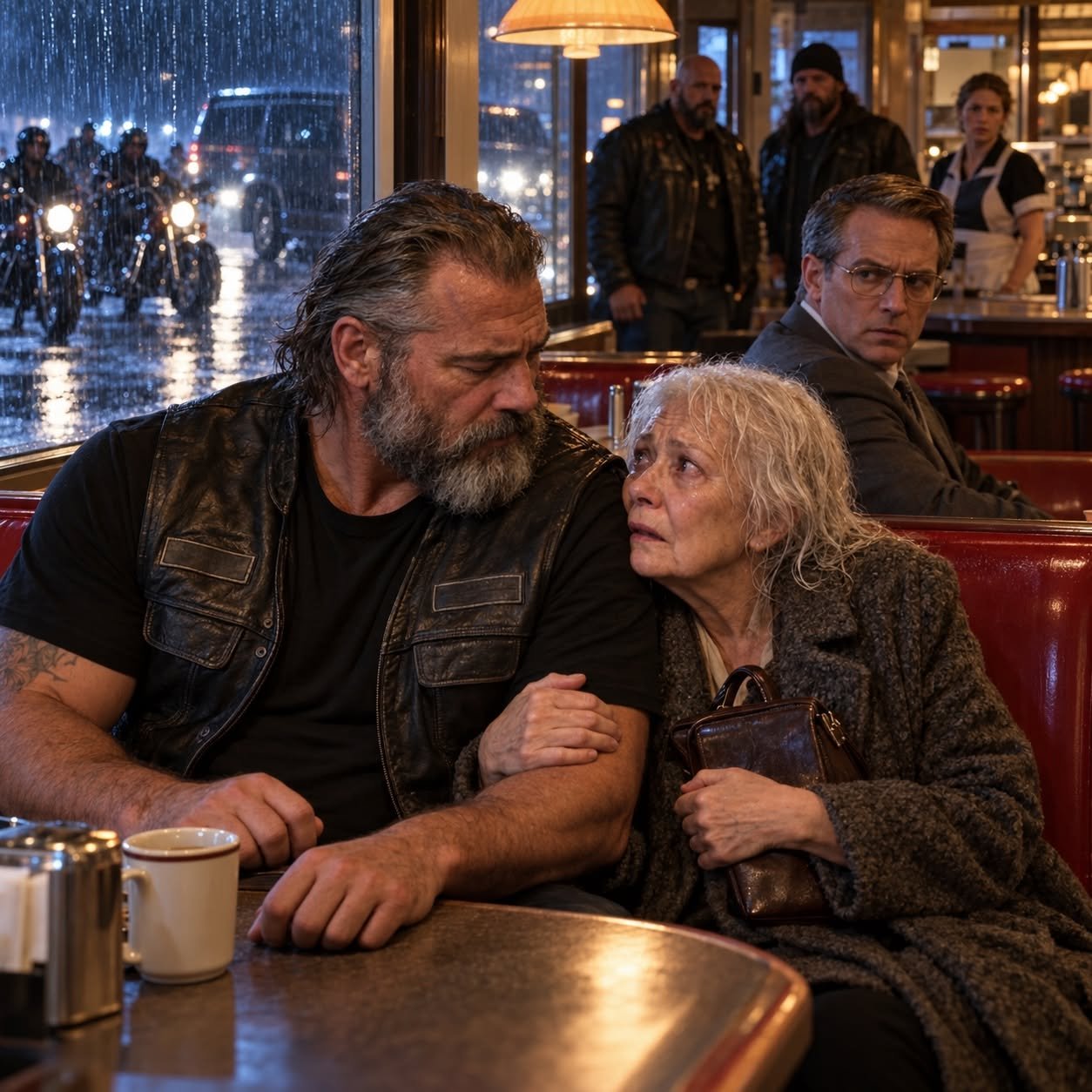
The old woman grabbed Wade Bennett’s wrist before she said a word. Her hand was so cold he nearly dropped his coffee.
“Please act like you’re my grandson,” she whispered.
Wade was fifty-two, built like a refrigerator, wearing a leather motorcycle vest most people crossed parking lots to avoid. Nobody had mistaken him for somebody’s comforting grandson in a long time. But he knew what fear looked like.
“Sit down, Grandma,” he said, moving over. “You’re freezing.”
That night, Wade had been riding through western Nevada on his way to a memorial outside Reno. His friend Kenny had died on a highway eight days earlier. After ten hours of wind, he had stopped at the Silver Lantern, a roadside diner off Highway 50, for coffee and somewhere quiet to sit with the fact that Kenny would never call again.
Then the old woman came in, rainwater running from her white hair, and went straight to his booth. And behind her came a man in a gray suit with no umbrella, whose expression, when he saw them together, was not relief but irritation.
“There you are, Evelyn,” the man said. “I’m sorry to bother you. My mother gets disoriented. We’ve been looking everywhere.”
He sounded patient. Practiced. His name, he said, was Graham Cole.
Wade asked the woman if she wanted to leave with him. She shook her head.
Graham showed a photograph of himself standing beside Evelyn. It proved they had stood together once. Nothing more.
“Is he your son?” Wade asked her.
“No,” Evelyn Turner said, her voice shaking but immediate.
What followed was a slow, polite siege. Graham insisted it was a family matter. Two men in dark jackets took up positions by the door. Evelyn clutched her purse in her lap beneath both hands, and Wade noticed Graham’s eyes kept going to that purse — not her wet clothes, not her shaking hands. The purse.
Then motorcycles rose beyond the rain. Wade’s club brothers pulled into the lot — the High Desert Riders, on their way to the same memorial. Cal, a retired diesel mechanic, came through the door, looked at the scene, and asked, “Everything all right?”
Evelyn stood, her knees nearly failing, and said clearly: “He’s not my son.”
Graham took a sharp step toward her. She flinched and clutched the purse to her chest.
“My husband found their accounts,” she said. “And now he’s dead.”
The diner went silent except for the rain.
Evelyn opened the purse.
Inside was a leather-bound ledger, its pages filled with her late husband’s meticulous handwriting — and beneath it, a banker’s envelope containing a letter from an attorney, dated two weeks before her husband’s death.
Wade read enough, standing there in the diner with the rain drumming on the roof, to understand everything.
Evelyn’s husband, Martin Turner, had owned a construction supply company. Graham Cole had been his junior partner. Over three years, Graham and two associates had siphoned company funds through fake vendors — “their accounts,” the ones Martin found. The ledger documented every transfer: dates, amounts, account numbers, in Martin’s own hand, cross-referenced with bank statements.
Martin had confronted Graham. A week later, Martin was dead — officially a heart attack at his desk at sixty-eight. Evelyn had never believed it. She had taken the ledger from his office safe the night after the funeral, and she had been running ever since.
“Graham found out I had it,” she told the room, her voice steadier now. “He’s been trying to get me declared incompetent for a month. A confused old woman can’t testify about a ledger. A confused old woman’s purse is just… a purse.”
Graham’s practiced smile was gone. “Evelyn, you’re overwrought—”
“Am I?” She held up the attorney’s letter. “My husband mailed this to his lawyer the day before he died. It names you, Graham. It names all three of you. And it says that if anything happened to him, the ledger would be with me.”
Cal had quietly locked the diner’s front door. Beth, the waitress, had already called the sheriff. The two men in dark jackets looked at the wall of leather vests now filling the room and decided, wisely, to sit down.
The sheriff arrived in twenty minutes. Graham Cole was arrested that night, and his two associates within the week. The ledger — backed by the attorney’s letter and Martin’s bank records — unraveled three years of embezzlement. A medical examiner, reviewing Martin Turner’s case at the sheriff’s request, found enough to reopen it.
Evelyn Turner testified at the trial. She wore the blue dress and the pearl necklace from Graham’s photograph, and she did not shake once.
After the verdict, Wade rode Evelyn home himself — a slow, careful ride, with half the club as escort. She insisted on cooking for all of them: fried chicken, biscuits, pie, enough to feed an army of bikers who ate like one.
She comes to every club memorial now. The riders call her Grandma — all of them, not just Wade. She sits in the front row in her good coat, and when the names of the fallen are read, including Kenny’s, she holds Wade’s hand.
Last month, Evelyn handed Wade a small wrapped box. Inside was Martin’s pocket watch, engraved on the back.
Wade opened it. The inscription read: “To the man who sat down when a frightened woman asked. — E.T.”
Wade Bennett keeps it in his vest pocket, over his heart. He says it’s the finest thing he owns — finer than his bike, finer than anything he’s ever earned.
All he did was move over in a booth and say, “Sit down, Grandma. You’re freezing.”
Sometimes that’s all it takes to change the ending of someone’s story.


