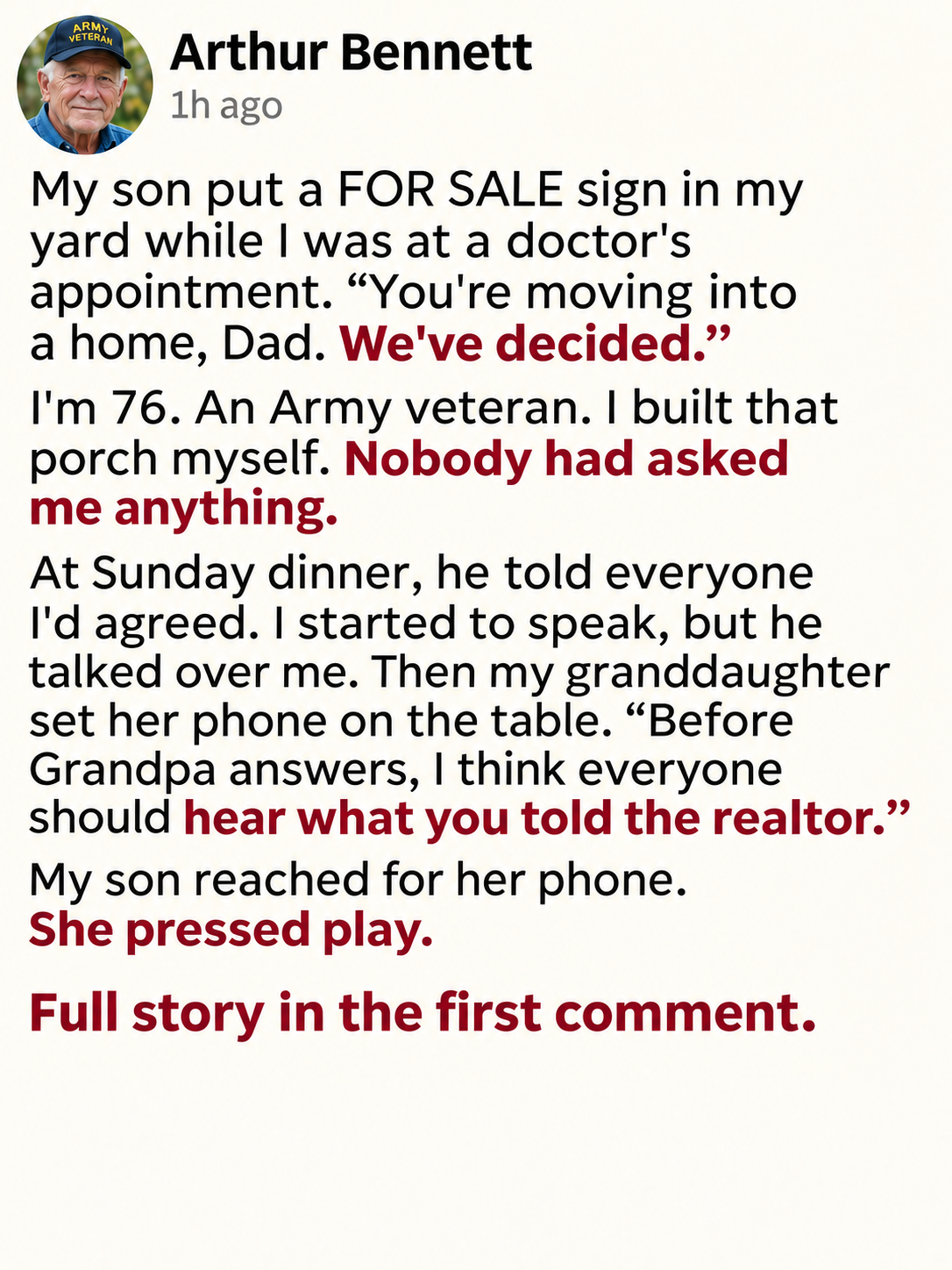
My son put the sign in my yard on a Tuesday, while I was at a routine doctor’s appointment. When I returned, he was standing beside the porch I built with my own hands.
“You’re moving into a home, Dad. We’ve decided.” I waited for him to smile and admit he was joking. Instead, he handed me a brochure and asked where I kept the spare keys.
I’m seventy-six, an Army veteran, and perfectly capable of answering a question about my own future. He had not asked one. He had decided that getting older meant I no longer needed a vote.
At Sunday dinner, he presented his plans like a favor already accepted. “Dad agrees the house is too much,” he told my sister. I opened my mouth. He started discussing moving dates.
My granddaughter, Emma, set her phone between the salt and pepper. “Before Grandpa answers, everyone should hear what you told the realtor.” My son reached across the table. She pressed play before he could touch it.
His voice filled the room. “Once the house sells, I’ll finally get those cards paid off. Dad won’t like the facility, but he’ll get used to it.” Someone’s fork struck a plate.
The recording came from my video doorbell. Emma had helped me install it after packages disappeared from the porch. She had found the conversation while showing me how to review the week’s deliveries.
He had been standing outside my front door, discussing the money from my house as if it were already his. Hearing him say it again was worse than hearing it the first time.
“That isn’t the whole conversation,” he said. I looked directly at him. “Then tell us the part where you asked what I wanted.” He studied the tablecloth. Nobody hurried to fill the silence.
I knew he was struggling. I had bought his groceries twice that winter and paid a repair bill he promised to repay. I had believed embarrassment explained why he rarely mentioned those favors afterward.
Now the brochure looked different. The photographs of cheerful residents had been covering a decision about his debts. The stairs, my age, and his concern had all been used to avoid an honest conversation.
My sister moved her chair closer to mine. “Arthur, do you want to move?” It was the first time anyone at that table had asked. “Not today,” I said. “And not like this.”
My son began saying he had meant well. Emma stopped the recording rather than play it twice. “You can still tell the truth now, Dad,” she said. “That’s all we’re asking.”
He finally admitted how much he owed. Saying the number seemed to empty him. He had imagined a sale would solve everything, then convinced himself I would be happier once someone else managed my life.
I did not promise to fix his debts. I said I would help him find someone to review his budget, if he wanted help. My house would not be the solution he chose without me.
The next morning, I called the realtor myself. She learned that I had not approved a move and that no sale would proceed with my agreement that week. The sign was collected before lunch.
My son returned that afternoon. He stood on the porch without the brochure. “Can I sit?” he asked. It was a small question, but after the week we had endured, I appreciated hearing it.
I told him I loved him and that I needed him to stop speaking for me. We discussed the stairs, too. I was willing to accept practical help without surrendering every decision attached to it.
Emma came over Saturday with groceries and a replacement latch for the porch gate. Before opening her toolbox, she asked which way I wanted it mounted. I laughed harder than the question deserved.
The patch of grass where the sign stood is growing back. This morning, I drank coffee on the porch and watched Emma tighten the latch. When she finished, she handed me the keys.