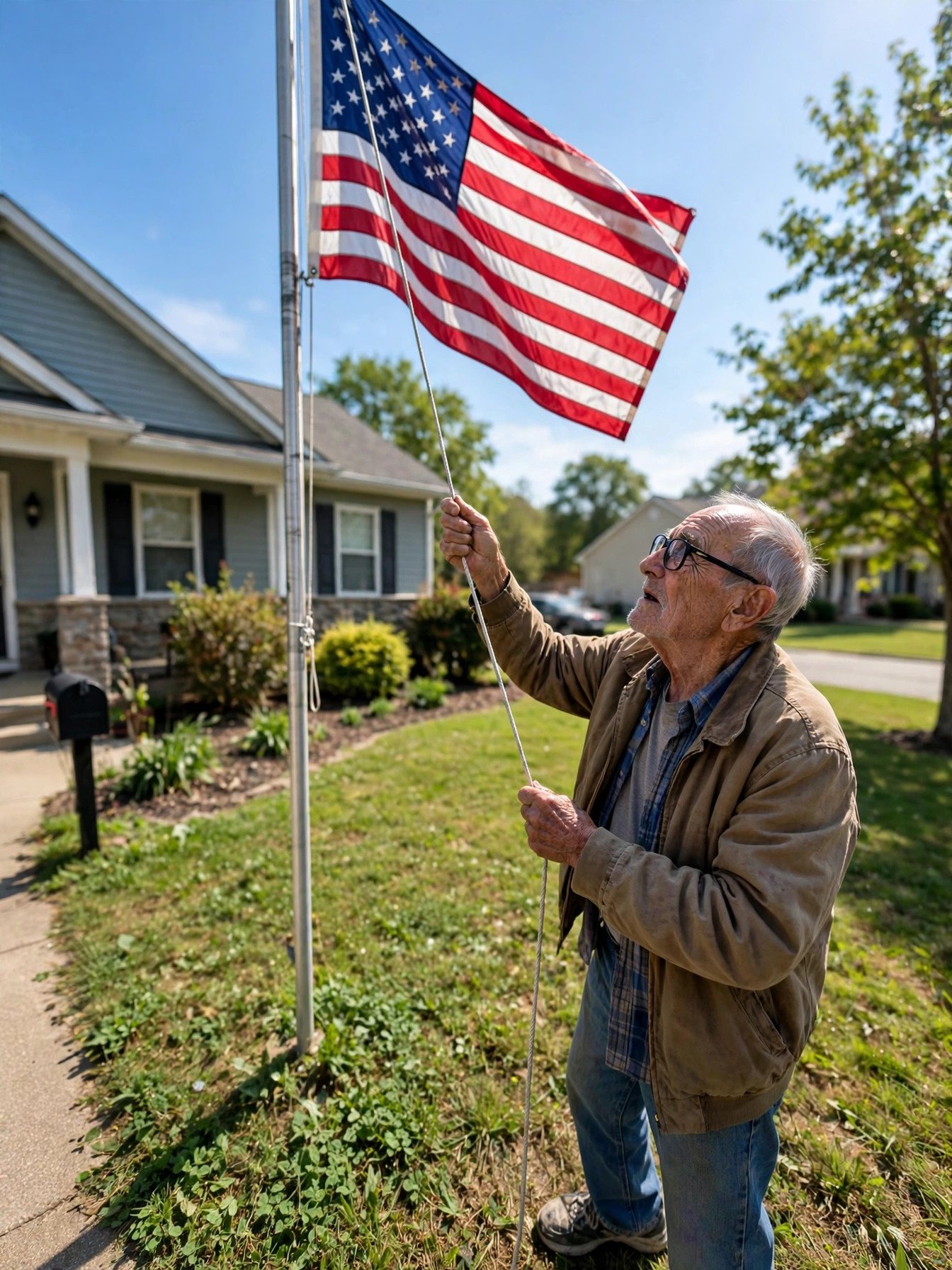
I am Don Keller, seventy-four, and I have raised the American flag in my front yard at eight every morning for thirty years. Rain, snow, heat wave — it does not matter. The neighbors on Maple Street in Dayton, Ohio set their clocks by it.
The pole is twenty-five feet of white aluminum my father helped me sink into concrete in 1995. The rope is frayed where my hands wore it smooth. Coffee first — black, two sugars — and by the time the pot gurgles I am at the door, jacket half on.
People assume it is about patriotism, and some of it is. I served two Army tours in Vietnam and came home in 1971 with a limp and a Bronze Star. But the flag I fly is not store-bought. It is the burial flag they folded and placed in my arms at my son Michael's funeral.
Michael was twenty-six. Army, like his old man, except he went to Afghanistan. The knock came on a Tuesday in October 2009 — two soldiers in dress uniforms on my porch, coffee going cold behind me. My wife Carol screamed loud enough that the neighbors came running.
At Dayton National Cemetery the honor guard folded that flag in thirteen folds. The sergeant knelt and said, "On behalf of a grateful nation." I set the triangle case on the mantel and stared at it for three nights — a folded flag in a wooden box, a period at the end of a sentence nobody wanted to read.
So the next Monday I raised Michael's burial flag on that pole. I saluted until my arm shook and promised the empty street: as long as I can stand, this flag flies.
The street understood. Kids watched from school bus windows. Mrs. Abernathy next door waved with her dish towel. When Carol passed in 2019 the whole block came, and somebody tied a black ribbon to the base of the pole.
Then in March the Henderson house across the street sold, and Tyler and Jenna moved in — late twenties, both working from home. They painted the shutters black, planted a minimalist lawn, and within a month Tyler was at my fence, hands in his pockets.
"Don, no disrespect," he said, "but have you thought about taking the pole down? It's kind of an eyesore. We're trying to keep the curb appeal up." I told him the pole was staying. He smiled the way people smile when they have already decided you are unreasonable.
Two weeks later a certified letter came from the City of Dayton: a formal complaint about a "non-conforming structure" in my front yard, and a summons to a zoning hearing. Tyler had filed it. He wanted my flagpole declared a violation and removed.
I sat at my kitchen table a long time that night. Carol's chair sat empty across from me, as it has for seven years. I was not angry the way I expected — just tired, and underneath, something hurt in a place I thought had scarred over.
The hearing was in a small room at city hall: humming fluorescent lights, five council members at a long table. Tyler sat in front with a folder of photos of my house circled in red. He talked about property values, sight lines, "visual clutter." He never once said the word flag.
When my turn came I stood up slow — these knees are not what they were — with no photos and no folder. I told them about the pole, about thirty years of mornings, about the rope worn smooth by my own hands.
Then I told them about Michael. Twenty-six. The knock on a Tuesday in October 2009. The thirteen folds. The sergeant's words. The flag on that pole is the flag they placed in my arms at Dayton National Cemetery — and my son deserved more than a period at the end of a sentence.
The room went completely silent. The lights hummed. One councilwoman wiped her eyes. The chairman cleared his throat twice, and all he said was, "Mr. Keller, thank you. Thank you for telling us that."
Then Tyler stood up, his face red to the hairline. "I'd like to withdraw my complaint," he said, voice cracking. "All of it. Right now, on the record." He turned to me: "Don, I am so sorry. I had no idea."
The hearing ended four minutes later. In the parking lot Tyler shook my hand and held on a second too long. "I didn't know," he said again. I told him most people don't, and that it was all right.
The next morning at eight I walked out with my coffee and heard footsteps. Tyler stood at the end of my driveway in a jacket, his breath fogging in the March air. "Teach me?" he said. "I want to help raise it."
So I showed him — hand over hand on the halyard, slow and steady, never letting it touch the ground. We raised Michael's flag together while Jenna watched from their porch. Tyler saluted at the top: a little clumsy, completely sincere.
That was months ago, and Tyler has not missed a morning since. He brings the coffee half the time. His grandfather served in Korea and never talked about it, and we are working on that. The pole still stands on Maple Street, the flag still flies at eight sharp, and every morning my son's flag goes up with two pairs of hands on the rope — because some things are not eyesores. They are anchors.


