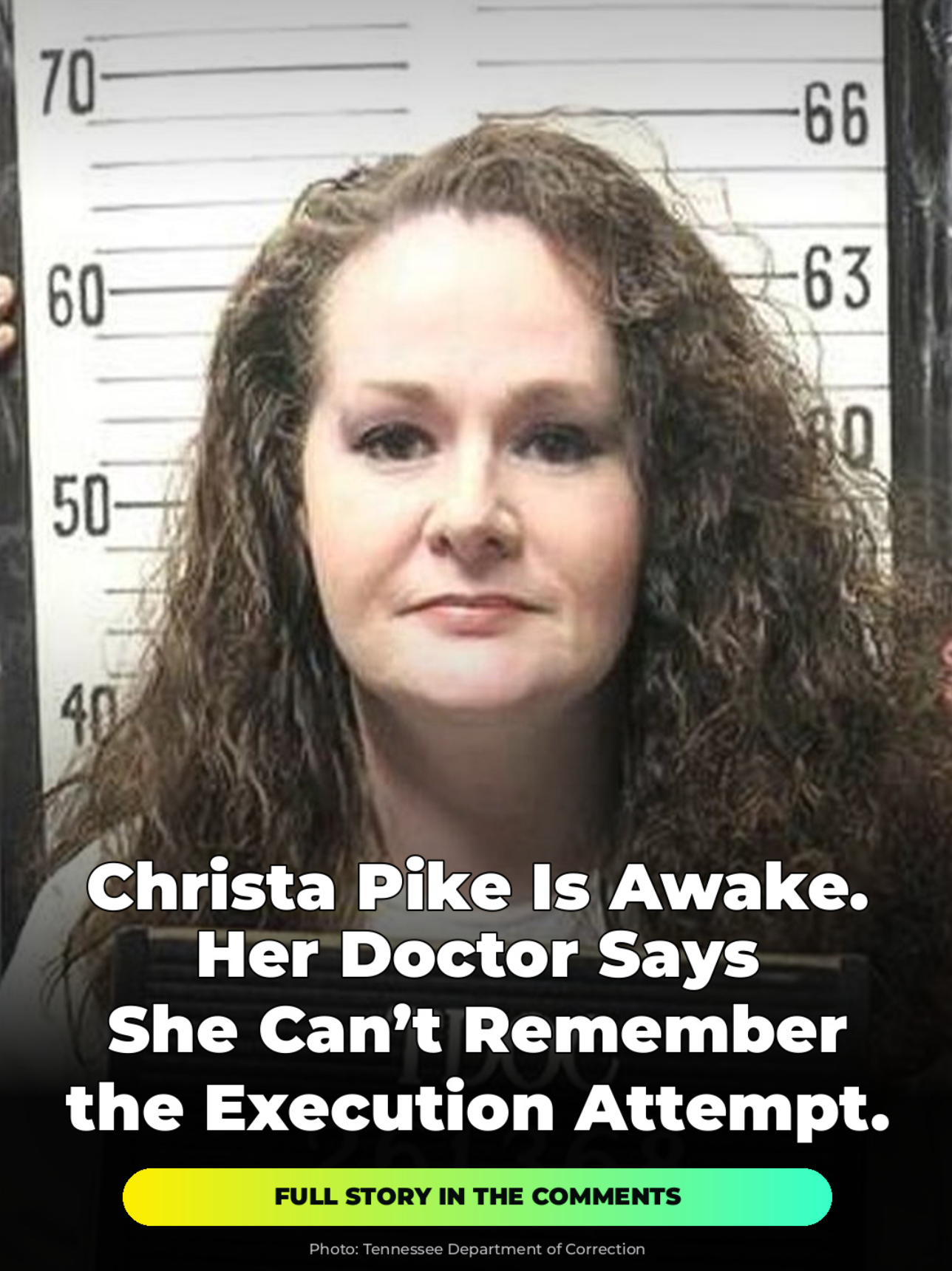
Tennessee set out to carry out Christa Pike’s death sentence. A week later, her lawyers were announcing that she was awake and speaking in a hospital. The woman taken from the execution chamber alive after two administrations of pentobarbital had regained consciousness, turning an already extraordinary failure into a medical and legal story with no settled ending. There was another development, too: a doctor advising her defense said she apparently did not remember the execution attempt. Her survival has left the state facing an investigation, her attorneys seeking protection against another attempt, and the family of the young woman she murdered confronting another painful chapter. [17] [18]
The announcement came on October 6, six days after the attempted execution at Riverbend Maximum Security Institution in Nashville. Attorneys Randy Spivey and Kelly Gleason said Pike was conscious, able to speak and still receiving critical medical care. Until then, the public updates had described her as unconscious and dependent on a ventilator. Their statement marked a significant change, but it came with caution: her prognosis remained uncertain, and they expected a long recovery. The development answered the immediate question of whether she would wake up. It left much harder questions about her injuries, her future abilities and the decisions Tennessee might eventually make. [1]
Dr. Joel Zivot, an anesthesiologist advising Pike’s defense, told PEOPLE that she appeared to remember intensive care and being intubated, but not the execution attempt. He said she recognized herself and her surroundings, while her sense of the date was confused. He cautioned that her memories could change. His account concerned her recollection at that point, rather than a final assessment of what she would recover. Surviving the attempt had not yet produced a clear account of it from Pike herself. [2]
Being awake did not mean Pike was out of danger. In the Associated Press account of the announcement, Zivot warned that serious risks remained and that it could take weeks or months to understand her recovery. Her lawyers described arm damage, including burns and blisters, and said she remained restrained in her hospital bed. Their account presented improvement alongside significant injury. The news could be startling without providing a reassuring forecast: the ability to speak was a development her attorneys could report, while the longer course of her recovery was still unknown. [1]
By October 8, there was a further report that Pike had begun walking. Coverage of the latest update described limited movement inside the hospital, while continuing to report serious physical difficulties and confusion. LBC also reported her legal team’s account of pneumonia, a blood clot in an arm and difficulty swallowing. These were updates supplied through lawyers and public reporting, rather than a complete medical record. Taken together, they described a changing condition: more activity than had been reported immediately after the execution attempt, but an ongoing need for care. Each improvement added information without settling what lasting effects, if any, the ordeal might leave. [3]
The case began long before the hospital updates, with the murder of nineteen-year-old Colleen Slemmer in Knoxville on January 12, 1995. Slemmer and Pike were students at a Job Corps center. The Tennessee Supreme Court’s account of the trial evidence described Pike leaving the center with Slemmer, her boyfriend Tadaryl Shipp and another student, Shadolla Peterson. Slemmer did not return with them. The court record detailed a prolonged, deliberate attack and Pike’s own statements about what she had done. That record is essential to understanding the present controversy: the punishment at the center of the failed procedure arose from a proven murder, not an unresolved accusation. [4]
For Slemmer’s family, however, a court record could never contain everything that had been lost. Her mother, May Martinez, has described a helpful young woman who volunteered at school and assisted children with disabilities. Reporting by ABC Australia recalled her interest in computers and her ability to take them apart and put them back together. Her grandfather had encouraged her to pursue computer courses through Job Corps. Those details restore a person to a story often told through the name of her killer. Slemmer had interests, relationships and plans before her death became the starting point for decades of legal proceedings and public attention. [5]
Pike was convicted and sentenced to death in 1996. Her age at the time of the crime, eighteen, later became a recurring part of arguments over the punishment, but the verdict rested on the jury’s findings about the killing and the evidence before it. The Tennessee Supreme Court affirmed her conviction and death sentence in 1998. Its opinion considered challenges to the proof, the sentencing process and the circumstances used to justify capital punishment. That history placed the September execution attempt at the end of a long sequence of proceedings. The hospital developments have opened new questions about carrying out the sentence; they have not replaced the original judgment with a finding of innocence. [4] [6]
The September 30 attempt followed last-minute legal challenges. Pike’s lawyers had raised concerns about obtaining access to her veins, an issue that later took on greater significance. The execution nevertheless proceeded. The state administered the drug under its lethal-injection procedure, Pike remained alive, and she was transported for medical treatment. The sequence moved the case from the anticipated implementation of a sentence to questions about the procedure itself. What had been authorized, what staff had done and what the available evidence could establish were now central to the story. [10] [17]
Witness accounts made clear that the attempt was not unfolding as expected. The Associated Press’s reconstruction described Pike complaining of arm pain, continuing to breathe and making audible sounds after the drugs were administered. The execution chamber’s curtain was closed at points, limiting what witnesses could see while they could still hear her. She was ultimately taken to a hospital. The account provided a sequence of observable events, but it could not explain every medical cause behind them. Someone remaining alive during the procedure established its outcome, without necessarily explaining why it failed. [7]
One explanation advanced by Pike’s legal team concerns the intravenous lines. Her attorneys have said they believe problems with IV access allowed pentobarbital to enter surrounding tissue rather than travel through her bloodstream as intended. They had previously warned that finding suitable veins could be difficult. Their explanation is an allegation and medical theory under examination, not a completed finding from the independent review. It nevertheless identifies a concrete issue investigators can assess: where the drug went, how the lines were established and what the equipment and records show. The answers may help distinguish a problem with administering the procedure from other possible explanations for the outcome. [8]
The Tennessee Department of Correction’s initial public statement took a different position on the conduct of the procedure. Issued late on September 30, it said officials had followed the state’s lawful, established protocol and that the protocol did not allow additional procedures beyond those already carried out. It also confirmed Pike’s transfer to an off-site medical facility. The statement defended compliance but did not provide a detailed explanation for her survival. That leaves two separate matters for scrutiny: whether staff followed the written instructions and whether those instructions, as applied, were adequate to carry out the sentence. The state’s assertion of compliance does not itself resolve the medical questions raised by the result. [9]
On October 7, Chancellor I’Ashea Myles ordered the preservation of relevant evidence from the failed execution. ABC News reported that the order covered photographs, recordings, surveillance footage, drugs and equipment in the state’s possession, along with handwritten notes, logs, checklists, timelines and witness accounts. Communications about complications, delays and possible deviations from the protocol were included. The scope showed how many kinds of material could contribute to reconstructing one evening. A recording might document an event; a log might establish its timing; a piece of equipment might help explain what occurred. Preserving those materials keeps investigators and the parties from having to rely solely on recollection or competing public descriptions. [10]
The hearing also concerned access to Pike herself. NPR reported that the judge required prison officials to respond within two hours to requests from her lawyers for in-person visits. Her ability to communicate had changed what those visits might allow, after days when she had been unable to speak with counsel. The order addressed the practical conditions under which her attorneys could meet her as well as the need to retain evidence. Both issues matter to the case ahead: her lawyers must be able to represent a client receiving hospital treatment, while the records of the failed attempt must remain available for examination. Neither part of the ruling established the cause of the failure. [11]
Outside the courtroom, Governor Bill Lee had already ordered a wider review and paused the state’s remaining scheduled executions for the year. Former U.S. Attorney Ed Stanton was retained to examine the Department of Correction’s actions, including whether the protocol was followed and whether further recommendations were needed. WTVC noted that Stanton had previously reviewed Tennessee’s execution process in 2022, a review followed by changes to the protocol. The new inquiry therefore returns to a question the state has faced before: what safeguards are needed to make its process lawful and effective? Its eventual findings will matter beyond Pike’s individual case, because the pause affects other scheduled executions as well. [12]
The consequences also reached the leadership of the prison system. Lee announced that Correction Commissioner Frank Strada had offered his resignation and would step down in October. Tennessee Lookout reported that the governor accepted the resignation after the failed execution and that an interim commissioner would be announced later. The departure is a significant institutional response, but it is not a substitute for the inquiry or a finding of personal responsibility for a specific error. It leaves the department facing both a leadership transition and unresolved questions about its procedures. A change at the top tells the public that the event has had consequences; the records and review are needed to explain what happened inside the chamber. [13]
The public debate has produced sharply different proposed responses. Senator Marsha Blackburn called for bringing back the electric chair, while Pike’s attorneys continued asking Lee to commute her sentence to life imprisonment without parole. These positions look toward changing how Tennessee carries out capital punishment or ending the possibility of Pike’s execution. Neither proposal is a final decision in her case. A political call does not establish a new execution date, and a request for clemency does not mean clemency has been granted. The review, continuing proceedings and governor’s decisions will shape the next steps. [8]
Pike’s transfer to hospital also draws attention to the different responsibilities of an execution team and medical professionals treating a patient. The American Medical Association’s ethical code says physicians must not participate in legally authorized executions, while describing medicine as a profession committed to preserving life when there is hope of doing so. Its guidance identifies activities such as administering execution drugs or establishing lethal-injection lines as participation. The hospital treatment described in Pike’s case had the purpose of caring for someone who remained alive. The ethical distinction helps explain why the same case can involve an attempt to impose a death sentence and subsequent efforts to sustain the prisoner’s life, without those activities serving the same objective. [14]
What happens if Pike continues to improve remains unresolved. Competency for execution is one legal issue that cannot be answered simply by saying someone is awake. In Madison v. Alabama, the U.S. Supreme Court emphasized whether a prisoner can rationally understand why the state seeks to execute them; it distinguished that understanding from remembering the crime itself. That ruling provides background for understanding the legal standard, rather than a determination of Pike’s condition or eligibility for another attempt. Medical assessments and any future court proceedings would have to address her actual circumstances. A hospital update, however significant, is not itself a court’s assessment of her competence. [15]
For May Martinez, the latest developments return to a loss that began more than thirty years ago. News4JAX reported that she traveled to witness the execution with a photograph of Colleen and that community donations helped the family afford the trip. She wanted her daughter’s face present at an event centered on the person convicted of killing her. Pike’s survival has extended the proceedings and the public attention, while leaving the family still seeking justice. There is no settled ending to report: Pike is alive, her recovery is continuing, the evidence has been ordered preserved and Tennessee’s review is underway. The next answers will concern both what happened that night and what the state chooses to do after it. [16] [11] [12]


