Nine-year-old Amara had been saving birthday money for a purple bicycle.
She kept the bills in a yellow envelope decorated with stars. Every Saturday, she counted them at the kitchen table while her mother reminded her that good things sometimes require patience.
She needed thirty-two more dollars.
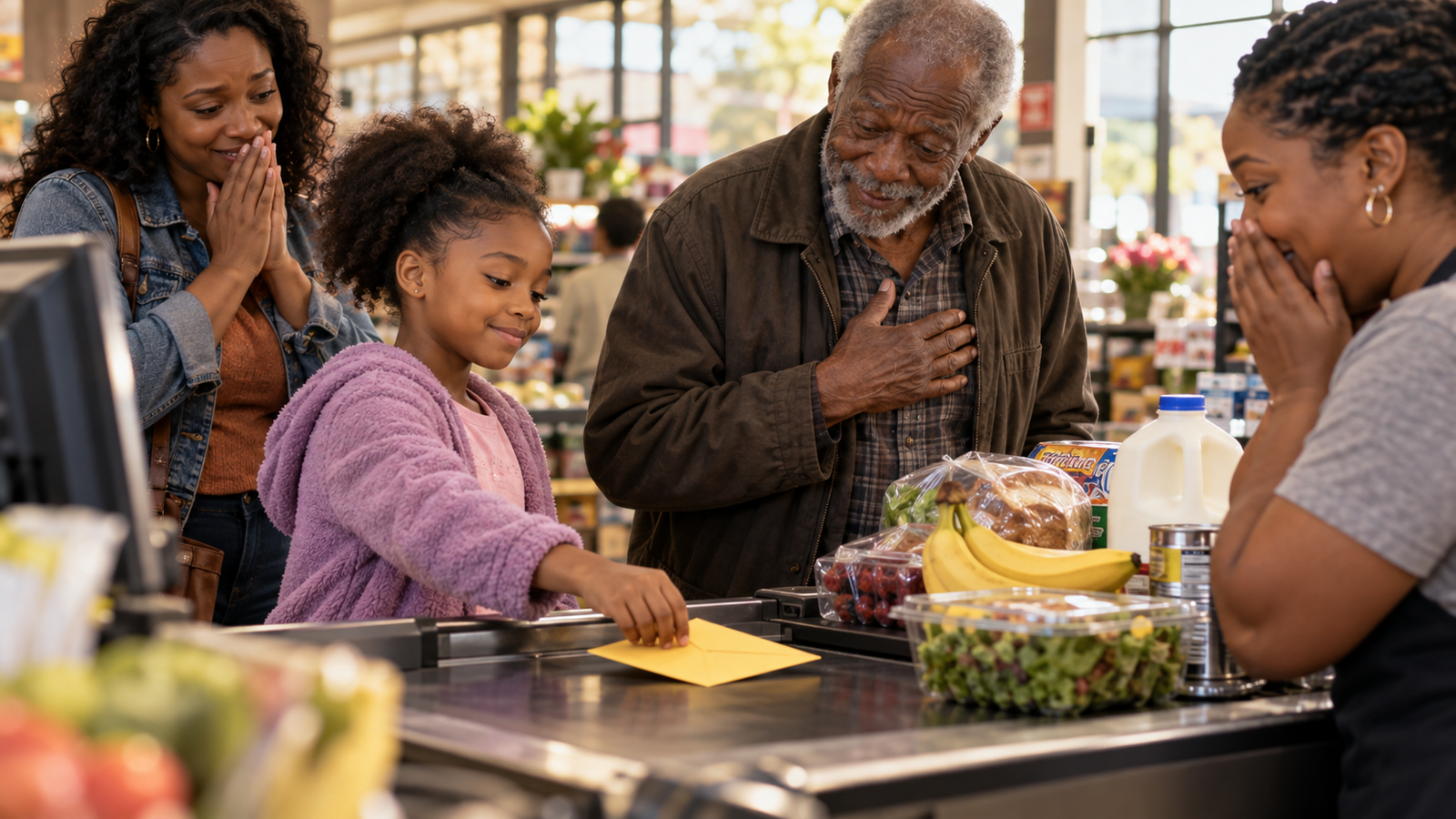
At the grocery store, an elderly man stood ahead of them in line wearing a brown coat too thin for the January cold.
His cart contained oatmeal, canned soup, bananas, bread, and a small package of chicken.
When the cashier announced the total, he searched every pocket.
“I must have left my wallet on the bus,” he said.
He began removing items.
First the chicken. Then the soup. Then the bananas.
Amara watched his hands tremble.
“Mom,” she whispered, “can we help?”
Her mother had only enough money for their own groceries and the bus ride home.
“We can put back something of ours,” she said.
Amara opened her backpack and removed the yellow envelope.
She counted twenty-eight dollars onto the counter.
The man shook his head. “No, baby. You saved that for something.”
“A bicycle,” she replied. “But food is for today. A bicycle can wait.”
The cashier covered the remaining amount from her own pocket.
The man introduced himself as Mr. Walter Reed. He had retired from the neighborhood elementary school after working there as a custodian for thirty-seven years.
Before leaving, he asked Amara to write her name on the back of the receipt.
The next morning, Amara and her mother heard knocking.
Outside stood Mr. Reed, the grocery cashier, and six adults they did not recognize.
One was a teacher. Another owned the bicycle shop. Two had attended the elementary school when Mr. Reed worked there.
After the cashier posted the story in a private neighborhood group, former students began sharing memories.
Mr. Reed had repaired backpacks, found winter coats, and kept granola bars in his supply closet for children who arrived hungry.
He had once walked a frightened first grader home during a storm. He had bought graduation shoes for a student whose family could not afford them.
Now the neighborhood wanted to repay two acts of kindness at once.
The bicycle shop owner rolled a purple bicycle onto the porch.
Amara covered her mouth.
Attached to the handlebars was a new yellow envelope containing every dollar she had spent at the store.
Mr. Reed handed it to her.
“This did not come because you bought my groceries,” he said. “It came because kindness introduced good people to one another.”
Amara rode the bicycle only after asking whether Mr. Reed had enough food for the week.
The adults laughed, then showed her a pantry they had filled in his kitchen.
The story could have ended there.
Instead, Amara used the returned money to begin something she called the Yellow Envelope Fund.
She placed a jar at the grocery store where neighbors could leave small donations for elders who came up short at checkout.
The cashier managed it quietly. No photographs were required. No one had to explain why they needed help.
Within a year, other stores copied the idea.
Mr. Reed became the fund’s first volunteer. Every Saturday, he sat near the entrance greeting families and sharpening children’s pencils with a little hand-held sharpener he carried from his school days.
On Amara’s tenth birthday, he gave her a bell for the bicycle.
Engraved across the silver top were five words:
Good things can wait. Kindness cannot.
Years later, the purple bicycle became too small, but Amara kept the bell.
She said its sound reminded her that a child does not need wealth or power to change a life.
Sometimes all she needs is the courage to open the envelope she planned to keep for herself.


