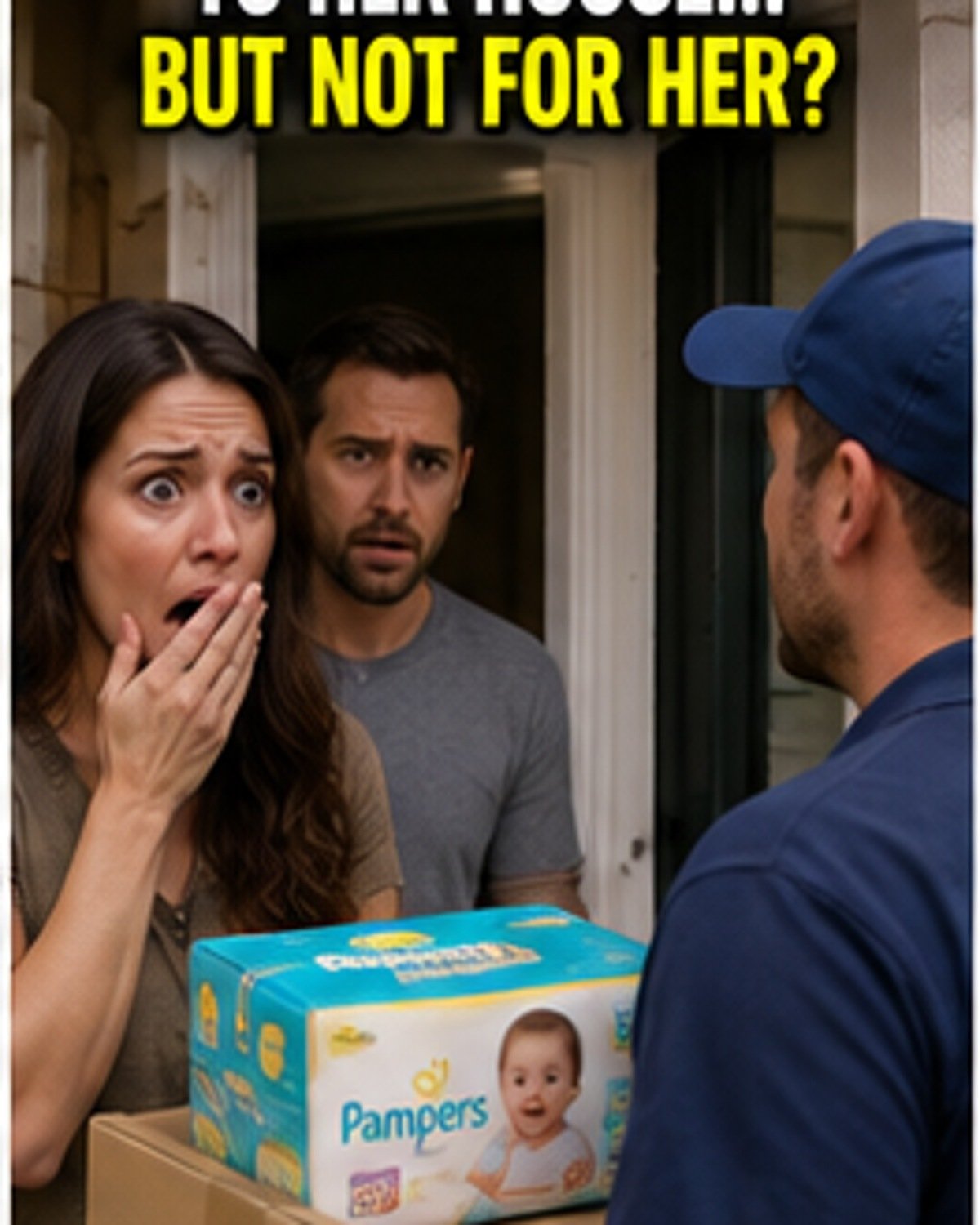
Rachel opened the front door expecting the small grocery order she had placed for the weekend. Instead, a delivery driver stood there beside two heavy paper bags, a case of bottled water, and an enormous box of newborn diapers. The ordinary setting made the moment feel even more unsettling, because nothing about the day had suggested that the mysterious weekly delivery was about to become a crisis.
She immediately said there had been a mistake. Her children were teenagers, and no one in the house had needed diapers in more than a decade. Rachel tried to focus on the facts in front of her, but every new detail made the situation harder to dismiss as a misunderstanding.
Her husband, Daniel, appeared behind her and reacted much faster than she did. He waved at the driver and said, “Wrong house. Sorry. Take it back.” For everyone nearby, the tension was visible in the pauses between sentences, when nobody seemed certain which explanation would come next.
The driver checked his screen again. He read the address aloud. It was correct. Then he read the delivery instructions: leave with Brielle if available, otherwise ring the bell. What had looked simple only minutes earlier was now turning into a confrontation about trust, responsibility, and the choices people make when they think nobody will challenge them.
Rachel turned slowly toward Daniel. “Who is Brielle?” she asked. Daniel said he had no idea and insisted that the delivery app must have mixed up customer profiles. Daniel still had opportunities to explain the situation honestly, yet each hesitation made the unanswered questions feel larger.
The driver hesitated. He was young, tired, and clearly wanted no part of a family argument. But he also looked certain that there was no mix-up. The details mattered because they showed this was not one isolated mistake; there was a pattern behind what had just been uncovered.
“I’ve delivered this exact order here before,” he said. “Most Thursdays.” Rachel’s face changed. Daniel immediately told the driver he was confused and tried to close the door. Rachel kept listening carefully, knowing that reacting too quickly could hide the very information needed to understand what had happened.
The driver held up one hand and said he was not accusing anyone of anything. He was simply required to verify the recipient because the order included baby formula that could not be left at the wrong address. Around them, the front doorway continued as usual, creating a strange contrast between an everyday place and a deeply personal turning point.
Rachel stepped outside so Daniel could not shut the door. She asked how long the driver had been making these deliveries. He checked his history and said about four months. No one needed dramatic music or a raised voice to understand the seriousness of the moment; the facts themselves were already enough.
Daniel claimed someone in the neighborhood must be using their address. Rachel asked why he had tried to send the driver away before the address was even confirmed.
That was when the driver noticed a gift note attached to the top bag. He said the app marked it as a message from the purchaser and asked whether Rachel wanted him to read it.
Daniel said no. Rachel said yes. The driver looked down and read: “For Brielle and our little girl. I’ll see you after work. Love, D.”
The air seemed to leave the entryway. Rachel looked at Daniel, waiting for him to deny it. He opened his mouth, but nothing came out.
Rachel asked one question: “Is there a baby?” Daniel finally admitted there was. He said the relationship had started during a separation they had never officially taken, and that things had become “complicated.”
Rachel repeated the word complicated as if she could not believe he had used it. He had not merely hidden another relationship; he had been buying diapers, formula, and groceries every week and routing them through an address connected to their own home.
The driver quietly offered to cancel the delivery and report the address error. Rachel told him not to. Instead, she asked him to photograph the bags exactly as they had arrived and email the delivery receipt to the account holder.
Daniel became angry, saying she was trying to humiliate him. Rachel replied that humiliation was not the problem. The problem was that she had been living inside a marriage whose facts everyone seemed to know except her.
She took a picture of the gift note, walked inside, and packed a small overnight bag. Daniel followed her, promising to explain everything after the driver left.
Rachel said explanations could wait. She needed space, legal advice, and the truth—preferably in that order. Then she left through the same doorway where the secret had arrived in grocery bags.
The delivery driver never expected a routine Thursday route to uncover a hidden family. For Rachel, the most painful part was not that a stranger knew before she did; it was realizing how many ordinary details had been carefully arranged to keep her from knowing.


