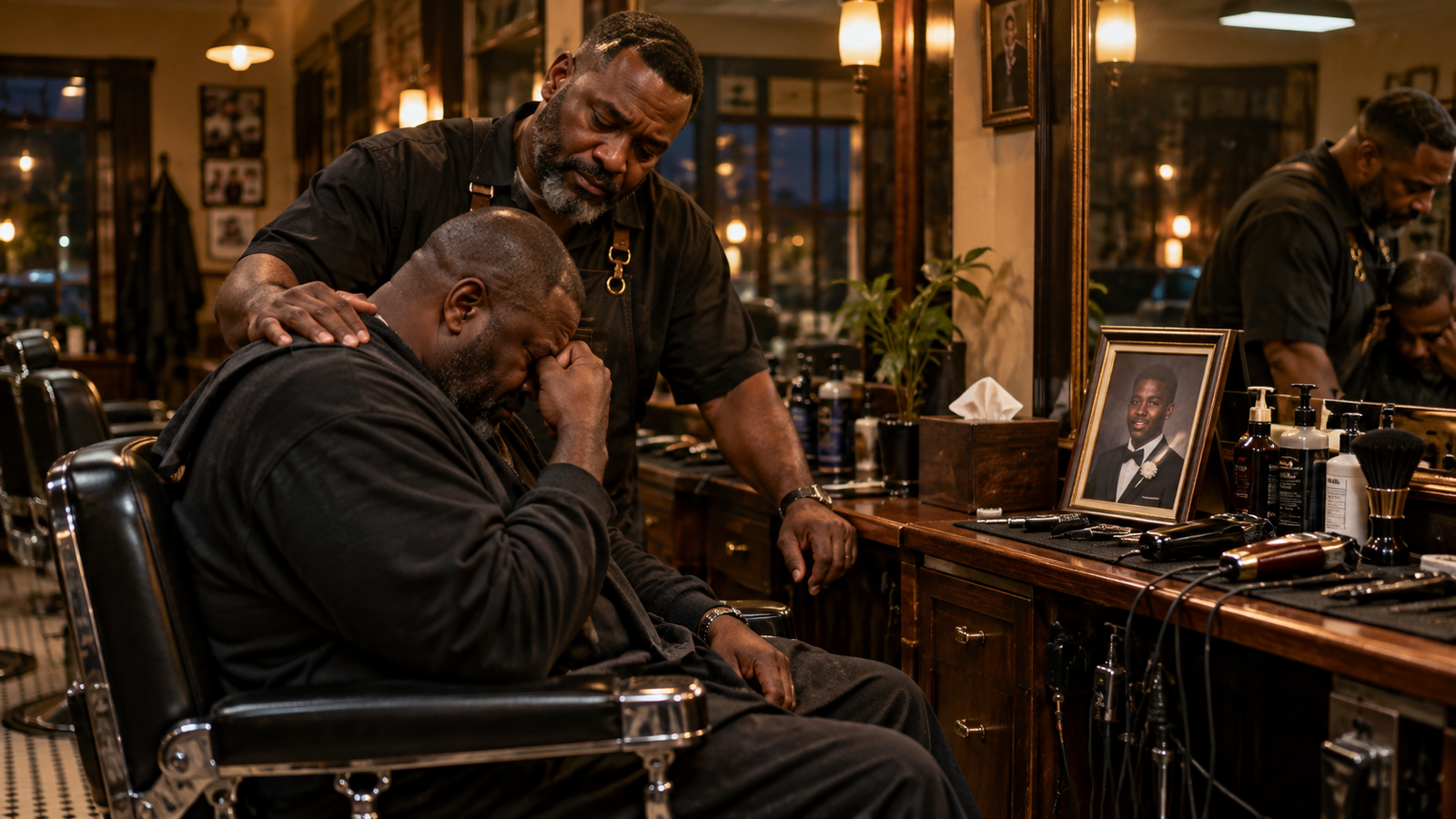
Marcus Green had owned the same barbershop on Jefferson Avenue for thirty-one years.
He knew who wanted a sharp line, who preferred silence, and which children needed the clippers turned on before they sat down so the sound would not frighten them.
On a Friday afternoon, a man named Calvin entered and took the chair nearest the window.
Marcus recognized him as the quiet custodian from the elementary school. Calvin always requested the least expensive cut and tipped exactly two dollars.
This time, he held a small photograph.
“I need to look right for tomorrow,” Calvin said.
Marcus saw the funeral details printed on the back. Calvin’s sixteen-year-old son had died after a long illness.
The waiting area was full. Six customers stared at their phones while rain tapped against the glass.
Marcus turned the sign from OPEN to CLOSED.
“Everybody, I’m sorry,” he announced. “I need the shop for a little while.”
No one complained.
After the customers left, Marcus locked the door and lowered the music.
He washed Calvin’s hair, trimmed his beard, pressed his suit jacket, and listened.
Calvin spoke about hospital nights, football games his son watched from bed, and the final promise he had made to stay strong for his daughter.
When Marcus finished, Calvin reached for his wallet.
Marcus pushed his hand away.
“A father does not pay to get ready to bury his child.”
The next morning, Marcus attended the funeral. He sat near the back and left quietly.
He never posted about it. He never told customers why he had closed.
Months passed.
Then a fire started in the apartment above the barbershop. Water from the sprinklers saved the building but destroyed the chairs, mirrors, tools, and photographs Marcus had collected across three decades.
Insurance covered only part of the damage.
Marcus stood on the sidewalk the next morning looking through the broken front window.
“Maybe this is retirement telling me to listen,” he said.
Calvin heard about the fire from a teacher.
By noon, he had created a handwritten flyer: THE MAN WHO SHOWED UP FOR US NEEDS US NOW.
He placed copies at the school, church, grocery store, and laundromat.
On Saturday morning, Marcus arrived expecting to remove damaged drywall alone.
More than eighty people were waiting.
Parents brought cleaning supplies. Teenagers carried lumber. Two former customers who had become electricians rewired the shop. A restaurant delivered lunch. Children painted a mural of the neighborhood beneath a pair of silver clippers.
At the center of the crowd stood Calvin and his daughter.
She held the same photograph of her brother.
“Dad told me what you did,” she said. “He said you gave him enough strength to walk into the hardest room of his life.”
Marcus turned away to hide his tears.
The shop reopened four weeks later under a new name: The Open Chair.
One chair remained free every Wednesday afternoon for anyone preparing for a job interview, funeral, graduation, or fresh start who could not afford a cut.
Calvin volunteered at the front desk.
The idea spread. Beauty salons joined. A clothing store donated interview outfits. The high school offered résumé help in the waiting area.
Marcus had closed the shop for one grieving father.
The neighborhood reopened it for everyone.
Years later, people still argued over who performed the greatest act of kindness.
Marcus always rejected the question.
“Kindness is not a contest,” he said. “It is a door. Somebody opens it for you, and your job is to keep it from closing behind you.”


