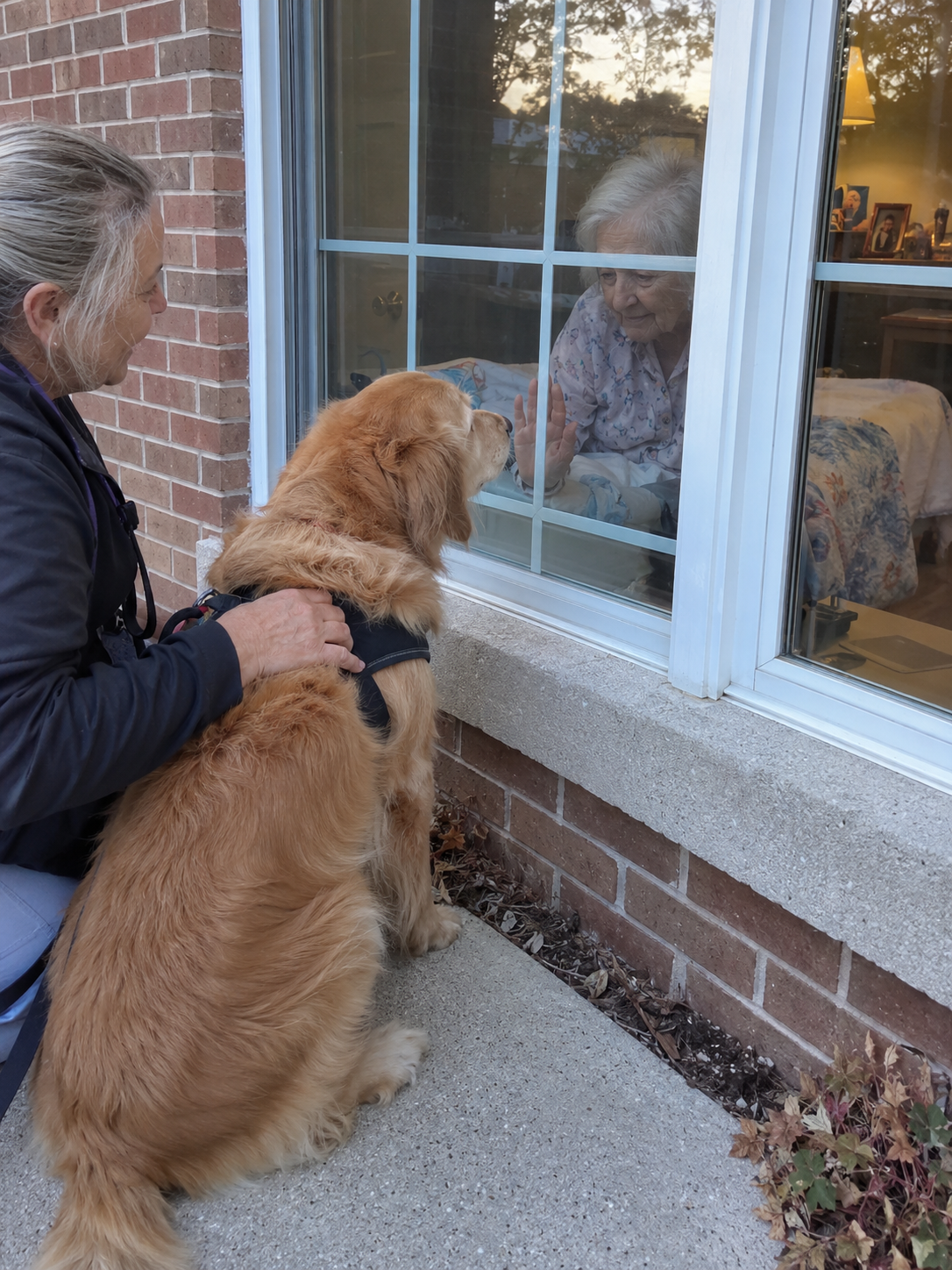
Some of the most meaningful moments happen in places people pass through every day. This one unfolded at a nursing home courtyard in northern Illinois, where a therapy dog, its handler, and a resident who could not leave her room crossed paths during an ordinary part of the day.
At first, the situation looked small. The resident missed her own dog and rarely spoke after moving into care. There was no reason for anyone to expect a memorable story. It was simply a moment when one person had reached a limit and another person noticed.
The turning point came when the handler brought the therapy dog to the window every afternoon. The gesture was practical rather than dramatic, but that is often what makes kindness believable. It solved the immediate problem without asking the person who needed help to explain every private detail.
One detail made the scene especially moving: the dog sat patiently until the resident placed her hand against the glass. That detail gave the moment a human shape. It showed that people can hold more than one feeling at the same time—worry and hope, embarrassment and relief, tiredness and gratitude.
No announcement was made. No one had prepared a camera or arranged the moment for attention. The people nearby simply continued with the day while a quiet decision changed the way one person would remember it.
For the person receiving help, the resident began asking when her afternoon visitor would return. That outcome mattered for more than the practical reason. It protected a sense of independence and reminded the person that needing assistance for one moment did not erase a lifetime of strength.
For the person who helped, the action may have felt ordinary. Many kind people do not think of themselves as doing anything special. They see a need, respond to it, and move on before anyone has a chance to praise them.
The people who witnessed the moment saw something worth remembering: gentle consistency can reopen a door to joy. That idea becomes powerful when it is attached to a real gesture—a hand carrying a bag, a chair pulled out, a door held open, or a few extra minutes given freely.
Stories like this matter because they offer a different picture of everyday life. They remind us that a busy store, a public bus, a hospital hallway, or a neighborhood street can still become a place where someone chooses patience over convenience.
The kindness may never appear in a history book. It may not travel beyond the people who were there. But for one person, it became part of the memory of a difficult day—and for everyone who heard about it, a reason to believe that decency is still close by.
In the end, gentle consistency can reopen a door to joy. The act was simple, but simple does not mean small. Sometimes a person does not need a grand rescue. Sometimes they need someone to notice, stay for a minute, and make the next step possible.