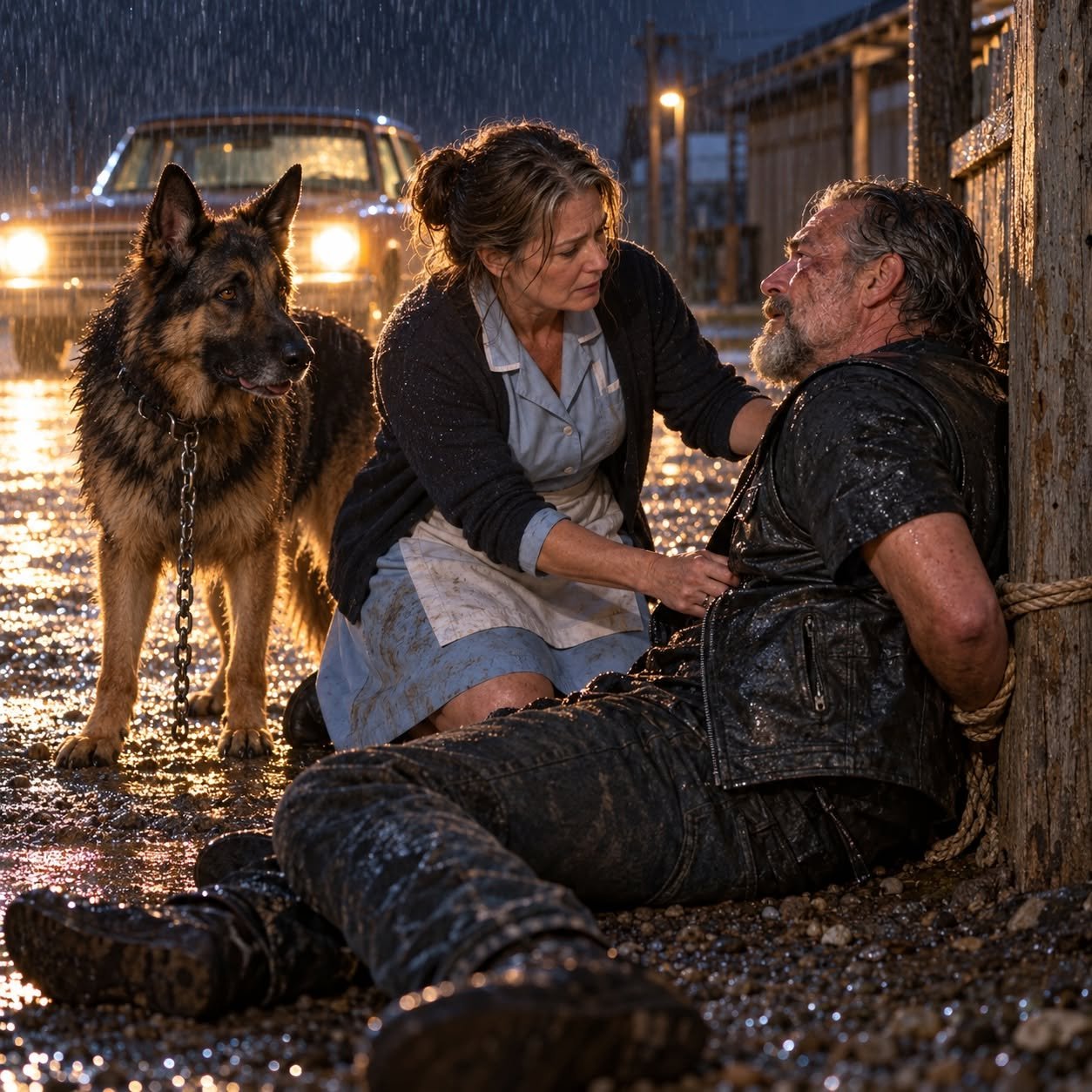
Nancy had worked the closing shift at the Copper Kettle diner for eleven years, and she knew every sound the old building made. So when she heard whimpering from behind the feed store across the alley — not quite human, not quite animal — she grabbed her flashlight and her old dog Ranger’s leash and went to look.
The rain was coming down in sheets. Her flashlight beam swept the back fence and stopped cold.
A man was tied to the fence. His wrists were bound to the chain-link with zip ties, his face bloody, one eye swollen shut. He wore a leather vest with biker patches. Ranger growled low, then whined and pressed against Nancy’s leg.
“Hey,” Nancy said, her heart hammering. “Hey, can you hear me?”
The man’s good eye opened. “Cut me loose,” he rasped. “Please.”
Nancy was fifty-four years old, five-foot-four, and had never cut anyone loose from anything. She’d raised Adam alone after his father left, worked double shifts to keep the lights on, and buried her mother the year Adam graduated. But she carried a box cutter for breaking down cardboard, and her hands didn’t shake as she sawed through the zip ties. The man slumped forward, and she caught his weight with her shoulder.
“I’m Cal,” he said. “Thank you.”
She got him into her old pickup, Ranger riding shotgun like a sentinel, and drove him to the address he mumbled — a garage on the edge of town with three Harleys out front and a hand-painted sign. Four bikers came spilling out, took one look at Cal’s face, and went very still. Then they were all talking at once, getting him inside, cleaning him up.
“He saw something,” one of them told Nancy later, pressing a twenty into her hand for the gas. She tried to refuse; he wouldn’t let her. “Cal saw trucks unloading at the Voss warehouse at 2 AM. No manifests. Men who didn’t want to be seen.”
Voss. Grant Voss owned the Copper Kettle, the feed store, half the commercial property in town — and, Nancy realized with a cold feeling, signed her paychecks.
Over the next two weeks, Nancy started paying attention. Her paycheck was short — twelve hours of overtime missing. Marla, the morning cook, whispered that her check was light too. When Nancy asked Grant about it, he smiled the way a shark smiles.
“Payroll errors happen, Nancy. I’ll look into it.” He never did.
Then came the knock at 4 AM. Nancy opened her door in her robe to find Grant Voss standing on her porch in the rain, no umbrella, water running off his coat. Ranger barked himself hoarse.
“You’re asking questions, Nancy,” Grant said softly. “About payroll. About that biker trash you picked up. Stop.” He leaned closer. “You’ve got a son in Sacramento, don’t you? Adam. Nice boy. Works at that auto shop. Be a real shame if something happened to his job. Or to him.”
The door closed. Nancy stood in her hallway shaking so hard she had to sit on the floor. Ranger laid his big head in her lap.
She didn’t sleep. At dawn, she drove to the bikers’ garage and told Cal everything — the missing wages, the threats, Adam. Her voice broke when she said her son’s name. She hadn’t told Adam about the short paychecks; she’d been too proud, too afraid he’d worry.
Cal listened without interrupting. Then he said, “Nancy, Grant Voss has been stealing from his workers for years. And those trucks I saw? We think he’s moving more than feed through that warehouse. But wage theft — that’s something we can prove. And nobody threatens your family. Not on our watch.”
What happened next, Nancy would later describe as the most organized thing she’d ever seen. The bikers fanned out. Torres, who’d done bookkeeping before the road called him, helped Nancy and three coworkers pull pay stubs and timecards. Preacher photographed the warehouse at night. Big Mike had a cousin in the state labor board.
The evidence was damning: doctored timecards, missing overtime for fourteen employees, nearly forty thousand dollars stolen over two years. And when the labor investigators started pulling threads, the warehouse unraveled too.
Grant Voss was arrested on a Tuesday morning, in front of the Copper Kettle, while the breakfast crowd watched. Wage theft, fraud, and a list of charges from the warehouse investigation that kept growing. He didn’t look at Nancy as they led him past. She looked right at him.
The diner got new management — a woman named Rosa who’d run a café two towns over and who asked Nancy what the regulars liked before she changed a single thing on the menu. Nancy got a check for every dollar she’d been owed, plus penalties — enough to fix her roof and her truck and finally replace the water heater that had been rattling since spring. Marla cried when hers came. The morning cook framed his and hung it by the register, where Grant Voss used to stand.
But the thing Nancy wanted most wasn’t money. She picked up the phone and called Sacramento.
“Mom?” Adam said, surprised. They hadn’t really talked — not really — in almost three years. Life, distance, pride. “Is everything okay?”
“Everything’s fine, baby,” Nancy said, and then she told him everything. The fence. The rain. The 4 AM knock. The bikers. When she finished, there was a long silence.
“I’m coming this weekend,” Adam said. “And Mom? I’m proud of you.”
He came that Saturday, and the Saturday after that. Ranger took to him immediately, the way dogs know. Cal and the boys showed up with a grill and too much potato salad, and Nancy’s little backyard filled with laughter for the first time in years. Adam and Cal talked engines for two hours straight. At one point Nancy caught her son looking at her — really looking — and she saw something in his face she hadn’t seen in a long time. Respect.
Grant Voss had tried to make her small and silent. Instead, he’d given her the fight that reminded her who she was: a woman who cuts strangers loose from fences in the rain, who stands up at 4 AM and refuses to be afraid, who raised a son worth calling.
These days, Nancy still works the closing shift — by choice now. And every night when she locks up, Ranger at her side, she checks the alley behind the feed store. Just in case someone out there needs cutting loose.

