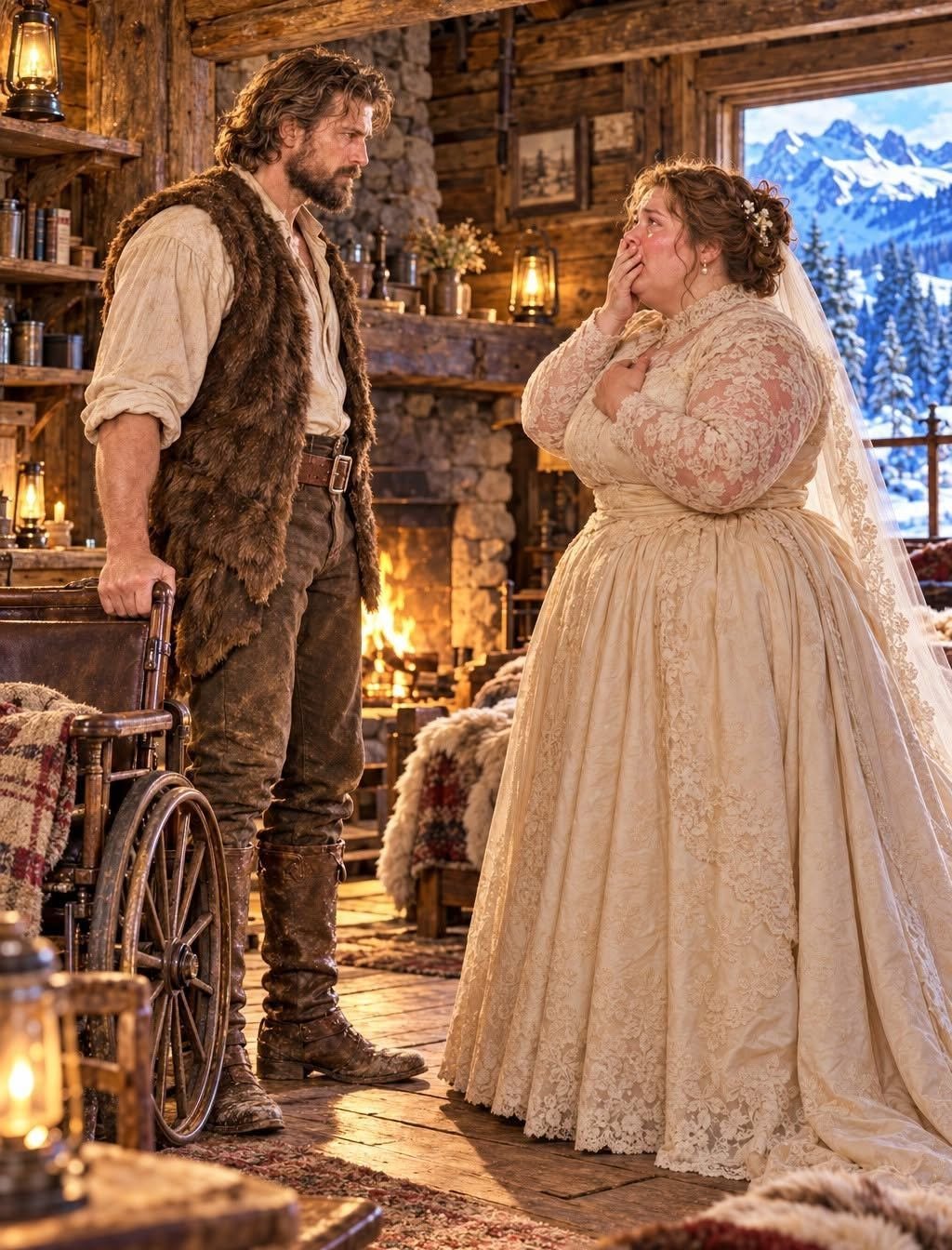
Nobody in Cold Water Basin believed a woman could be worth less than a mule — until the afternoon Miriam Oaks watched her father sign her name to a stranger’s ledger for $42 and a promise that the stranger would never come back to town looking for more.
The stranger was her father’s creditor, a land speculator named Dunore, who wore his waistcoat too tight and smelled of bay rum and old debts. The debtor was Edmund Oaks, a man who had lost his seed money, his timber lease, and the last shred of his dignity at the card tables of a Rivertown saloon three counties south. The commodity was his daughter, Miriam Louise Oaks, twenty-seven years old, unmarried, and apparently priced somewhere between a draft horse and a used wagon wheel.
Dunore didn’t want Miriam for himself. What he had was a business arrangement with a trapper named Vain up in the Bitterroot — a man who lived alone on a high ridge and needed a woman to keep his household from falling into ruin. Word had come down through the trading post that Vain would pay well for a capable bride. He had the silver to back the offer. He just couldn’t walk down the mountain to collect her himself.
The buckboard that carried Miriam up the switchbacks was driven by a sullen half-breed named Casper, who hadn’t spoken ten words since she climbed in. The morning sky was the color of ash and yellow pine pollen. She sat with her canvas bag in her lap and her eyes fixed on the ridgeline above the treeline, where the timber gave way to raw granite and the wind never stopped moving.
She had cried exactly once, in the outhouse behind her father’s house at three in the morning, and she had decided that was the last time she would spend tears on Edmund Oaks or his debts. She was not given to self-pity. Self-pity was a luxury that required you to believe things could have been different, and Miriam Louise Oaks had long since stopped believing in different.
The trapper’s name was Hollis Vain. Full name: Hollis Arden Vain. That was what Dunore had written on the contract beside hers, a name she had read six times in the wagon, trying to build a picture of a man out of two words and $42.
The picture she built was not encouraging. They said Hollis Vain had been brought down from the high country two winters back on a stretcher made of pine poles and rawhide, his legs crushed between a rolling boulder and the wall of a narrow canyon. They said the doctor in Cold Water had examined him and declared the spine damaged — not severed, but damaged enough that the man would never stand again.
They said he’d had himself hauled back up to his ridge as soon as the wounds were stable enough to survive the journey, and that he’d been up there alone ever since, trading furs twice a year through a go-between at the post, refusing charity, refusing pity, refusing every offer of a room in town where a doctor could monitor him.
What they said at the trading post was that Hollis Vain was a broken man going slowly to pieces on a ridge above the treeline. What they said at the saloon, in quieter voices, was that the furs he traded were too fine, too numerous, and too expertly prepared for a man who supposedly couldn’t leave his cabin.
Miriam didn’t know any of this. When Casper pulled the wagon into the clearing and pointed at the long, low cabin squatting in the middle of it like something that had grown there over decades rather than been built, she only knew what Dunore had told her: that she was to keep house, cook, and present herself as a wife without causing difficulties. In return, she would not starve and she would have a roof.
The cabin door opened before she reached the porch steps. The man in the chair was not what she had expected. She had expected withered — the gaunt, slope-shouldered look of a man whose body had surrendered. Hollis Arden Vain was broad across the chest and shoulders in a way that made the doorway behind him look inadequate. His hair was dark, pushed back from a face that was all hard angles and several days of beard, and his eyes, when they found her across the clearing, were the particular pale gray of water moving under river ice. He had a rifle across his knees and a second one leaning against the doorjamb. The wool blanket draped over his lap covered his legs completely.
“Miriam Oaks,” she said when she reached the porch.
“I know who you are.” His voice was low, with the careful flatness of a man who had spent years speaking to no one.
The preacher arrived that evening, a small harried man named Reverend Couts, who stumbled through the vows with the brisk efficiency of a man aware that the trail home turned treacherous after dark. “Do you take this man? Do you take this woman? By the power of God and the territory of Montana.” Then he was gone, and Miriam was Miriam Vain now — by law, if not by any warmer mechanism.
She did what she always did when she needed to think: she worked. She found the pantry, started a fire, heated beans, set two plates on the table. They ate in silence — not uncomfortable, more the silence of two people who have arrived at the same understanding from different directions.
After supper, she washed the plates. “Where do I sleep?” she asked, her back to him.
“Bed’s in the back. I’ll take the chair.”
She turned and studied him the way she studied accounts at the trading post when she suspected an error. Then she said nothing more.
Later, lying in the bed with the bare pelts pulled to her chin, she could see through the gap in the curtain: Hollis Vain sat by the single window with his rifle across his knees, facing the darkness outside. He sat like a man on watch, like a man waiting for something specific to arrive.
On her wedding night, Miriam woke to an empty wheelchair.
The cabin was dark. The chair sat by the window, vacant, the blanket folded neatly over its seat. Her heart hammered. Then she heard it — footsteps crossing the cabin floor. Slow. Deliberate. The tread of a man with two working legs.
She lay frozen as the footsteps passed the curtained alcove and stopped at the door. The latch lifted with barely a sound. Cold air breathed in. The footsteps moved onto the porch — and then, impossibly, down the steps. A man’s full stride, unhurried, circling the cabin in the dark.
Miriam’s mind raced. The furs at the trading post — too fine, too numerous for a cripple. The rifle always across his knees. The way he watched the treeline. She thought of the saloon whispers and felt a cold clarity settle over her: Hollis Vain could walk. He had always been able to walk.
She didn’t confront him that night. She waited until morning, when he was back in the chair, blanket arranged, rifle in place — the performance resumed. She set his breakfast down and said, conversationally, “You walk the perimeter every night. How long has it been?”
The rifle didn’t move. His eyes did — just a flicker. “You’re mistaken.”
“I woke up. The chair was empty. I heard you on the porch.” She sat down across from him. “I’m not going to scream or run. I just want the truth. I’m your wife, for better or worse. Start with the truth.”
For a long moment, he said nothing. Then, slowly, he pushed the blanket aside and stood. He stood easily, with the balance of a man who had never been injured at all, and Miriam felt the floor tilt beneath her — not with fear, but with the strange relief of a suspicion confirmed.
“The boulder was real,” he said quietly. “Two winters ago. It pinned my legs for three hours before Casper found me. The doctor said I’d never walk again.” He took a step toward the window. “He was wrong. Or I healed wrong, or right — I don’t know. Six months after they carried me up here, I stood. A year after, I could run.”
“Then why the chair? Why the lie?”
“Because of what happened before the boulder.” Hollis turned to face her, and for the first time, she saw something raw in those pale gray eyes. “I had a partner. Silas Brandt. We trapped the high country together for six years. Then Silas decided he wanted my share of the season’s take — and my rifle, and my cabin. He came at me with a knife in the dark. We fought. He went over the ridge.”
Miriam’s breath caught. “You killed him.”
“It was him or me. But his brother is Harlan Brandt, and Harlan runs freight through Cold Water Basin with six men who owe him money and loyalty in equal measure. Harlan swore he’d see me hang — or buried. The boulder gave me a gift: a dead man walking. Harlan doesn’t hunt cripples. A man in a wheelchair, rotting on a ridge, isn’t worth his time.”
“So you’ve been hiding in plain sight.”
“For two years.” Hollis sat back down — in a real chair this time, not the wheelchair. “The furs had to be good enough to live on but not good enough to attract attention. The rifle stays across my knees because Harlan’s men ride through these mountains. And now—” He looked at her steadily. “Now I’ve brought you into it. Dunore’s arrangement — I needed a wife on paper. A married man with a household looks settled. Settled men don’t get questioned.”
Miriam felt anger rise — hot and clean. “You bought me to be camouflage.”
“I paid for a housekeeper with a marriage license,” Hollis said bluntly. “I didn’t expect—” He stopped.
“You didn’t expect what?”
“I didn’t expect you to hear me on the porch.”
Before Miriam could answer, a sound cut through the morning stillness — hoofbeats. Not one horse. Several. Hollis was on his feet in an instant, rifle in hand, moving to the window with a speed that confirmed everything. His face went hard.
“Harlan,” he said. “Four riders. Coming up the switchback.”
Miriam’s blood turned to ice. “How—”
“Dunore,” Hollis said grimly. “He sold the contract details. Harlan’s been waiting for me to show I can walk — or for something worth taking.” He turned to her. “Get in the root cellar. There’s a hatch under the rug by the stove. Stay there until I call you.”
“No.” Miriam’s voice was steel. “I’m not hiding while you—”
“This isn’t your fight.”
“You made it my fight when you put my name on that contract.” She grabbed the second rifle from the doorjamb — the one she’d noticed that first day — and checked the load with hands that didn’t shake. “My father taught me to shoot before he taught me to read. Where do you want me?”
Hollis stared at her for one heartbeat. Then something like admiration crossed his face. “The loft. Cover the clearing. Don’t fire until I do.”
What followed lasted less than ten minutes but changed everything. Harlan Brandt rode in with four men, demanding Hollis come out and settle the debt of his brother’s blood. Hollis stepped onto the porch — walking tall, no chair, no blanket — and Harlan’s face twisted with fury at the deception.
“You’ve been lying, Vain.”
“I’ve been living,” Hollis said. “Your brother tried to murder me for furs. I defended myself. There were no witnesses but the mountains, and they’ve kept my secret better than your men ever kept yours.”
Harlan went for his gun. He never cleared leather.
The shot came from the loft — clean, precise, taking the pistol from Harlan’s hand and sending it spinning into the dirt. Miriam worked the lever with calm hands. “Next one goes through your shoulder,” she called down, her voice steady as stone. “Ride out.”
Harlan stared up at the loft, at the woman in the wedding dress she’d never changed out of, holding a rifle like she’d been born with it. His men looked at each other. Four against two — but one of the two had just disarmed their leader without killing him, which meant she could have killed him, which meant the odds were worse than they looked.
They rode out. Harlan’s parting words were a curse, but curses were cheap, and everyone on that ridge knew it.
That evening, Hollis burned the wheelchair in the yard. They watched it go up together, the blanket and the lie and the two wasted years curling into smoke.
“I’m sorry,” Hollis said quietly. “For the $42. For making you part of this without asking.”
Miriam looked at him — really looked at him, standing straight and unbowed in the firelight. “My father sold me for the price of a wagon wheel,” she said. “You gave me a rifle and a choice. That’s more than any man ever offered me.”
He took her hand — the first time he’d touched her without the barrier of the chair between them. “Stay,” he said. “Not because of the contract. Because I—” He stopped, the words unfamiliar in his mouth after years of silence.
“I know,” Miriam said. “Me too.”
They were married twice after that — once by law, which had already happened, and once by choice, which happened slowly over the following year: in the way he taught her the traplines, in the way she turned the cabin into a home, in the way they stood together on the porch each evening, watching the treeline, two people who had both been priced too cheaply by the world and had decided, together, that they were worth more.
Harlan Brandt never came back. Word travels in the mountains, and the word was that the Vain place was guarded by a woman who could shoot a pistol out of a man’s hand at forty yards — and a man who would walk through fire for her.
Miriam never did find out what happened to the $42. She liked to think Dunore drank it. Hollis liked to think it was the best money anyone ever wasted — because it bought him the one thing he’d stopped believing existed on that lonely ridge: someone who stayed.


