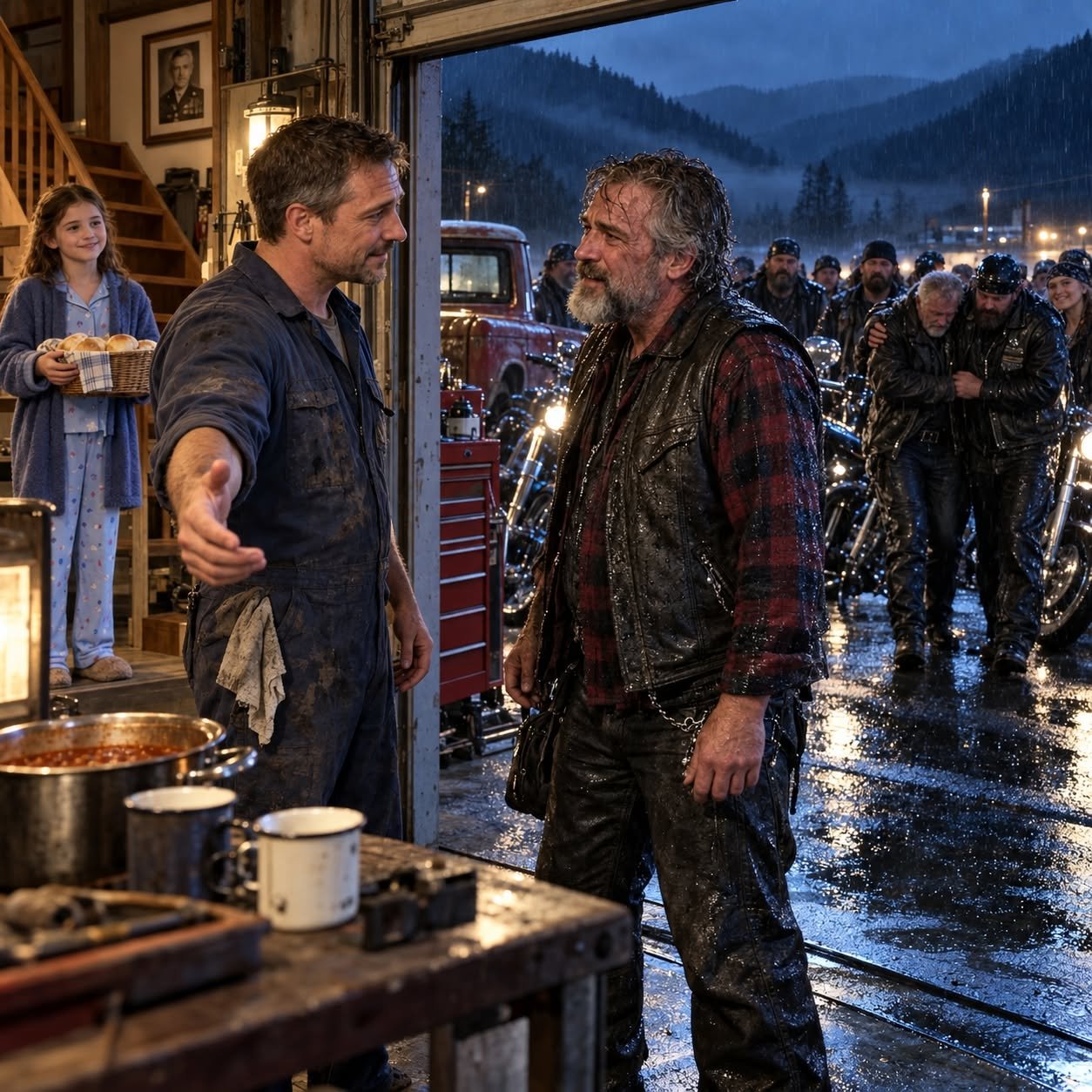
The sheriff stood in Luke Bennett’s garage while fifteen bikers ate the last of the chili. Beside him, the man who had been trying to buy Luke’s property pointed toward the door. "Get them out, Luke. Before this becomes everybody’s problem." Luke looked at the men warming their hands around coffee mugs — and made the decision that would change his town before morning. "They’re staying."
Luke Bennett was forty-three, a former Army combat engineer, a widower, and the owner of a garage barely surviving outside Briar Hollow, West Virginia. His father had opened Bennett Automotive thirty-two years earlier. After he died, Luke inherited the tools, the building, and his habit of charging people less than the work was worth.
Luke’s wife Sarah had died three years before that November night. Since then, Luke and his eleven-year-old daughter Emma had lived in the apartment above the shop. He kept the business running partly because it paid their bills and partly because he didn’t know who he would be without something to fix.
Martin Rusk knew that. Rusk owned the hardware supply business and several properties downtown, and he wanted Luke’s land for a commercial development. He had spent eight months reminding Luke that the garage was worth more demolished. The unpaid invoices on Luke’s workbench suggested Rusk might eventually get his way.
That night, Luke was beneath a pickup when he heard motorcycle engines slowing outside. Fifteen headlights turned into his lot. He almost stayed where he was. Then someone knocked.
The man at the side door had a silver-streaked beard, soaked flannel, and a leather vest carrying the emblem of the Stone Ridge Riders. "Adam Cole," he said. "Sorry to bother you." He stepped aside so Luke could see the others. "One rider went down on the ice. Another’s getting too cold. We’ve got a bike that won’t restart." He swallowed. "We need somewhere warm until the road clears. We’ll pay."
Fourteen men waited behind him without approaching. They looked exhausted. Luke remembered arriving home from deployment and discovering that people could admire a uniform while having no patience for the person still trying to live inside it.
Luke opened the door wider. "Bring everybody in."
They entered quietly. Nobody touched a tool. Nobody demanded anything. A broad man called Mack, a former military medic, helped the injured rider onto a sturdy bench. Two others peeled wet gloves from hands that had stopped working properly. Luke made coffee.
Adam noticed the framed Army photograph beside the register. "Engineer?" "Eight years." "Infantry," Adam said. "Then rescue work after I got out." They shook hands.
Upstairs, Emma stood outside her bedroom. "Who’s downstairs?" "Travelers. They got caught." She looked toward the stairs. "Are they okay?" "Working on it." She opened the refrigerator. "There’s chili." "I know." "And the rolls in the freezer." "The Thanksgiving ones?" She shrugged. "They’re hungry now." Luke heated everything.
Forty minutes later, Sheriff Paul Danner arrived with Martin Rusk and two council members. Someone had called about the motorcycles. The sheriff looked at the injured rider, the blankets, the coffee. Martin looked at the patches. "You’ve got a child upstairs," Martin said. "I’m aware." "These people need to leave."
Adam set down his mug. "We’ll go when it’s safe." "There’s a motel south of here." "The south road’s closed," the sheriff said. Martin turned toward him. Paul didn’t look away. "I drove it twenty minutes ago."
After the others left, Martin lingered. "You’re making a mistake." He glanced at the overdue notices. "You can’t afford many more." Luke held the door until Martin went through.
At eleven-forty, the power failed. Three flashlights came on before Luke found his lantern. Two riders offered to inspect the outdoor generator. Within minutes, it was running again. Upstairs, the refrigerator hummed. For the first time all evening, Luke began to think they might get through the night.
Then his father’s old emergency scanner crackled. A volunteer firefighter reported flooding at the abandoned sawmill offices on Creek Road. Six people had taken shelter upstairs. The exterior stairs were gone. The creek was rising.
Adam stood. "Where is it?" "A mile north." "You know another approach?" Luke did. Before answering, he went upstairs. Emma was awake, holding a book she wasn’t reading. "There are people who need help," Luke said. "Mack’s staying here. Mrs. Doyle next door is coming over." "Are you going?" "Yes." She reached for his hand. "Then come back." Luke promised to do everything he could.
When Luke returned downstairs, the sheriff called. His voice had lost its usual steadiness. "The bridge just washed out, Luke. Rescue crews are stuck on the other side." Through the static, Luke heard a woman screaming. And he understood that the six people at the mill were waiting for help that could no longer reach them.
What happened next is the part the town still talks about. Adam Cole looked at his men — cold, exhausted men who had asked for nothing but a warm floor — and said, "Gear up." Mack stayed with Emma and the injured rider. The rest followed Luke into the freezing rain.
Luke knew the old logging trail behind the mill — a path his father had shown him decades earlier, impassable to trucks but just wide enough for motorcycles. Riding two at a time through mud and rising water, the Stone Ridge Riders ferried the six trapped people out in relays: an elderly couple, a young mother with two children, and the mill’s night watchman. It took four trips. On the last one, Adam’s bike slid sideways in the current and Luke caught the handlebar with both hands, holding it steady until Adam regained control.
They got everyone out before the water took the building’s lower floor.
By dawn, the freezing rain had stopped. The fifteen bikers stood in Luke’s lot, warming their hands on fresh coffee Emma had insisted on making. Sheriff Danner shook Adam Cole’s hand for a long time. Even Martin Rusk was quiet — until he cleared his throat and said, "Luke. About those invoices. Let’s talk next week. No rush."
Nobody in Briar Hollow ever learned the full story of what the Stone Ridge Riders did that night, because the riders didn’t stick around to tell it. By eight in the morning, the lot was empty except for fifteen small oil stains on the gravel and a folded note on Luke’s workbench: "For the chili. For the floor. For staying. — A.C."
But something had shifted in the town. The council members who had come to throw the bikers out started bringing their trucks to Bennett Automotive. Martin Rusk’s development plans quietly moved to a parcel on the other side of town. And when people asked Luke why he had risked everything for fifteen strangers, he gave the same answer every time.
"They’re staying," he said. "That’s what you do when people need a roof. Everything else is just noise."
Emma still keeps one of the Thanksgiving rolls — now hard as a rock — in a jar on her bookshelf. She says it’s to remind her that the night the town wanted to throw fifteen strangers into a freezing storm, her father opened the door wider instead. And that sometimes, the people everyone is afraid of turn out to be the only ones who show up when the bridge washes out.


