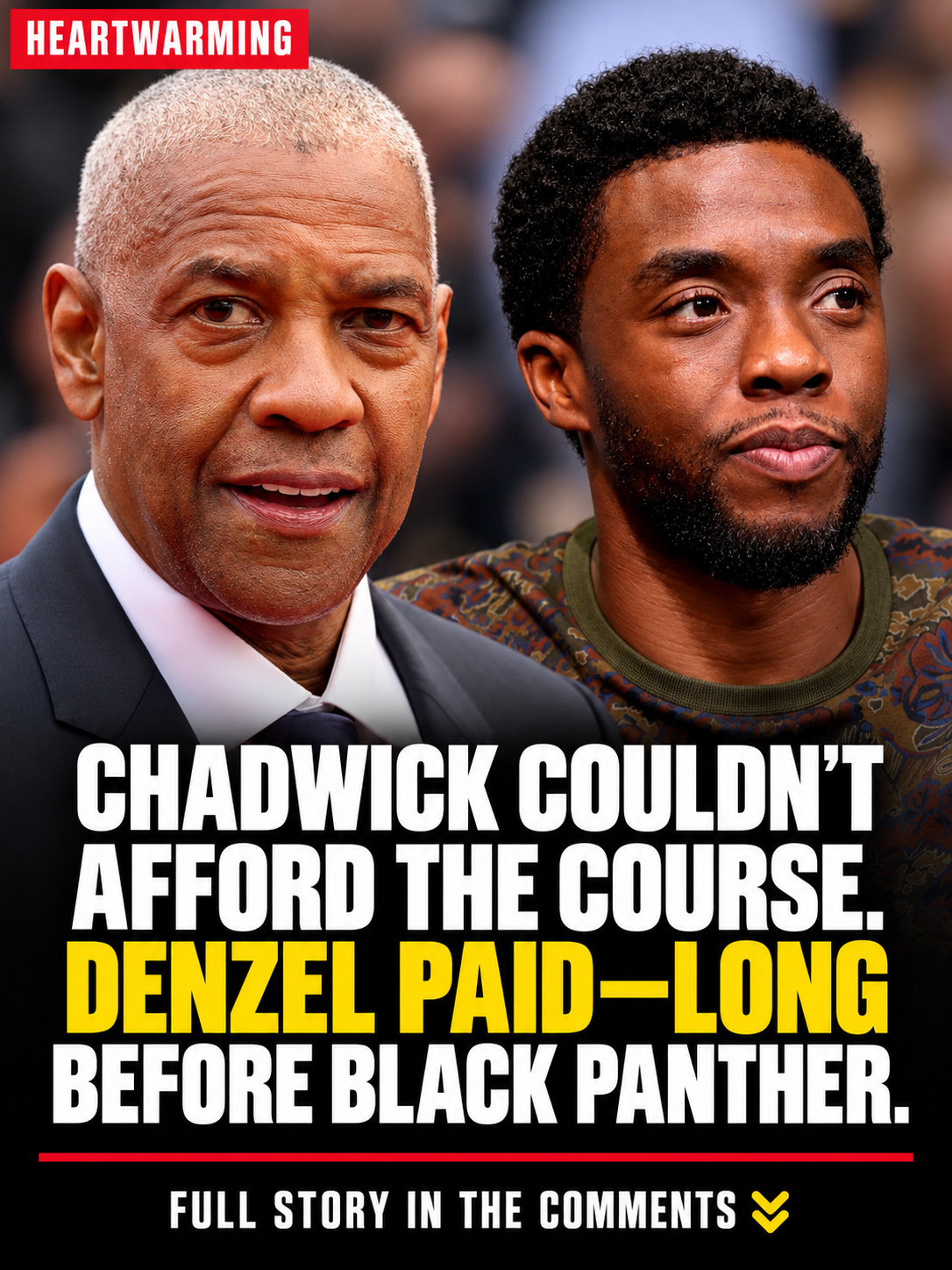
Chadwick Couldn’t Afford the Course. Denzel Paid—Long Before Black Panther.
Before audiences knew Chadwick Boseman as Black Panther, he faced a problem many families recognize: an opportunity had arrived, but the money had not. The Howard University student had been accepted into a summer acting program at Oxford. Paying for it was another matter. [1] The gap between acceptance and attendance can be easy to overlook in a success story. A place in a program signals that someone has earned an opportunity; it does not provide the means to take it. Before the celebrated performances, Boseman’s path included that practical obstacle, one that promising students and their families encounter every day.
The person who helped bridge that gap was already famous. Denzel Washington contributed support that allowed Boseman to attend. The connection became especially moving years later, when the younger actor had a career of his own and could thank a man whose generosity had preceded his success. [3] The gift’s meaning changed as the years passed, but its original purpose remained simple: help a student reach a course. Washington could contribute resources that the younger actor lacked. Boseman could contribute his effort and ability. The relationship between those contributions makes the story moving without suggesting that generosity alone produces an artistic career.
The course was the British American Drama Academy’s Midsummer in Oxford program. BADA identifies Boseman as a 1998 participant. This was summer training, not a claim that Washington financed a full Oxford degree or all of Boseman’s university education. The actual assistance is meaningful enough without expanding it. [2] Precision also helps readers understand what the program offered. A summer course is a defined period of training and experience, with its own value. It should not have to become a university degree in retellings to seem worthwhile. The opportunity mattered because Boseman wanted to pursue it and because a cost threatened to keep him from participating.
Phylicia Rashad was an important part of how the help reached him. Howard’s biography explains that she recruited celebrity friends, including Washington, when Boseman could not afford to attend. A teacher’s attention turned a financial barrier into a problem that other people could help solve. [1] A mentor can see a barrier that would remain invisible to someone looking only at grades or an acceptance letter. Rashad responded to the financial problem rather than assuming the student’s success would somehow solve it. That response gives her an active role in the story and shows how teaching can extend beyond the boundaries of a classroom.
BADA describes a group of ten Howard students receiving support from Rashad, Washington and other donors that summer. The kindness therefore belonged to a wider effort, not an isolated fairy tale about one future star. People invested in young performers before they could know what careers would follow. [2] The wider group of students is important because the donors were supporting education, not selecting a guaranteed future celebrity. Some beneficiaries would become more publicly visible than others. The value of the assistance did not depend on that difference. Each student had earned a chance to learn, and the funding helped make participation possible for the group.
That is the detail that gives the story its strength. Washington’s contribution did not depend on Boseman already being a celebrity. At that point, the opportunity was educational. Helping a student take it meant placing trust in potential without requiring a public result first. [3] This is one reason the story speaks to grandparents as well as young performers. Older relatives often make decisions about helping before anyone knows how a career will unfold. Their contribution might be smaller, but the uncertainty is similar. A useful opportunity can deserve support because of the work a young person is already doing, not because fame is assured.
Howard remembers Boseman as an artist interested in directing and in the representation of Black lives. His training sat within a larger development as a storyteller. A scholarship or donated fee cannot create someone’s entire talent, but it can keep a financial obstacle from closing a useful door. [1] Access to training can expose a student to different approaches, teachers and expectations. That experience becomes one part of development alongside talent and continued practice. In Boseman’s case, the summer program belongs within his education rather than standing above everything else. Remembering it accurately keeps the act of support connected to the work he undertook himself.
The public expression of thanks came at Washington’s AFI Life Achievement Award tribute in June 2019. It was a ceremony honoring a major career, filled with established performers. Boseman’s presence added another kind of evidence of Washington’s influence: a younger actor who had benefited from his help. [4] The tribute reversed their public positions in a moving way. Washington was being honored for a long career, while Boseman could now speak as an accomplished performer rather than an unknown student. His acknowledgment brought an earlier act of assistance into the room and showed that the influence of a career can extend beyond the roles audiences remember.
Boseman linked that assistance to the road that eventually led to Black Panther. AFI reported his acknowledgment of Washington’s importance to his generation of performers. The gratitude was personal, but its meaning was larger: one successful artist had helped make room for those coming after him. [4] Gratitude can reveal a connection that would otherwise remain private or overlooked. Movie audiences see the finished performance, not every opportunity that helped prepare an artist. Boseman’s tribute made one of those opportunities visible. It gave viewers a fuller account of the journey while allowing Washington’s educational generosity to become part of his public legacy.
For parents and grandparents, the story may recall the smaller opportunities that shape a child’s path. Course fees, travel expenses or the cost of a program can decide whether an acceptance letter becomes a real experience. The student needs more than praise when the barrier is a bill. [3] For a household weighing such a bill, the issue is often concrete rather than philosophical. The family may believe in the student’s ability and still be unable to cover an additional program. Stories about assistance matter because they acknowledge that those two facts can exist together. A financial barrier does not show that the ambition is unworthy.
Rashad’s role is equally worth remembering. She noticed that a student had earned an opportunity and worked to make participation possible. Mentorship included using her own relationships to secure practical support. The lesson is concrete: encouragement sometimes needs to become an introduction, a call or a contribution. [2] Rashad’s intervention also illustrates the usefulness of relationships built over time. A teacher may not personally have the resources to meet every need but may know someone able to help. Asking on behalf of a student can turn that network into an opportunity. The important step is recognizing the problem and taking responsibility for finding a practical response.
The story also gives Boseman agency. He was accepted into the program and did the work required to develop his craft. Receiving assistance did not make his later achievements someone else’s property. It gave him access to training that he still had to use for himself. [1] Maintaining Boseman’s agency makes the kindness more credible. Support gave him a way into the program; it did not attend classes or develop his skills for him. The later career required continuing decisions and work. The story honors Washington and Rashad most honestly when it also honors the student whose effort made their support useful.
Washington’s honor at AFI provided a fitting place to recognize that relationship. A lifetime achievement award normally looks at the films an actor has made. Boseman’s contribution to the tribute brought attention to an influence that would not appear in a film credit: helping another person reach a classroom. [4] An actor’s influence can therefore appear in places that are not part of a filmography. A donated fee may not receive a screen credit, yet it can matter to the person whose education it enables. Boseman’s presence at the tribute gave that invisible contribution a public form, adding mentorship and access to the usual account of artistic achievement.
It is easy to turn a true kindness into a larger internet legend. Africa Check specifically verified the summer-program support. Keeping that detail accurate protects the story from becoming a false claim about paying every tuition bill. A particular, documented act is more persuasive than an exaggerated one. [3] Online retellings often simplify a complicated path into one extraordinary gift. That can make a headline stronger while making the history weaker. Here, the actual sequence already carries emotional force: acceptance, a financial obstacle, help through a teacher’s network, and a later public thank-you. Preserving that sequence is enough to explain why people remember it.
After Boseman’s death, educational support became part of how Howard honored his legacy. The university and Netflix announced a $5.4 million endowed memorial scholarship in 2021. The initiative aimed to help students in the College of Fine Arts with the financial cost of their education. [5] The memorial scholarship changes the direction of the story again. Boseman’s name became associated with assistance for students facing educational costs of their own. That is a concrete way for remembrance to serve the living. People who admire an artist can support a structure that helps others learn, rather than limiting the tribute to looking back at his performances.
That later scholarship is separate from Washington’s earlier contribution. One concerns Boseman as a student receiving help; the other concerns future students receiving help in his memory. Together, the events suggest a meaningful continuity without implying that the two programs are the same fund or arrangement. [5] The connection between the two events is a theme, not a claim that one donation automatically created the later fund. Boseman benefited from support while studying, and students could later benefit from a scholarship honoring him. Keeping the arrangements distinct makes it possible to see the continuity of purpose without inventing a financial link between them.
For a family deciding whether a young person’s artistic ambition deserves support, the story offers a useful perspective. An early opportunity can matter even when no one can predict fame. Education has value before a graduate becomes a household name, and help should not require that prediction. [2] Artistic education also matters to a community before a graduate reaches a national stage. Students may go on to teach, direct, write or contribute locally. An opportunity to learn can serve those futures too. The fact that Boseman became a major star makes this example recognizable, but it does not define the only worthwhile outcome of support.
The memorable part of the AFI tribute is the relationship between the two stages of life. The person who once needed help could stand before an audience and acknowledge it openly. Success did not make the earlier gift irrelevant; it gave him a larger platform from which to honor it. [4] Remembering the gift publicly gave Boseman a way to connect personal success with the help that preceded it. That acknowledgment can be especially powerful for young viewers who imagine accomplished people never needed assistance. His account showed a more familiar path: ability and commitment existed alongside moments when another person’s resources made the next step possible.
The memorial scholarship carries that spirit into another generation. A future performer may never meet the people associated with the fund, but the reduction of a financial barrier is real. Supporting access is one way admiration for an artist can become something useful for another person’s future. [5] A scholarship’s usefulness is experienced one student at a time. A public announcement may emphasize the fund’s scale, but the individual effect is access to an education that costs money. Connecting that practical benefit with Boseman’s remembered experience gives the memorial an emotional meaning while keeping attention on the people it is intended to help.
Long before the superhero role, there was a student, a summer course and a cost he could not meet alone. Rashad and the donors helped. Washington’s contribution became part of Boseman’s remembered journey, and the gratitude that followed shows how a practical kindness can remain important for years. [5] The lasting appeal lies in the delay between the act and its public meaning. The donors helped before there was a famous career to celebrate. Years later, Boseman could name the assistance as part of his journey. That is what gives the story its warmth: a useful kindness continued to matter long after the original bill had been paid.

