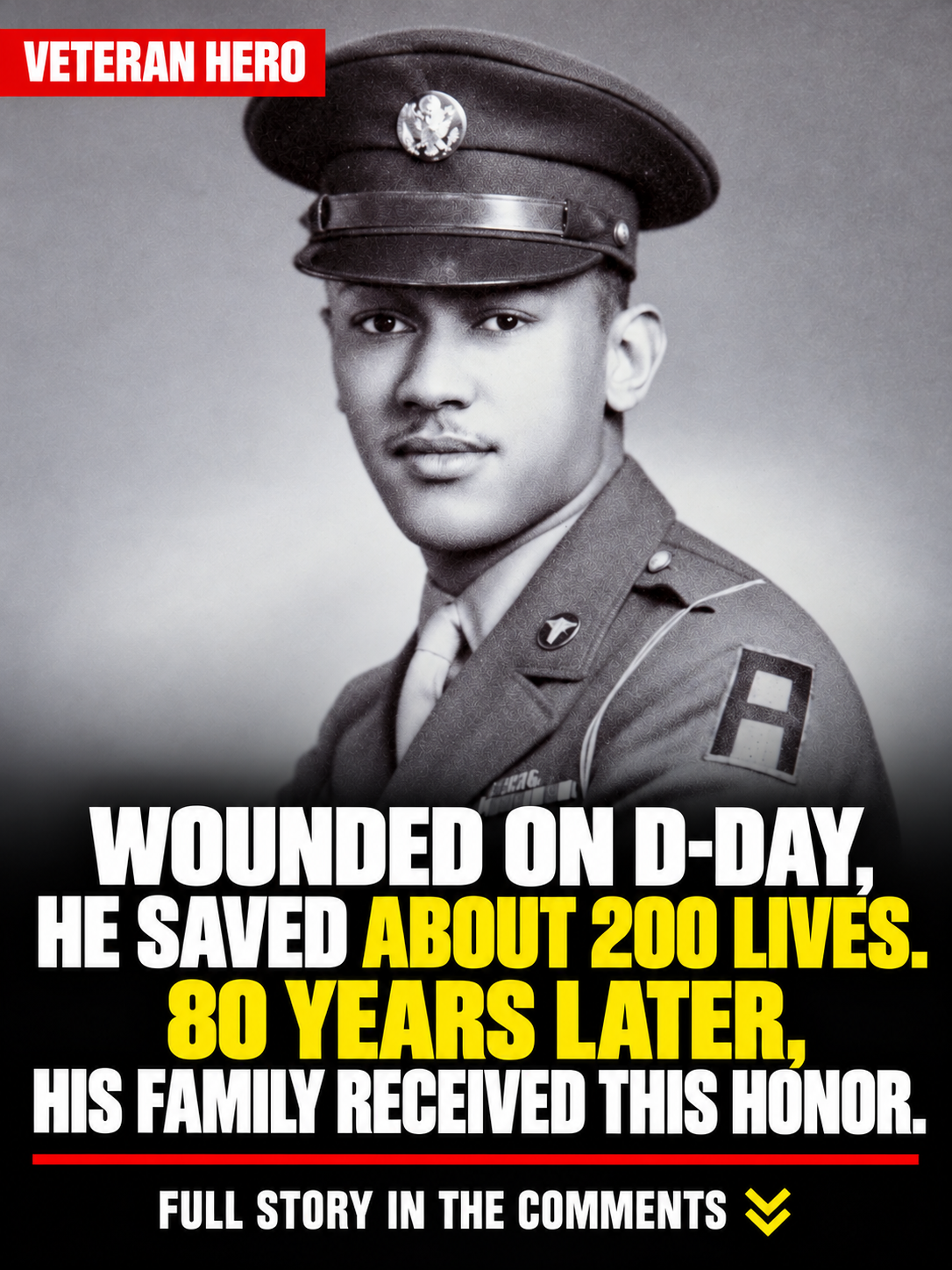
Wounded on D-Day, He Saved an Estimated 200 Lives. Eighty Years Later, His Family Received This Honor.
Waverly Woodson did not arrive on Omaha Beach unhurt. The young Black medic was already wounded when he began helping other soldiers on D-Day. The story would eventually reach his family through a medal presentation, but the recognition took almost 80 years to catch up with the actions. [3] That delay makes the account more than a battlefield profile. It is also a family story about what happens after an extraordinary act falls short of the recognition it deserves. Woodson’s actions unfolded in an emergency; the effort to secure an appropriate honor unfolded across generations, with relatives helping to carry the record forward.
Woodson served with the 320th Barrage Balloon Battalion, an all-Black unit that landed during the Normandy invasion. The National Park Service identifies him among the Black soldiers whose service forms part of that enormous operation. His contribution deserves a name and a face, rather than a passing mention. [1] Naming the battalion helps place him within the invasion rather than treating him as a figure outside its main story. D-Day required many kinds of service, including tasks that did not receive the same attention as infantry assaults. A full account must include the soldiers whose specialized work supported the operation and those who cared for its casualties.
His landing craft encountered enemy fire and a mine as it approached the beach. Woodson suffered injuries, yet he began treating casualties. In the immediate emergency, his medical responsibilities were not limited by whether he was in pain himself. Other wounded men needed help around him. [2] His wounds are important because they establish the conditions under which he continued working. The story is not simply that a medic performed his assigned duties. It is that he did so while also needing care himself. That combination helps readers understand why his actions drew such determined efforts for higher recognition decades later.
Accounts of his service describe more than 30 hours of medical work under dangerous conditions. The later Senate announcement credited him with saving an estimated 200 lives. That number is an estimate, not a precise patient count, but it conveys the extraordinary scale attributed to his efforts. [4] An estimate of lives saved cannot describe each encounter on the beach. It does, however, suggest repeated acts of assistance over a sustained period. The scale matters alongside the duration. Woodson’s contribution was remembered as more than one moment of bravery; it involved continuing to respond as wounded men needed medical help around him.
For the men he treated, the work was more immediate than any decoration. A medic’s actions could mean surviving long enough to reach further care. In Woodson’s story, the battlefield achievement came first; the public record of honor became a separate struggle that continued far beyond the beach. [2] Medical service can be less visible in a familiar war narrative because its purpose is to keep others alive rather than seize a position. Yet that work changes the outcome for individuals and families. Every wounded soldier who survives an emergency has a possible future beyond the battlefield, which gives a medic’s intervention a significance extending far beyond the immediate scene.
He survived the war. The Army’s account describes later work in medical technology, including years at the Naval Medical Center in Bethesda and the National Institutes of Health. His life of service continued after the episode that would eventually draw national attention to his name. [2] His later career prevents the wartime episode from becoming his entire identity. A veteran carries the experience home and continues to live a life beyond the event that appears in an award citation. Woodson’s medical work after the war provides that wider picture: the young man who cared for casualties remained connected to useful work afterward.
Woodson died in 2005 at 83 and was buried at Arlington National Cemetery. That fact gives the later recognition a particular sadness. He could not stand at the ceremony to receive the upgraded honor. The family and others who had kept advocating had to receive it on his behalf. [1] Posthumous recognition carries a different emotional burden from a medal presented to a living veteran. Relatives can receive the honor and hear the public acknowledgment, but the person whose actions earned it cannot answer. The ceremony therefore becomes an act of remembrance as well as a correction, with his absence shaping what the family is finally able to celebrate.
The delay was not presented by advocates as an ordinary forgotten detail. Senator Chris Van Hollen’s office explicitly connected the failure to fully recognize Woodson’s wartime heroism to racial discrimination. His family, historians and military officials worked to correct the place he had been given in the record. [4] The advocates’ explanation also brings the history of racial exclusion into the discussion of military honor. A medal process can appear neutral when readers see only its final decision. Looking at the delay asks them to consider whose service was recognized promptly, whose testimony was valued, and which families had to spend decades seeking a fuller acknowledgment.
The campaign required documents as well as conviction. Army historian Kevin Braafladt searched records for evidence of the medic’s service. A family might know what a loved one had done, but obtaining an official military upgrade required evidence that could support the recognition within the award process. [2] Historical research gives that advocacy a concrete foundation. Letters, unit records and official accounts can preserve information that memory alone cannot carry into a formal review. Recovering such material is demanding work because evidence may be scattered or incomplete. The historian’s role becomes part of the story of how a family’s effort reaches an institution capable of acting.
That distinction can be painful. The strength of a person’s actions and the survival of the paperwork about them are not the same thing. Woodson’s advocates faced a history in which the available documentation became central to the level of recognition the Army could approve. [3] For families, the gap between knowing and proving can feel especially difficult. A veteran’s service may be central to their understanding of a loved one, yet an official process needs records it can evaluate. Woodson’s recognition illustrates why preserving papers can matter long after their original purpose has passed and long after the person who received them has died.
In 2024, he was posthumously awarded the Distinguished Service Cross, the Army’s second-highest decoration for valor. The award was a significant achievement in the family’s long campaign. It should not be confused with the Medal of Honor, which was also sought for him by advocates. [4] The name of the decoration deserves precision because the level of the honor is part of the development. Receiving the Distinguished Service Cross represented substantial recognition of valor. Understanding that achievement does not require claiming that every goal of his advocates had been met. It allows the family to celebrate a real result while keeping the wider campaign in view.
The medal’s journey gave the ceremony an unusual emotional connection to the battlefield. First Army leaders brought a World War II-era Distinguished Service Cross to Omaha Beach and placed it on the sand associated with Woodson’s actions. The object linked recognition to the place where he had served. [1] Taking the medal to Omaha Beach added a physical connection that paperwork could not provide. The landscape was associated with the actions described in the record. Bringing the award there linked the official acknowledgment to the place where those actions mattered, before the medal traveled to the people who had preserved his memory at home.
Later that year, the medal was presented to his family on Capitol Hill. His widow, Joann Woodson, received it with relatives and officials present. She was 95, old enough to have carried the memory of his service through decades of waiting for a fuller public acknowledgment. [3] An elderly widow receiving a husband’s military honor makes the passage of time visible. The years are no longer only a number in a headline. They are represented by the person holding the medal and the long life she shared with the veteran before his death. That is why the family ceremony remains such a powerful part of the story.
The Association of the U.S. Army described the recognition as overdue. That is the heart of this feature: the honor was real and substantial, but it arrived after the veteran’s death. A public ceremony could correct the record while also revealing how long the correction had taken. [5] The word overdue also raises a question beyond this particular award. When recognition arrives late, the institution has an opportunity to explain how the omission happened and what the correction means. A ceremony can honor courage, but a fuller account must also preserve the delay so that the public understands why the family needed a campaign at all.
His family’s presence prevented the event from becoming merely administrative. Behind the medal was a husband, father and relative. Military history often moves through battles and units; family remembrance brings it back to the person who returned home and the people who lived beside him afterward. [5] Relatives give history its human continuity. They remember habits, work, relationships and ordinary days alongside the military record. At a public presentation, their presence reminds observers that the citation describes a person who lived among others. His service mattered on a beach, and his life mattered in a household after he returned from the war.
The National Park Service’s biography also records later tributes, including a clinic named for Woodson and recognition in Philadelphia. Such acts help make a once-overlooked name visible in ordinary places. The recognition extends beyond a single ceremony when people encounter his story in daily life. [1] Public naming can extend that memory to people who were never part of the family. Someone encountering a clinic or a commemorative marker may ask who Woodson was. That question creates another opportunity to explain his work. The lasting value of a tribute depends partly on whether the name remains attached to an accessible, accurate account of the person.
The effort for the Medal of Honor had its own documentary obstacles, according to the Senate’s account. The Distinguished Service Cross did not settle every question about the highest recognition his advocates believed he deserved. It did establish a major correction that the family could finally hold in their hands. [3] Continuing interest in a higher award shows that official recognition can be both meaningful and incomplete in the eyes of advocates. Their position does not diminish the decoration already received. It explains why the discussion continued. The story can hold a successful correction and an unresolved aspiration together without presenting either one as the only relevant outcome.
For readers who grew up hearing relatives’ wartime memories, the story offers a reason to listen closely. A veteran’s modest explanation of having done his duty can hide an extraordinary event. The public record can remain incomplete unless someone asks questions, preserves documents and continues to pursue the answers. [5] Many families inherit fragments of a veteran’s experience rather than a complete narrative. A place name, a unit patch or a brief recollection may be all younger relatives initially hear. Woodson’s case offers a reason to preserve those fragments carefully. Their significance may become clearer when placed beside records that survive elsewhere or research carried out years later.
Woodson’s recognition also enlarges how D-Day is remembered. Black service members were part of the operation, and his work as a medic belongs within its central history. Honoring him is not an addition outside that history; it makes the account of the battle more complete. [4] Including Black soldiers within the central account of D-Day changes what people are able to recognize in the familiar anniversary images. It makes room for service that was always there but was not always equally visible. Woodson’s medical work belongs to the invasion’s history because he was present and helping other soldiers survive it.
The most affecting image is not an invented battlefield rescue. It is the documented journey from a wounded medic helping others to an elderly widow receiving his honor decades later. Waverly Woodson’s family waited a lifetime for the country to give his actions a fuller place in its memory. [5] The ending contains both achievement and loss. The family received a major honor, and the public record gained a fuller acknowledgment of his valor. But Woodson did not live to see that result. Remembering both parts respects the relatives’ persistence while allowing readers to understand why late recognition can move people so deeply.

