The laughter at the livestock auction followed Marin Belrose all the way home to Brier Hook Hollow, echoing in her ears louder than the rattling of the old trailer behind her truck.
Gideon Rusk had stood beside two cattlemen, grinning wide as the twenty-three-year-old woman signed papers for one hundred and twenty underfed goats. “Hope she bought enough rope to tie them together when the coyotes come!” The men had roared. Marin had folded her receipt, slipped it into her pocket, and walked away without a word. They mistook her silence for defeat. They had no idea what kind of woman they were dealing with.
Marin had come home with an aging truck, a few hundred dollars, and one fierce determination: to save her family’s three hundred and eighteen acres. Her grandmother Althia, eighty-one years old and sharp as a tack, still lived in the leaning farmhouse. The barn leaked, the fences sagged, and brush swallowed the pastures. Worst of all, everyone insisted the property had no reliable water. Two agricultural advisers had told her to walk away.
She refused. The land had been in her family for four generations. She was not going to be the one who lost it.
Her answer came from an unexpected place: her grandfather Isaiah’s old farming ledgers. Between decades of rainfall records and livestock expenses, one sentence caught her eye and would not let go: “These animals eat what the land offers and ask nothing extra.” He had been writing about goats.
She looked toward the mountain, where cedar, locust, blackberry, and wild rose had swallowed the hillsides. Everyone saw useless brush. Marin saw free food.
Three days later she bought the goats. Some limped. Others were painfully thin. One old nanny was blind in one eye. When she unloaded them at the farm, Althia stared at the trailer for a long moment. “How many?” “One hundred twenty.” “Your grandfather started with forty-six. Said that was too many.” Althia disappeared into the kitchen and came back with two cups of coffee. That was all the encouragement Marin needed.
The weeks that followed were brutal. She repaired fences until her hands blistered, doctored sick animals, and chased twenty-three escaped goats through freezing rain. Two of them died, and she cried alone in the barn, wondering if she had made a terrible mistake. Meanwhile Gideon and his friends kept laughing every time she drove into town. “Still feeding those coyote traps?” She never answered. She simply worked harder.
Then the hillside began to change. The goats cleared the tangled brush, exposing ground no one had walked in decades. Their bodies filled out. Their coats turned sleek. Even the limping doe she had named Tuesday began walking comfortably again. Where there had been a wall of thorns, there were now open slopes of new grass, and the goats grew fat on what everyone else had called worthless.
One afternoon her uncle Cobb came to help repair an old fence. Without looking up, he asked a question that stopped her cold: “Your grandmother give you the key yet?” “What key?” Cobb immediately regretted speaking, but that evening Althia retrieved an old candy tin from her bedroom. Inside lay a heavy iron key. “Your grandfather called it insurance,” she said. “Insurance for what?” “For the day this land needed saving.”
Marin searched the ledgers until midnight and found a hand-drawn map — the farmhouse, the barn, the eastern hillside, and a small X beside two underlined words: COVERED SPRING.
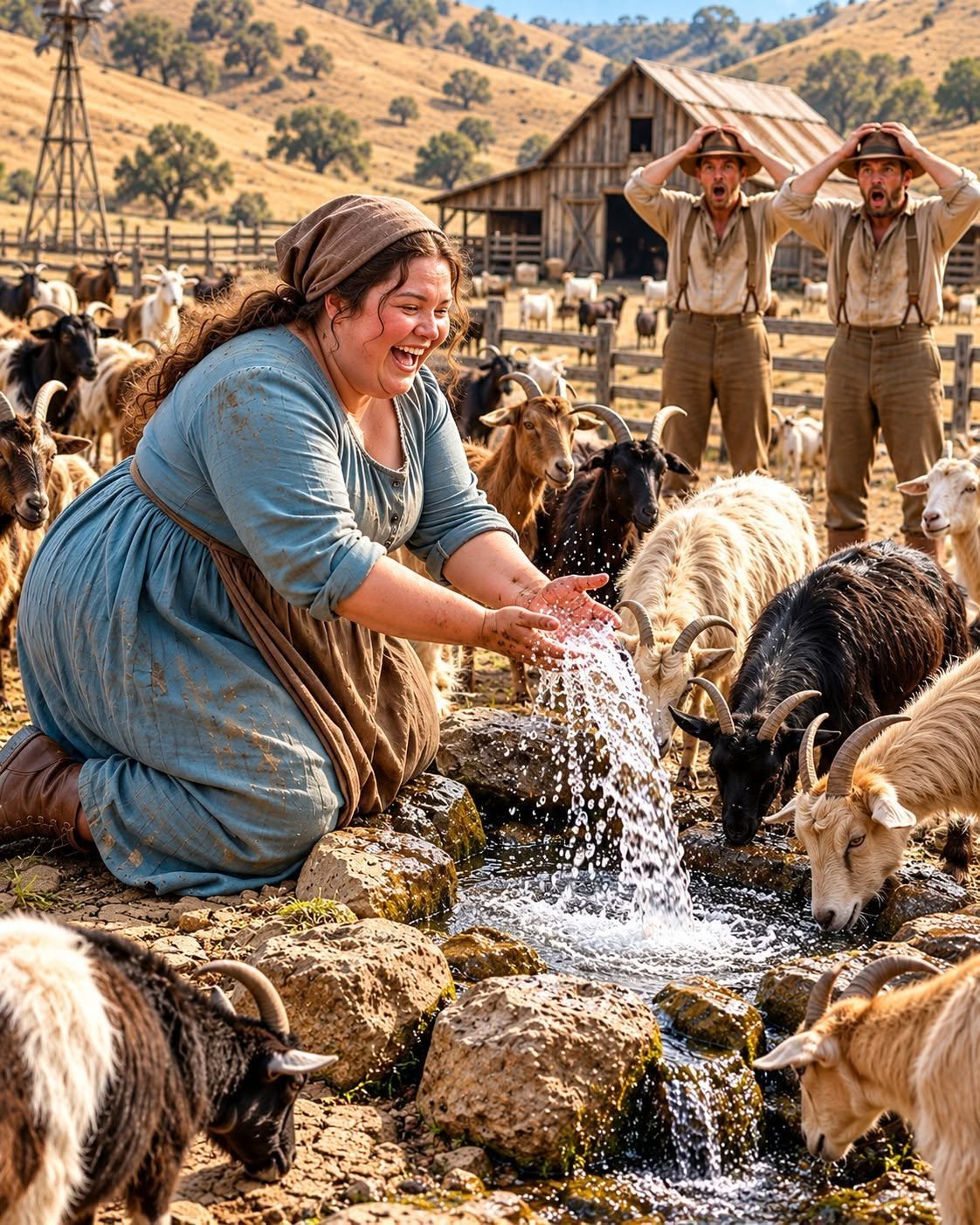
The following Saturday, she and Cobb climbed through the newly cleared brush. Beneath tangled roots stood a circular structure of fitted stones, sealed with a wooden cover and an ancient padlock. Her fingers trembled as she turned the key. Together they lifted the heavy cover, and cold air rushed upward. Far below, water shimmered against the stone — cold, clear water flowing beneath the mountain.
Cobb stared into the opening. “Your grandfather knew.”
But one question haunted Marin that night: why had he sealed the spring in the first place? A man does not lock away water in dry country without a reason.
The answer was waiting in the last ledger, in entries she had skimmed too quickly the first time. Forty years earlier, during the great drought, a cattle company — the same company Gideon Rusk’s father now ran — had tried to buy the Belrose land for a fraction of its worth. When Isaiah refused, the company claimed the mountain spring as its own, insisting the water belonged to whoever could develop it first. Isaiah knew that if the spring were open and known, the company would drain it, claim the rights, and leave the Belrose land a dry husk.
So he had done the bravest and strangest thing a farmer can do: he sealed his own water. He covered the spring, locked it, hid the key, and told no one but his wife. He spent the rest of his life farming the hard way, waiting for the company’s claim to expire and for the day a Belrose would need the water badly enough to deserve it. The key was insurance — not against drought, but against thieves.
Marin sat at the kitchen table until dawn, the ledger open before her, and wept for a grandfather she had barely known. Then she wiped her eyes, made coffee, and got to work.
With Cobb’s help, she had the county water office survey the spring. The old company’s claim had expired twenty years earlier. The water — and the rights to it — belonged to the Belrose family, free and clear. She ran pipe from the spring to a holding tank, then to troughs across the pasture. For the first time in living memory, Brier Hook Hollow had reliable water.
What happened next, the whole county watched. The goats, already thriving, multiplied. Marin sold breeding stock and goat’s milk cheese at the farmers’ market in town, and her chèvre and her kid goats commanded prices that made the cattlemen blink. She paid off the farm’s debts. She rebuilt the barn, straightened the fences, and put a new roof on her grandmother’s house. The girl they had laughed at became the most talked-about young farmer in Yansy County.
Gideon Rusk came to the farm one evening in late autumn. He stood by the fence, hat in his hands, and watched Tuesday the old doe nuzzle Marin’s pocket for a treat. “I owe you an apology,” he said quietly. “My father told me your grandfather was a fool for sealing that spring. Turns out he was the smartest man in this county.”
Marin smiled. “He knew what the land needed. He just had to wait for someone stubborn enough to listen.”
That winter, Althia sat by the fire in the warm farmhouse and watched her granddaughter pore over plans for the spring — a second tank, a small orchard, maybe a few beehives. “Your grandfather would be proud,” she said. “He saved that water for forty years. He was waiting for you.”
Marin looked up from her papers. Outside the window, one hundred and twenty goats — now sleek, strong, and worth ten times what she had paid — moved across the hillside like a living blanket, and the mountain stood above them all, keeping its secrets no longer.
She had bought the goats everyone mocked. She had unlocked the spring everyone said did not exist. And she had learned the lesson her grandfather had written in the margins of his ledger, in words she finally understood: the land provides for those who are willing to work with it, not against it.


