“You’ll Never Sleep Outside Again” — The Silent Rancher’s Seven Words
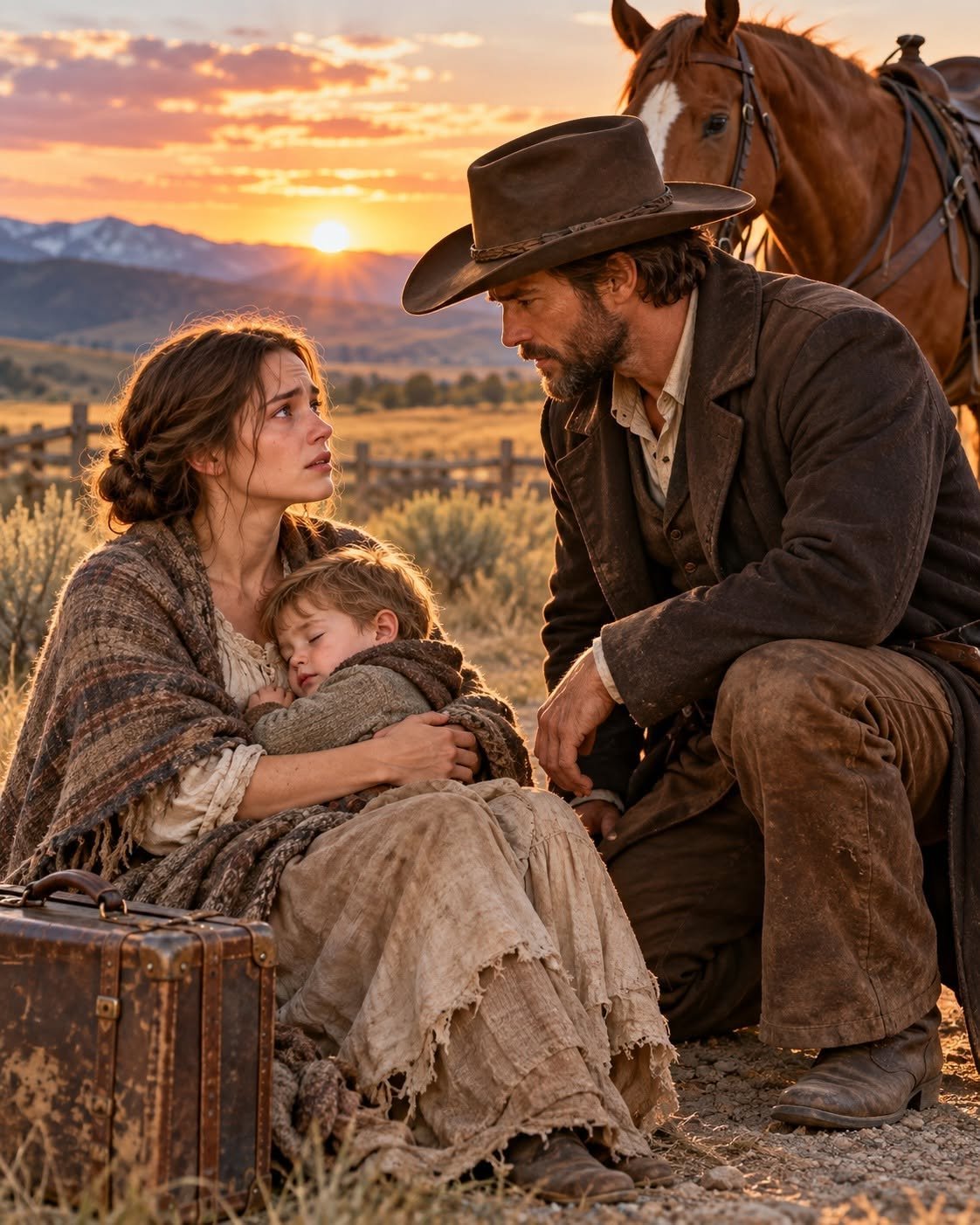
“You’ll never sleep outside again.” Those seven quiet words stopped Sarah Collins from breaking completely on a cold Wyoming evening when she had no food, no home, and no hope left — only a sleeping two-year-old son in her arms and a battered suitcase containing nearly everything she owned in the world.
Six months earlier, Sarah had been a wife with a home and a future. Then her husband Thomas died in a mining accident, and the creditors came like wolves. They took the cabin. They took the furniture. They took the small, ordinary things that had once made Sarah believe her life was secure. People who had once promised to help stopped answering their doors.
For weeks, Sarah had walked from town to town asking for work. A cook. A housekeeper. Anything. But every answer sounded the same. “Sorry. We already have someone.” “Sorry. We don’t need help.” “Sorry.” That morning, she had given little Noah their last piece of bread. She told him she wasn’t hungry. It was a lie — her stomach had been aching for two days.
Now the cold wind was sweeping across the prairie, and Sarah sat beside the dusty trail with Noah asleep against her chest, her shawl painfully thin. “I failed you,” she whispered, kissing his forehead. “I’m so sorry, baby.” Then she heard hoofbeats — slow, steady, getting closer.
A tall man on a chestnut horse appeared against the dying light. Sarah stiffened. It was Daniel Harper, a rancher known throughout the valley for working hard and speaking very little. Years earlier, sickness had taken his wife and young son within a single terrible month, and Daniel had buried his grief beneath fences, cattle, and endless work. He had learned to live alone.
But when he saw Sarah, he did not simply ride past. He noticed the empty water bottle, the battered suitcase, the exhausted mother, and the little boy sleeping far too quietly in her arms. Daniel dismounted. Sarah stood quickly. “I’m sorry,” she said. “We’ll move. We won’t bother anyone.”
“You aren’t bothering anyone.”
“We’ll be gone as soon as he wakes.”
Daniel looked toward the darkening sky, then back at her. “Where will you sleep tonight?” Sarah hesitated. She wanted to give him a better answer. She couldn’t. “Here.” Daniel said nothing for a long moment. Then he stepped closer and lowered himself until he was near her eye level, and spoke the seven words that changed everything: “You’ll never sleep outside again.”
Sarah stared at him as though she had misunderstood. No one had offered her shelter in six months. No one had looked at her circumstances and simply decided she deserved somewhere safe to sleep. But Daniel did not ask what she could give him in return. He only looked at Noah, then at Sarah, and waited. For the first time since her husband’s death, Sarah felt something she had almost forgotten how to feel: hope.
She gathered Noah into her arms and followed Daniel toward the ranch, visible now as a cluster of lamplit windows beyond the darkening hills. She did not know what waited there — what Daniel had lost, what secrets his quiet cabin carried, or what trials would come once she crossed his threshold. She only knew that, for one night, her son would be warm. And sometimes, when a person has lost everything, one safe night is enough to begin believing in tomorrow.
The Harper ranch was spare but solid: a big log house, a barn, corrals, and pastures rolling to the horizon. Daniel gave Sarah the small bedroom off the kitchen and put Noah in the trundle beside her. That first night, after Noah was asleep, Sarah found a hot meal waiting on the table and Daniel sitting across from her, watching her eat as if making sure she finished every bite.
“I can work,” Sarah said. “Cooking, washing, mending — I can earn our keep.”
Daniel nodded once. “Kitchen’s yours.”
The days that followed taught Sarah the shape of Daniel’s silence. He rose before dawn and worked until dark. He spoke perhaps fifty words a day. But she noticed things: the way he paused outside the kitchen door to listen to Noah’s laughter. The way he carved a small wooden horse one evening and left it on Noah’s pillow without a word. The way his eyes followed Sarah when she sang while she worked — the same lullaby, she realized with a start, that his own wife must once have sung.
She also discovered the locked room at the end of the upstairs hall. Daniel never mentioned it, and Sarah never asked — until the afternoon she found Noah standing before its door, his small hand on the knob, saying, “The sad room.”
That evening, she asked Daniel gently. He was quiet for so long she thought he wouldn’t answer. Then: “My wife’s room. Anna’s. I haven’t opened it in four years.”
“May I?” Sarah asked softly. “Not to change it. Just to — air it. A closed-up room gets damp.”
Daniel studied her face. Then, slowly, he took a key from his pocket and placed it in her hand. The room inside was frozen in time: Anna’s shawl on the chair, her books on the shelf, and in the corner, a small cradle draped with a sheet. Sarah’s throat closed. She understood then the full weight of what Daniel Harper carried — not just a dead wife, but a dead child, and a nursery that had never been used.
She aired the room, dusted it, and closed the door again. She never moved a single thing. But that night, Daniel found her on the porch and sat beside her, and for the first time, he talked — about Anna’s laugh, about his son Samuel’s first steps, about the fever that took them both in eleven days. He talked until the stars came out, and Sarah listened, and something broken in the quiet rancher began, very slowly, to mend.
But grief does not surrender easily. As winter deepened and Sarah’s place in the household grew surer, Daniel’s fear grew with it. One evening he came in from the barn with snow in his beard and said, flatly, “Come spring, you should think about where you’ll go next. A town job. Something permanent.”
Sarah felt as though the floor had dropped away. “You want us to leave.”
“I can’t do this again, Sarah.” His voice was raw. “I can’t watch another — I can’t bury another — ” He couldn’t finish. He walked out into the snow, and Sarah stood in the warm kitchen with tears freezing on her cheeks, and began to pack.
She would have left the next morning. But that night, little Noah woke from a dream, slipped from his trundle, and padded upstairs in his nightshirt. Sarah found him standing before the locked room — the sad room — holding the little wooden horse Daniel had carved for him. “For the sad baby,” Noah whispered. “So he’s not lonely.”
And there was Daniel in the hallway, having followed the sound, staring at the small boy offering his dearest treasure to a brother he had never met. The big silent rancher sank to his knees in the hallway and wept — great shaking sobs, four years deep. Sarah knelt beside him and held him, and Noah patted Daniel’s shoulder with his tiny hand and said, “Don’t cry. Mama says sad gets better.”
Daniel looked up at Sarah through his tears. “Don’t go,” he whispered. “Please. I was a coward. Stay. Stay forever.”
The next day, Daniel unlocked the room at the end of the hall and carried the little cradle downstairs himself. Together, he and Sarah turned Anna’s room into a nursery — not erasing Anna, but making room for life alongside memory. Anna’s shawl stayed on its chair. Her books stayed on the shelf. But the cradle was oiled and polished, and Noah’s wooden horse stood guard on the windowsill.
They were married in the spring, when the prairie was green and the meadowlarks had returned. The whole valley came — the same people who had once closed their doors to Sarah now brought pies and quilts and congratulations. Daniel, who spoke so little, stood before them all and said clearly, “This woman walked through my valley with nothing, and she brought everything back to life. I promised her she would never sleep outside again. Today I promise her she will never be alone again.”
Years later, travelers on the Wyoming trail would stop at the Harper ranch and remark on the laughter coming from the big log house — children’s laughter, for Sarah and Daniel’s family had grown. And if anyone asked Daniel Harper, the once-silent rancher, the secret of his happiness, he would smile and say, “Seven words. That’s all it took. Seven words, and the courage of a woman who had lost everything but never stopped believing in tomorrow.”


