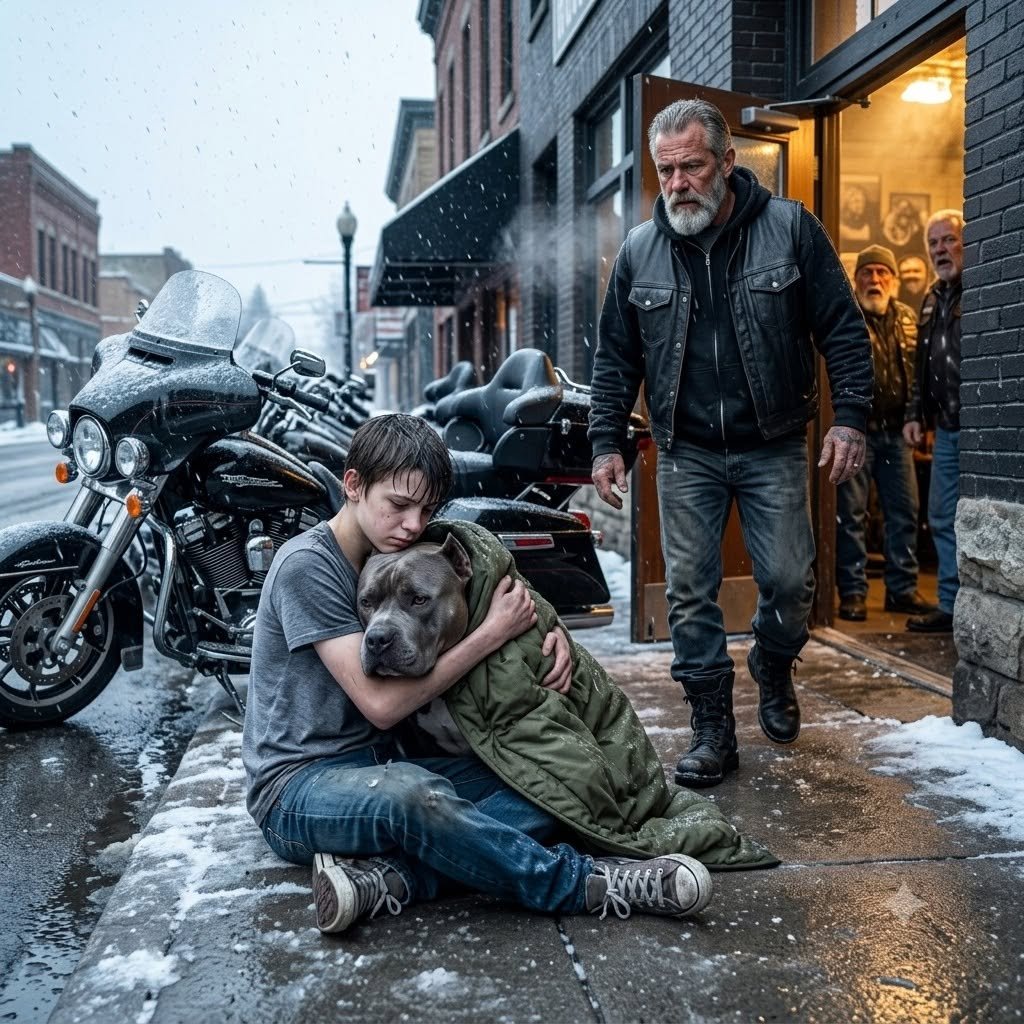
The Boy Who Gave His Coat to a Freezing Dog — and the Hundred Bikers Who Stood Between Him and the State
I had been homeless for ninety-seven days when I gave away the only winter coat I owned. Not to another kid. Not to an old man. To a dog tied outside a biker clubhouse in downtown Helena, Montana. That decision nearly froze me to death. By the next morning, more motorcycles than I could count had filled an entire downtown street, because strangers had decided I wasn’t going back to the place I had escaped from.
My name is Eli Turner. I was fourteen. My father had died when I was eleven, my mother had disappeared somewhere between Montana and Idaho a year later, and after that I became what the paperwork calls a ward of the state. I had been through three foster homes and two residential facilities. The last one was Brookside Youth House outside Helena. Nice name. Ugly place.
I left Brookside in August. By November, I had learned most of the rules for staying invisible. Never sleep twice in the same doorway. Never show cash. Never let anybody see where you hide your backpack. Stay away from drunk people after midnight. And above all, don’t attract attention from cops, security guards, or men wearing motorcycle-club patches.
That Tuesday afternoon, freezing rain started falling over downtown Helena. I was sitting behind a closed furniture store with my back against a refrigerator box that had already turned soft from the rain. My shoes were soaked. My socks were worse. Across the street stood a windowless brick building called The Foundry. Everybody knew it belonged to the Iron River Riders. Heavy motorcycles lined the curb, and I normally gave the place half a block of extra space.
Then I saw the dog. He was tied to a parking post beside a huge black motorcycle. Brown-and-gray bully mix. Broad head. Short coat. No shelter. The rain had turned to sleet, and ice was collecting along his back. He was shaking so hard his collar rattled against the post. I told myself to keep walking. That dog belonged to somebody inside. Somebody large.
Then the dog stopped trying to stand. That scared me. I crossed the street. “Hey, buddy.” He lifted his eyes but not his head. I tried the leash clasp. Frozen solid. I hit it with my palm, pulled, twisted — nothing. The wind cut through my jeans. I looked toward The Foundry’s steel door, twelve steps away, warm light glowing around the edges. But going inside seemed more dangerous than freezing outside.
So I did the only thing I could think of. I took off my coat. It was ugly. Army green. Too big. Torn lining. But it was heavy canvas, and until that moment it was the most valuable thing I owned. I wrapped it around the dog, sat in the gutter beside him, pulled his body against my chest, and used myself as the rest of the blanket. At first I shook harder than he did. Then something worse happened. I stopped shaking.
I didn’t know enough about hypothermia to understand that was bad. I just felt tired. Really tired. I closed my eyes. A metal door slammed. I heard boots. Then a man said: “What the hell?” I opened my eyes. A biker stood over me. Mid-fifties. Gray beard. Black leather vest. Hands like construction tools. His expression changed when he saw the dog. “Atlas?” The dog thumped his tail once.
The man looked at my coat around Atlas. Then at my wet T-shirt. “You did this?” I tried answering. My teeth wouldn’t cooperate. “The clip… froze.” That was all I got out. He didn’t ask anything else. He ripped the frozen clasp loose, grabbed me under both arms, and hauled me upright. My knees folded. He caught me. “Jesus, kid.” Then he dragged me — and Atlas — inside.
The Foundry went silent. Six bikers turned toward us. I expected questions. Maybe threats. Instead somebody shouted for towels. A giant bald man cut my wet shoelaces because my fingers couldn’t untie them. Someone put my feet into warm water. Another biker dropped a sweatshirt over my head so large the sleeves hung past my hands. They gave me hot broth. Then burgers. Three of them. I ate like somebody might change their mind and take the plate away. Nobody did.
The biker who found me sat across the booth. His name was Grant Mercer. Road name: Brick. Atlas was his dog. “Where’s home?” he asked. “Don’t have one.” “Parents?” “Dad’s dead.” “Mom?” I shrugged. “Don’t know.” “You in foster care?” I stopped eating. That told him enough. Eventually I told them about Brookside. About staff ignoring things after lights-out. About the night supervisor who liked frightening smaller kids when nobody important was watching. About leaving after I finally fought back.
Nobody gave me one of those sad adult faces. Brick just asked: “How long outside?” “Ninety-seven days.” His jaw tightened. Atlas put his huge head on my knee. For the first time in months, I fell asleep somewhere without keeping one shoe on. I woke the next morning wearing dry sweatpants, thick socks, and brand-new work boots sitting beside the booth. Then somebody knocked on the steel door. Three sharp hits.
A woman from Montana Child and Family Services stood outside with a police officer. She had a clipboard. Of course she did. “Eli Turner is in state custody,” she said. “He needs to come with us.” My stomach dropped. Brick stepped between me and the door. “He says the facility you want to return him to isn’t safe.” “That complaint is under internal review.” “Then take him somewhere else.” “That decision isn’t yours.” I stood behind Brick. Atlas pressed against my leg.
The officer looked tired. “Don’t make this difficult. We’ll have an emergency order within the hour.” I knew how this ended. Back seat of a government SUV. Another intake room. Another locked door. I whispered: “I’ll go.” Brick turned. “No.” “I don’t want you guys arrested.” He looked almost offended. “We bought you boots.” I stared at him. “So?” “So you don’t run away in brand-new boots before breakfast.” Then the woman outside said: “We’ll return with the proper order.” The door closed. I looked at Brick. “You can’t stop the state.” He picked up his coffee. “No.”
Then the floor began vibrating. At first I thought a snowplow was passing. Then came the engines. One after another. Dozens. Then hundreds. I stepped outside. Motorcycles were pouring into downtown Helena from both directions. Black bikes. Chrome. Leather. Riders from Montana, Idaho, Wyoming, Washington.
They parked along both sides of the street. Then more arrived. And more. Nobody shouted. Nobody threatened anybody. They simply stood there — hundreds of bikers in freezing slush. Atlas sat beside me. Brick put one heavy hand on my shoulder. Across the street, three police vehicles stopped, and the woman with the clipboard stepped out again. Staring at that wall of motorcycles, I realized something terrifying: for the first time in my life, people had shown up because somebody was trying to take me away.
The woman walked toward Brick with a sheriff beside her. I couldn’t hear everything, but I heard Brick say one sentence loud enough for the whole street: “Nobody here is breaking the law. We are watching. All of us.” Then, very quietly, he said something else that made the sheriff nod: he had called a lawyer in the middle of the night — a biker’s wife, a family attorney — and she had filed an emergency petition for temporary guardianship before the sun came up.
There was a hearing three days later. Brick stood before a judge and said he was a sixty-two-year-old grandfather with a clean record, a paid-off house, a spare bedroom, and thirty years as a diesel mechanic. Seventy-three bikers had signed letters vouching for him. The state argued a single older man with motorcycle-club ties was not a suitable placement.
Then the judge asked me one question: “Eli, where do you feel safe?” And I said: “The night I froze in a gutter, a dog’s owner brought me inside, fed me, and bought me boots before I woke up. Nobody at Brookside ever did one of those things.” The courtroom went quiet. The judge granted Brick temporary guardianship and ordered a full, independent investigation of Brookside Youth House.
The investigation confirmed everything — and worse. Brookside was shut down within four months. Two staff members lost their licenses. The county sent Brick a letter saying my account had “substantially contributed” to the closure. Brick taped it to the fridge and told me to read it whenever I felt the system had beaten me. I never did feel that way again.
Life with Brick was not what I expected. He made me go to school, eat breakfast, wash dishes, mow the lawn, and learn the difference between a socket wrench and a torque wrench. The first week a counselor asked what my hobbies were, and I almost laughed — for three months my hobby had been not freezing.
Atlas became my shadow. Brick said the dog had been his late wife’s idea — a rescue nobody wanted, who turned out to be the gentlest animal in three counties. Dogs know. They always know who the kind ones are.
Six months later, Brick asked if I wanted to keep the last name Turner or take his. I thought about my father, who died when I was eleven. “Turner,” I said. “He’d like that I kept it.” Brick nodded. “Then you’re Eli Turner, and this is your house, and that’s the end of that conversation.” He never asked me to be grateful. He only asked me to pass it on.
Years have passed now. I graduated high school and work in Brick’s garage, where Atlas used to sleep under the workbench. Every winter, the Iron River Riders run a coat drive for homeless kids in Helena, and I organize it. I tell the volunteers the same thing Brick told me that first morning, and I say it like a law: nobody runs away in brand-new boots before breakfast. And if you ever find a shivering dog tied to a parking post in the sleet — take off your coat. It’s worth it. Trust me. I know.

