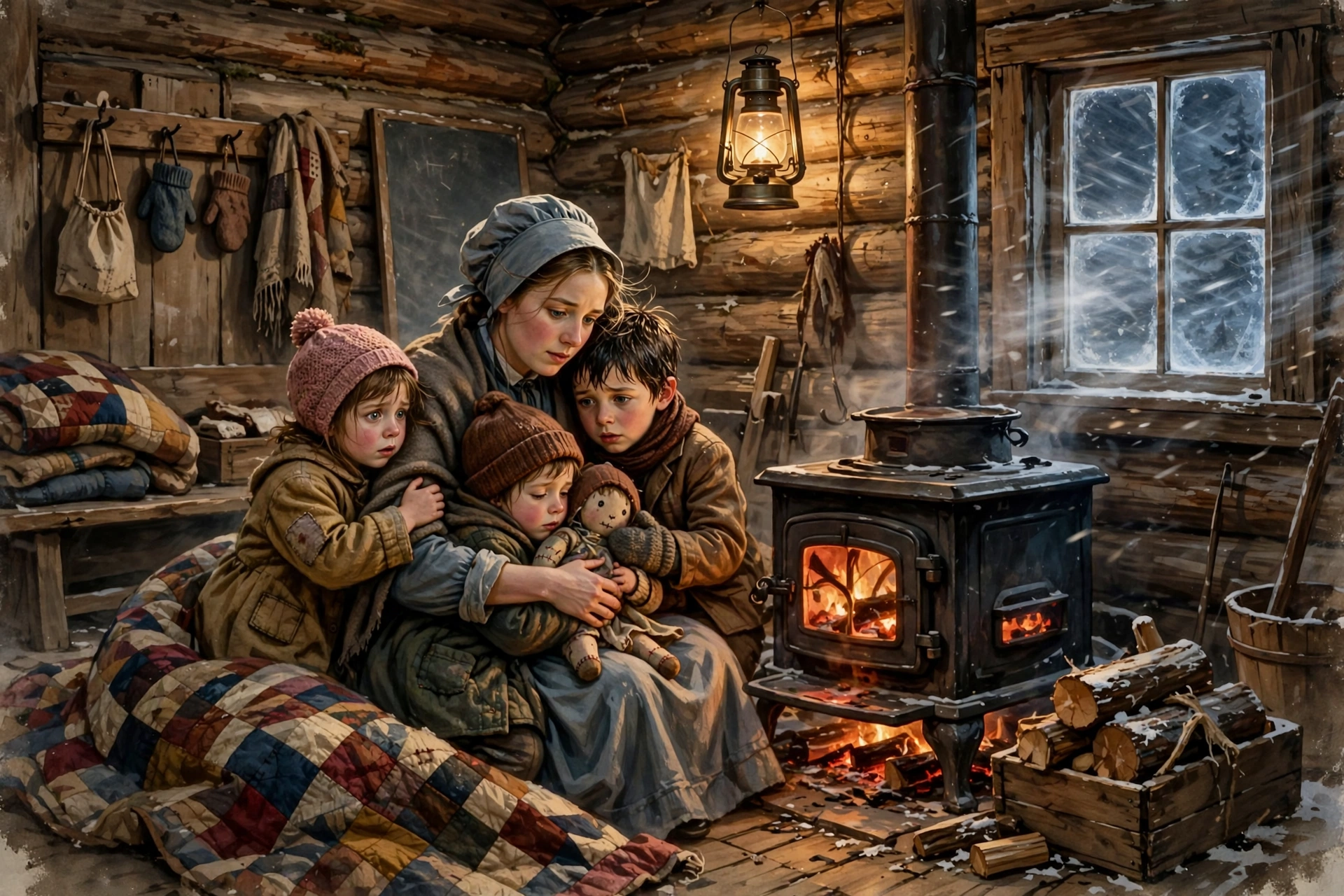
The schoolhouse bell at Cottonwood Hollow rang at half past eight on the morning of February the third, 1879, and no one in Montana Territory rang it again for a long, long while.
Margaret Ellison was twenty-two years old, the new schoolmarm from St. Louis, and she had twelve children at her desks that morning — the Baker twins, the three Okafor boys, little June Peterman, who was only six, and six others whose names she whispered under her breath every night so she wouldn’t forget a single one. The sky outside had been a flat, milky white all morning, the kind of sky her grandfather had warned her about back in Missouri. “A white sky on the plains,” he’d told her, “means the devil is drawing his breath.”
She had come west the previous spring with a carpetbag, a teaching certificate, and a letter of introduction from a church committee that had never set foot west of the Mississippi. The ranchers of Cottonwood Hollow had built the schoolhouse themselves from cottonwood logs, and they paid her in flour, salt pork, and six dollars a month. She had never been colder, poorer, or happier in her life.
The morning lessons went as they always did. The older boys stumbled through their arithmetic on the slate board. Little June read aloud from the McGuffey reader in her small, careful voice, and the whole room went quiet to listen, the way it always did, because June had the prettiest reading voice Margaret had ever heard. Outside the window, the first flakes began to fall — fat, lazy things that the children watched with delight, pressing their noses to the glass.
By ten o’clock, the devil exhaled.
The blizzard came down the valley like a wall of grinding teeth. Margaret had never seen snow fall sideways before. The wind found every crack in the little log schoolhouse and screamed through it, and within an hour the drifts had swallowed the path to the door. She did the only sensible thing she could think of: she closed the shutters, stoked the potbelly stove until it glowed, and told the children to gather close and tell stories while she prayed.
On the second night — no, it was the third day; she had lost count by then — the roof gave out.
She remembered the sound more than anything else: a deep, wounded groan from the beams, and then the whole center of the roof simply sank, dumping a ton of packed snow onto the reading corner. Only by God’s grace did it miss the little ones. But the stove’s chimney pipe bent sideways, smoke began backing into the room, and Margaret understood with cold clarity that if she didn’t move those children into the lean-to woodshed behind the school, they would all suffocate where they sat.
The woodshed was smaller than a jail cell. Twelve children and their teacher, packed shoulder to shoulder on a bed of split logs, while the wind tore the rest of the schoolhouse apart plank by plank. Margaret stripped her own coat and laid it over little June, whose teeth were chattering so hard Margaret feared they’d shatter. She led them in every hymn she knew. When the hymns ran out, she told them stories — the tale of the rabbit who outsmarted the bear, the story of her own grandmother crossing the Missouri River in a spring flood. The children’s voices grew thinner, then fainter. Somewhere in the second night, Thomas Okafor, the eldest at fourteen, stopped shaking, and Margaret — knowing that stillness in the cold was the most dangerous thing of all — shook him awake and made him slap his own arms until he cursed at her, and she wept with relief to hear it.
Somewhere in the dark hours of the second night, the smallest Baker twin began to cry for his mother, and Margaret held him against her chest and sang the lullaby her own mother had sung to her, the one in the old language her grandmother had brought across the ocean. The other children joined in, humming what they could, and for a little while the shed was warm with something no blizzard could touch.
By the third morning, the firewood was gone. Margaret burned her own desk first, then the benches, then the bookshelf, feeding the little stove slat by slat like a miser counting coins. Thomas Okafor, the eldest boy, tried to help her break the wood, and she saw his hands were white at the fingertips and made him sit back down and breathe on them. The last thing she had left to burn was her grandfather’s Bible, the one with the silver clasp, and she stood there holding it in both hands while June Peterman watched her with enormous eyes.
“Miss Margaret,” June whispered. “God won’t mind. He knows we’re cold.”
Margaret put the Bible down. She couldn’t do it. Instead she burned her own trunk — her letters from home, her mother’s wedding quilt wrapped around her shoulders for warmth first, and then, at last, fed to the flames one square at a time.
And then, in the grey hour before dawn on the fourth day, when she was sure they were going to die quietly in that shed and be found in the spring like stones in a field, she heard it: a horse’s scream, and a man’s voice shouting her name.
She clawed the shed door open, and a wall of white light poured in, and through it came a man on a frost-crusted mule, half-frozen himself, dragging a sled loaded with blankets and a sack of coal. He stumbled to her, pulled back his scarf, and Margaret’s knees went out from under her.
It was Daniel Crow.
Daniel Crow had been her father’s ranch foreman back in Missouri, twenty years her senior, the man who had taught her to ride and told her stories of the frontier at the kitchen table. Eight years before, he had left their ranch in the night after a bank robbery in the county — a robbery everyone swore he had helped plan. Margaret’s father had died believing his best friend was a thief. Margaret had believed it too. She had carried that betrayal across the country like a stone in her boot.
“Miss Margaret,” Daniel said, his voice breaking, wrapping a blanket around her shoulders. “I never touched that bank money. I ran because I was the only witness against the sheriff’s own brother, and they would have buried me in the river. I spent eight years clearing my name in courtrooms in three territories. I came west looking for you because your father’s last letter said you’d gone to Montana — and I rode three days through this storm because a freighter told me the schoolhouse had gone quiet.”
He had ridden a dying mule through a killing blizzard, following nothing but a rumor and a debt he felt he owed a dead man. Later, the children would tell how his coat was frozen stiff as a board, how ice hung from his beard like chandelier glass, how his hands were so numb he couldn’t unbuckle the sled straps and Thomas Okafor had to do it for him with his teeth.
Margaret knelt in the snow beside him and wept — not from cold, but from the shame of it, eight years of believing the worst of the one man who had never once lied to her. Daniel only shook his head. “Your father knew the truth before the end, Miss Margaret,” he said gently. “He wrote it in that last letter. He asked me to look after you if ever you needed it. I reckon this counts.”
One by one, the children were loaded onto the sled, wrapped in the blankets Daniel had somehow carried. Twelve children — for on the second night, old Widow Halvorsen’s boy, who had walked to school that morning from the far claim, had slipped into the shed with the rest — twelve children, alive. Frostbitten, starving, but alive.
Daniel Crow stayed with them in the wreckage of the schoolhouse for two more days until the storm broke and the ranchers could get through with wagons. And when the county men finally arrived, Daniel handed them the court papers he’d carried in an oilskin pouch against his chest for two thousand miles — proof, signed and sealed, that he was an innocent man.
The schoolhouse was rebuilt by spring, with a stronger roof and a stone chimney, and the children of Cottonwood Hollow painted the bell bright red. Daniel Crow never left the valley again. He took work as the school’s caretaker and handyman, and every winter morning he was the first one there, stoking the stove before the children arrived, checking every beam in that roof with his own two hands.
And Margaret — she learned that sometimes the people we bury in our hearts aren’t dead at all. They’re just riding toward us through a storm, carrying blankets.