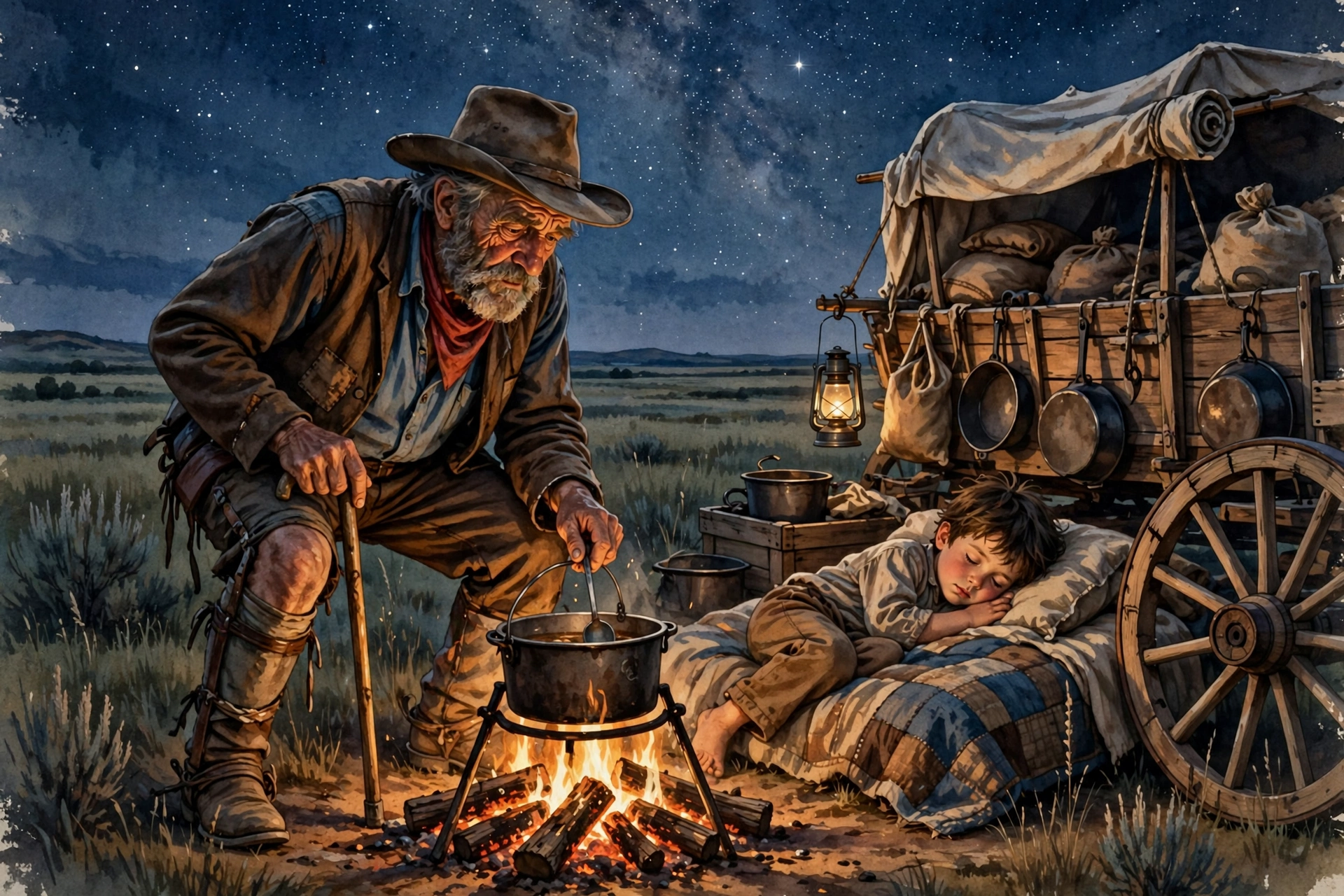
Walt Brannigan had cooked for the Circle Bar Ranch for thirty years, and the cowhands said his biscuits could break a tooth and his temper could break a man. At sixty-eight, with a limp from an old bronc wreck and a vocabulary made mostly of grunts, Walt believed in exactly three things: strong coffee, a hot fire, and minding his own business.
The spring drive changed all of that. Crossing the rain-swollen Rio Blanco, the Circle Bar herd spooked at a lightning strike and stampeded straight through the water. In the chaos, a supply wagon overturned — and Tommy Rourke, the young wrangler driving it, was crushed beneath it. Tommy had been a widower; his wife had died of fever two winters before. That left nine-year-old Danny Rourke an orphan before sundown.
The ranch owner, a hard man named Cole Bennett, had no use for orphans. “County home in Santa Fe,” he told the foreman at the graveside. “The boy goes out on Friday’s freight wagon.” Danny stood by his father’s fresh grave with dry eyes and a jaw set like stone, and Walt — who had never so much as patted a child’s head in his life — felt something crack open inside his chest like an egg on a hot skillet.
That night, Walt did something he had never done in sixty-eight years: he disobeyed. He led Danny to the old storage shed behind the cookhouse, spread a bedroll on the flour sacks, and told him, “You stay quiet as a mouse in church, you hear? Anybody asks, you’re my nephew from El Paso, come to learn the trade.” Danny nodded, and for the first time since the river, he cried — silently, into Walt’s spare apron.
For two years, the secret held. Danny became Walt’s shadow — up before dawn to stoke the fire, learning to flip flapjacks, riding along in the chuckwagon on the short drives. The hands called him “the Biscuit Kid” and asked no questions; on a ranch, a boy who works hard earns the right to be left alone. Walt taught him to read from an old mail-order catalog, and to pray the way Walt’s own mother had taught him, kneeling by a cookfire under the stars.
Walt had never had a family of his own. He had given his life to the Circle Bar — to other men’s cattle and other men’s sons. But at night, when Danny fell asleep on the cot beside the stove with flour in his hair, Walt would sit a long while in the dark, listening to the boy breathe — and he understood, at sixty-eight, what fathers must feel when they look at their sons.
Then came the morning Danny fell from the hayloft and split his forehead open. Walt carried him to the ranch house shouting for the doctor — and as he pressed a cloth to the boy’s head, the string around Danny’s neck broke, and a small brass locket fell onto the floorboards. Walt had never seen it before. Danny had kept it hidden, even from him.
Inside the locket was a tiny tintype photograph of a young woman with Danny’s own dark eyes — and folded behind it, a letter in a woman’s hand, worn soft from years of reading. Walt read it by lamplight that night while Danny slept with a bandaged head, and the words turned his blood to ice water.
The letter was from June Hollis to her son. June — the only daughter of Hattie Hollis, the iron-willed widow who owned the Diamond H, the great ranch bordering the Circle Bar to the north. Twelve years ago, June had run off with a penniless wrangler named Tommy Rourke. Hattie had disowned her in a fury. The letter said June was dying of fever, and begged whoever raised her boy to know that he was loved — and that he was the heir to the Diamond H.
Walt sat by the stove until the fire went cold. Hattie Hollis had spent a fortune on detectives — every hand in the territory knew it — searching for her daughter’s child, the grandson she believed had died with June in a fever camp across the border. The Diamond H, ten thousand acres and the finest water in the county, was waiting for an heir who was sleeping three feet away, drooling on Walt’s spare pillow.
For a week, Walt told no one. He watched Danny — his Danny, the Biscuit Kid, who liked his flapjacks burned on one side and who had finally started laughing again — and he imagined two futures. In one, he kept the secret, and the boy grew up a cook’s helper with flour in his hair and no name of his own. In the other, he lost him.
“You’re awful quiet, old man,” Danny said one evening, scrubbing pots beside him. “Is it the locket? Mama said never to show it. She said bad men would come.” Walt’s throat closed up. “Your mama was a smart woman,” he said hoarsely. “Walt? Am I in trouble?” “No, son,” Walt said, and the word son nearly broke him in two. “But I’ve got some thinking to do.”
On Sunday, Walt did the thing he least wanted to do: he saddled up and rode to the Diamond H. Hattie Hollis received him on her porch — seventy-five years old, straight as a fence post, eyes like chipped flint. Walt laid the locket on the table between them and told her everything, his voice cracking like green wood in a fire.
Hattie picked up the locket with hands that trembled for the first time in anyone’s memory. She opened it, saw her daughter’s face, and made a sound like a wounded animal. “Twelve years,” she whispered. “Twelve years I paid men to find this child. They told me he died with her.” She looked up at Walt, tears cutting clean lines through the dust on her cheeks. “Where is he?”
“At the Circle Bar,” Walt said. “He’s mine — I mean, he’s been with me. Two years. He’s a good boy, ma’am. He can cook, he can ride, he reads better than half my crew.” He swallowed hard. “He’s the heir to all this. I know what I have to do. I just came to ask — to ask you to be gentle with him at first. He’s lost everybody twice already.”
Hattie Hollis studied the old cook for a long moment. Then she did something no one in the territory had ever seen her do: she took his rough, burned hand in both of hers. “Mr. Brannigan,” she said, “you kept my grandson alive and taught him to laugh again. The Diamond H can wait for its heir. But that boy —” her voice broke — “that boy cannot wait one more day for his grandmother.”
They rode back together at sunset. Danny saw the strange old woman climbing down from the buckboard and hid behind Walt’s apron — until Hattie knelt in the dust, opened the locket, and said, “Your mama was my June. She had your eyes and your stubborn chin. I’ve been looking for you since before you can remember.” Danny stared, then slowly stepped forward. Hattie held him like she would never let go.
That night, Walt packed his bedroll, his Dutch ovens, and his broken heart, and told Danny the Diamond H needed its heir and a cook needed his kitchen. But at dawn, Hattie Hollis was waiting at the cookhouse door with a proposition no gruff old man could refuse. “The Diamond H has the biggest kitchen in the territory and no cook fit to run it,” she said. “The quarters by the garden are empty. And that boy — he told me last night he won’t go without his Walt.”
So Walt Brannigan became the cook of the Diamond H, with a room by the garden and a grandson — in every way that mattered — sleeping just down the hall. Hattie signed the papers making Danny her heir, and on the line marked “guardian,” she wrote two names: her own, and Walt’s. “A boy ought to have a grandmother,” she said gruffly. “And it seems he’s already gone and got himself a grandfather.”
Years later, when Danny Hollis — for so the territory came to know him — took over the Diamond H, the finest ranch in the county, he kept one thing from the old days hanging in the great kitchen: a dented tin coffee pot, and beneath it a small wooden sign Walt had carved. It read: FAMILY AIN’T ALWAYS BLOOD. SOMETIMES IT’S WHO SHOWS UP WITH SUPPER. And every hand on the ranch knew it was true.