Eli Sanderson had driven a stagecoach for thirty-one years, and he could read a man’s history in the way he held his hands — on a rein, on a door handle, on a hymn book. At seventy-one, retired to a small adobe house at the edge of Copper Wells, Arizona Territory, he spent his mornings on the porch with coffee, watching the town he had helped build rattle past in wagons and on horseback.
Twenty-two years earlier, on a moonless night in Rincon Pass, Eli’s stage had been stopped by three masked riders. They took the strongbox with twenty thousand dollars in mining payroll. His shotgun guard and dearest friend, Pete Callahan, had ridden beside him that night — and Pete had been shot dead in the first minute of the robbery, before he ever raised his scattergun.
Eli never got over it. He had replayed that night ten thousand times: the whistled signal from the rocks, the leader’s low laugh as he lifted the strongbox, the single pistol shot that took Pete. The territory rangers never caught the gang. Eli’s driving days ended two years later when his hands gave out, but the guilt rode with him every day like an extra passenger.
That was why he nearly dropped his coffee cup at the Founder’s Day picnic that August afternoon. The town’s most respected citizen, banker Amos Rutherford, had just told a joke at the church social table — and laughed. Eli knew that laugh. He had heard it in the dark in Rincon Pass, twenty-two years ago, coming from behind a black bandana.
Eli told himself he was an old fool with a rattling memory. But then he watched Amos Rutherford’s hands as the banker sliced pie, and his blood went cold. The little finger of the banker’s left hand was missing its tip — bitten off, the ranger had said back then, by one of the horses in the struggle that night. The outlaw leader had lost a fingertip in Rincon Pass.
For three weeks Eli watched. He stood across the street from the Copper Wells Bank and watched Amos Rutherford greet farmers by name, approve loans for young couples, slip coins to barefoot children. Every kind act looked, to Eli, like a mask. And one evening, passing the bank at dusk, he heard the banker humming through the open window — the same mournful trail tune the masked leader had hummed while his men tied up the passengers. Eli’s hands shook so hard he had to sit down on the boardwalk.
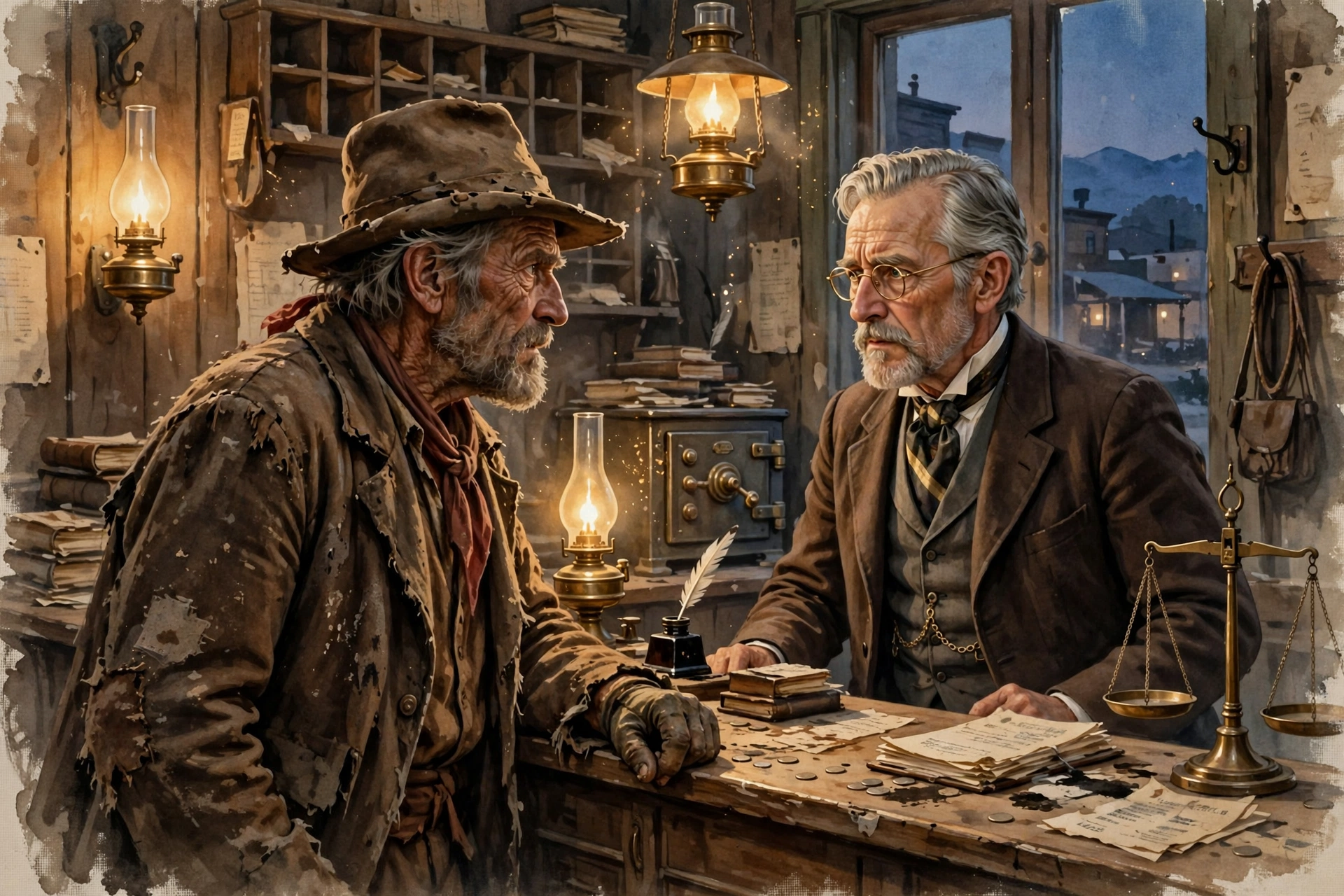
He waited until a Friday evening, when the bank was empty and the lamps were being turned down. Eli walked in with his old driver’s shotgun — unloaded, though Amos didn’t know that — and closed the door behind him. “Rincon Pass,” Eli said. “Twenty-two years ago. Take off the mask, Amos.”
The banker went white as flour. He didn’t reach for the bell under his counter. He didn’t call out. He just sat down slowly in his chair, the way a man sits when the last of his strength has gone out of him. “Pete Callahan’s friend,” he whispered. “The driver. I wondered if you’d ever come.”
“You killed him,” Eli said, and the words came out like stones. “You laughed while you did it.” Amos Rutherford closed his eyes. “I never laughed at Pete,” he said quietly. “God forgive me, Eli — I never laughed at all that night, except to keep my own nerve from breaking. And I never meant for a shot to be fired.”
Then the banker told him the truth, and it was not the truth Eli had carried for twenty-two years. Amos had not been a road agent by trade. He had been a railroad clerk in Tucson, watching the railroad’s land agents cheat homesteader families out of their savings with forged deeds. Forty families were about to lose everything. Amos stole the payroll money — the railroad’s money — to buy back their land notes before the evictions began.
“I hired two desperate men to ride with me,” Amos said. “I told them no shooting — those were my exact words. But one of them, a hothead called Dutch, panicked when Pete reached for his gun. The shot was never part of my plan, and I have heard it every night since, in my sleep, for twenty-two years.”
Eli’s finger tightened on the shotgun. “Pete’s widow raised three children washing other folks’ clothes,” he said. “What did your stolen money buy you? This bank? This fine house on the hill?” Amos opened his desk drawer and laid a leather ledger on the counter. “It bought me this,” he said. “Open it.”
The ledger held twenty-two years of entries in Amos’s neat clerk’s hand: drafts and money orders sent anonymously — to the railroad families whose notes he had bought back, and then, page after page, to Pete Callahan’s widow. Every quarter, for twenty-two years. “Her mortgage is paid,” Amos said softly. “Her youngest is in teachers’ college in Prescott. I never signed a single one.”
Eli stared at the columns of figures until they blurred. “Why?” he managed. Amos pulled up his left sleeve. High on his shoulder was an old bullet scar, puckered and white. “Because when Dutch fired, I threw myself between him and Pete. I was too late — God knows I was too late — but I took Dutch’s second bullet in the shoulder. That is why I never raised my own gun that night. I was already bleeding.”
“Then why not confess?” Eli demanded. “Why let this town make a hero of you?” For the first time, Amos’s voice broke. “Confess to what? That the bank holding every family’s savings in Copper Wells was founded by a robber? The bank would fail. The depositors would lose everything. I decided to serve my sentence in silence — paying back, dollar by dollar, everyone that night ever harmed.”
Eli lowered the shotgun. The rage that had carried him across the street had nowhere left to stand. “Pete would have hated this,” he said at last. “Not the robbery — the silence. He always said a man ought to own what he’s done.” Amos nodded slowly. “Then let me own it now. To you. Do what you think is right, Eli. I’ll not run.”
Eli looked at the old man across the counter — at the scarred shoulder, the missing fingertip, the ledger full of quiet restitution — and thought of Pete Callahan laughing beside him on the box seat, twenty-two years gone. “Pete’s youngest girl,” he said slowly. “She’s marrying a railroad surveyor next month. They need a house.” He slid the ledger back across the counter. “You’ll buy it for them. Anonymously. And you’ll fund the new schoolhouse — and you’ll put Pete Callahan’s name over the door.”
Amos Rutherford wept then, openly, like a child. “And you’ll let me?” he whispered. Eli set the shotgun down. “I’m seventy-one years old, Amos. I’ve carried Rincon Pass long enough. Pete’s gone, but his name can still do good in this town — and so can you, if you keep paying.” He held out his hand. After a long moment, the banker took it.
The schoolhouse went up that spring, with PETE CALLAHAN SCHOOL painted over the door in gold letters. Amos paid for every brick and never told a soul why. And when the school needed someone to drive the children’s wagon each morning, Eli Sanderson — who hadn’t held reins in twenty years — climbed back up onto the box seat, his old hands steady for the first time in decades.
People in Copper Wells still speak of Amos Rutherford as the finest banker the territory ever knew, and they are right — though not for the reasons they think. And if you ask Eli Sanderson what he learned in Rincon Pass, he’ll tell you this: gold is heavy to carry, but forgiveness is heavier — and it is the only load that ever gets lighter the longer you carry it.