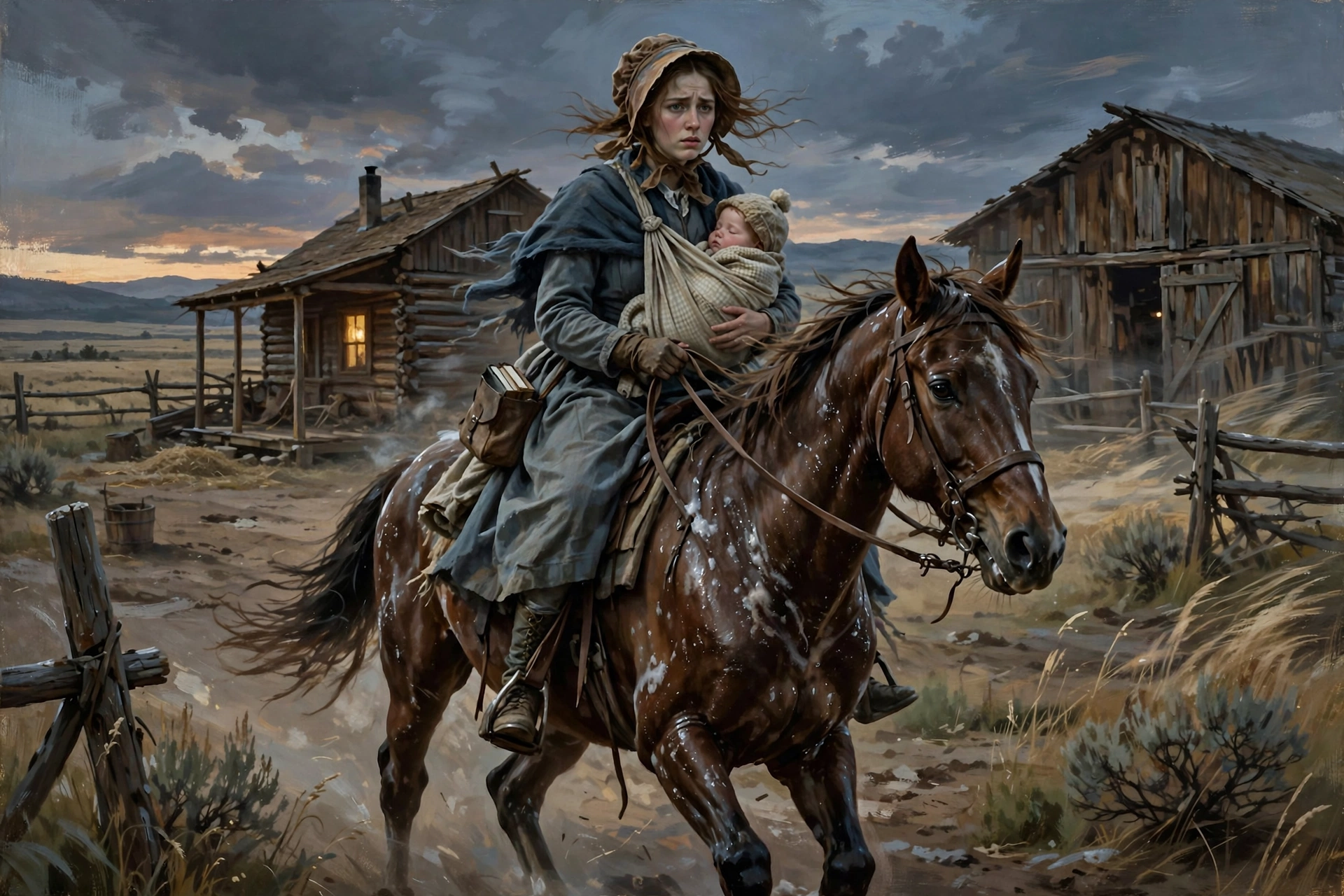
The dust of the Wyoming Territory had barely settled behind her when June Calloway rode into the yard of the Broken Spur Ranch, a six-month-old baby tied against her chest in a flour sack sling, and every ranch hand on the place stopped what he was doing to stare.
It was October of 1879, and the wind coming off the Laramie range had teeth in it. June’s horse was lathered and trembling, her own face gray with exhaustion, and the baby — mercifully — was asleep, one tiny fist curled against the collar of her coat.
The screen door of the ranch house banged open, and Silas Brennan stepped onto the porch with a Winchester in the crook of his arm. He was sixty-two years old, weathered down to gristle and bone, and the look he gave her could have frozen water. “State your business,” he said. “And make it quick.”
June dismounted slowly, her legs nearly buckling under her. She lifted her chin. “My name is June Calloway, Mr. Brennan. I was the schoolteacher with the Harlan wagon train. This —” she touched the baby’s downy head gently — “this is Eli. He’s your grandson.”
Silas did not move. For a long moment the only sound was the wind worrying the cottonwoods. “My son Caleb’s boy,” June went on, her voice steady though her hands shook. “Caleb and his wife Nora were killed three weeks ago when the train was attacked at the Sweetwater cutoff. I pulled Eli from the wreckage of their wagon. I promised Nora —” her voice cracked — “I promised her I’d bring him to his kin.”
Something flickered in the old man’s face, too fast to name. Grief, maybe. Or fury. “Bury him with his folks, then,” Silas said at last, turning back toward the door. “I got no use for a baby. Ranch ain’t no place for one.”
“Please.” The word tore out of June before she could stop it. “He’s all that’s left of your son. You can turn me away — but don’t turn away from him.”
Silas stopped with his hand on the doorframe. He did not turn around. “Bunkhouse,” he said roughly. “One night. You ride out at dawn.”
That night, June lay awake in the cold bunkhouse with Eli fretful against her shoulder, and through the thin wall she could hear Silas Brennan pacing the ranch house like a caged animal. Every small cry the baby made seemed to strike the old man like a blow. June knew that sound — she had heard it in her own chest for three weeks. It was the sound of a heart trying not to break.
By morning, something had shifted. Silas watched from the porch as June fed Eli warmed milk from a tin cup, and his gaze kept drifting to the baby’s face — to the unmistakable Brennan chin, the same cowlick Caleb had been born with. “He favors him,” Silas muttered, almost against his will. Then, louder: “You can stay till the boy’s stronger. That’s all.”
The ranch foreman, Deke Mallory, watched June with narrow eyes from the moment she arrived. He was a big man with a silver spur on his left boot shaped like a coiled rattlesnake, and something about the way he looked at the baby made June’s blood run cold — because she had seen that spur before, glinting in the firelight, on the night the wagon train burned.
June had told no one what she truly remembered about the attack. The raiders had not come for horses or supplies. They had gone straight for Caleb Brennan’s wagon — for the iron strongbox bolted beneath the seat, which held the deed to the Broken Spur’s water rights, the most valuable paper in the county. And the man who had put a torch to the canvas had worn a rattlesnake spur.
For days June wrestled with her fear. Deke Mallory was Silas Brennan’s right hand, trusted for a decade. Who would believe a strange woman’s word against his? But each evening, watching Silas carve a tiny wooden horse for Eli by lamplight, pretending gruffness while the baby gripped his finger, her resolve hardened. The truth was a debt she owed Nora.
On the fourth night, she found Silas alone in the barn and told him everything — the strongbox, the deed, the spur in the firelight. She expected disbelief, even anger. Instead, the old man’s face went white beneath his weathering. “Rattlesnake spur,” he repeated softly. “Deke’s had that spur twelve years.” He was quiet a long time. Then: “You and the boy leave at dawn. I’ll settle this.”
But Deke Mallory was already settling it himself. Near midnight, June woke to the smell of smoke and the baby screaming — the barn was ablaze, and through the roaring orange light she saw Deke dragging a strongbox of ranch papers toward the flames. Without the deed records, he could claim the water rights were never Brennan’s at all.
June did the only thing she could. She wrapped Eli tight, ran barefoot across the yard, and seized the iron triangle by the well, beating it until the whole ranch rang. Men came pouring from the bunkhouse in their long johns as Silas burst from the house with his Winchester — and found his foreman of ten years feeding the ranch’s future to the fire.
What happened next, the hands talked about for years. Silas walked into the burning barn without hesitation and leveled the rifle at Deke’s chest. Deke drew his revolver — too slow. One shot from Silas took the gun spinning from his hand, and by the time the others dragged Deke out and bound him, the deed box had been kicked clear of the flames, scorched but intact.
At dawn, two hands rode Deke into town in chains to wait for the territorial marshal. He would hang for the Harlan train murders; everyone knew it. Silas stood in the ruined doorway of his barn, the saved deed in his hands, and for the first time since June had arrived, the old man wept — great silent shaking sobs, for the son who had died protecting his family’s future, and for the ten years he’d trusted the man who killed him.
June packed her saddlebags that morning, certain her welcome was spent. But when she carried Eli out to her waiting horse, Silas was standing in the yard — holding a cradle he had built through the night from barn pine, the name ELI BRENNAN burned into the headboard with a hot iron. “That boy needs a mother,” he said gruffly, not meeting her eyes. “And this ranch needs somebody who ain’t afraid of the truth, even when it costs her. Stay.”
Spring came late to the Laramie range that year, but it came. June taught the ranch children their letters in a rebuilt schoolroom, Eli took his first steps chasing chickens across the yard, and Silas Brennan — who had not smiled in three years — was heard laughing one evening when the baby pulled his hat clean off his head.
On the anniversary of the attack, Silas rode out alone to the Sweetwater cutoff and stood a long time where the wagons had burned. When he returned, he lifted Eli high against the sunset and told him about Caleb — about the boy who’d once cried over a sparrow with a broken wing, and the man who’d died with a strongbox key clutched in his fist. “He was braver than me, little one,” Silas whispered. “But I aim to be worthy of him now.”
Family, June learned on the frontier, is not only the blood you’re born to. Sometimes it’s the promise you keep to a dying woman in the firelight. Sometimes it’s an old man building a cradle through the night. And sometimes — if you’re lucky, and if you’re brave — it’s both.

