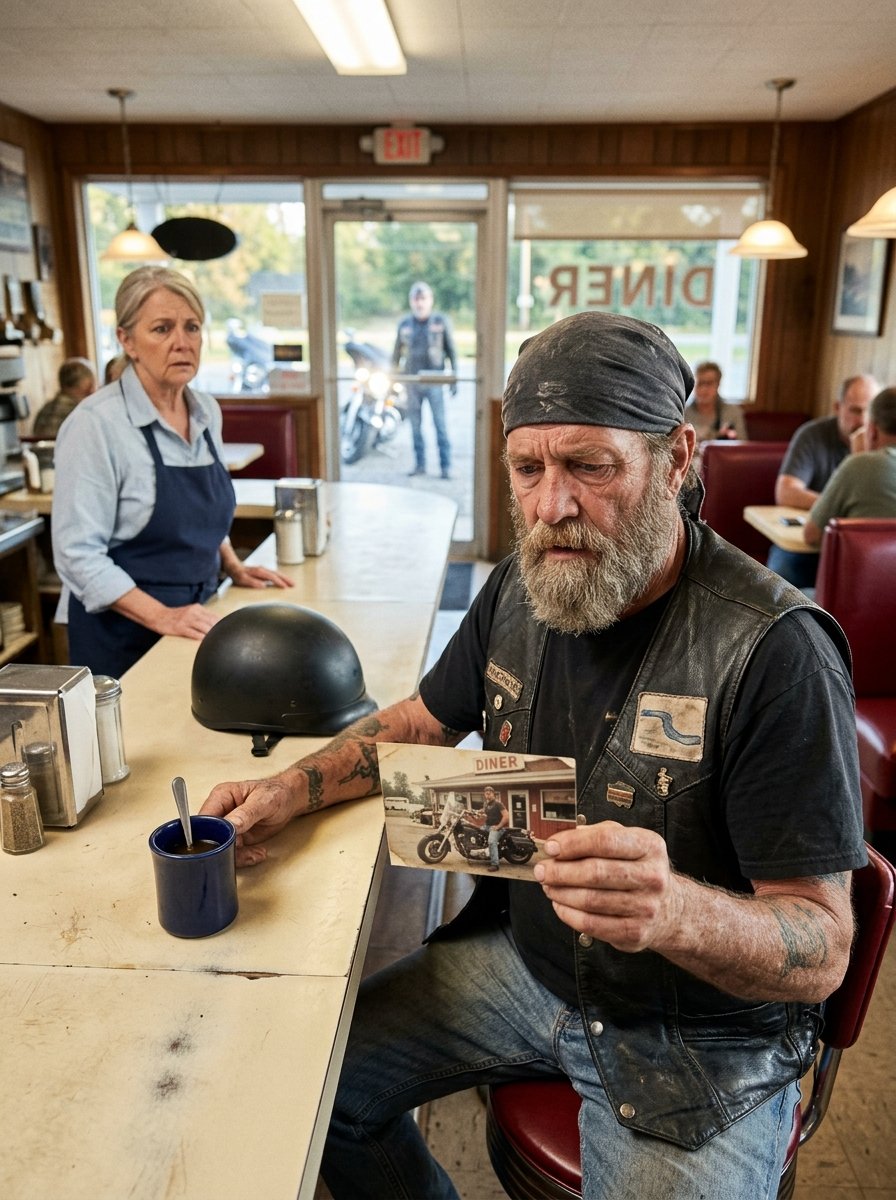
Frank Mercer kept his eyes on the locked diner door while the rider outside rested one hand on the metal handle. Behind him, three motorcycles idled in the parking lot, their headlights washing pale strips of light across the glass. Evelyn stood frozen behind the counter. Frank could hear the low hum of the coffee machine, the faint dramatic music from an old radio near the kitchen, and his own breathing. “What did Daniel get into?” he asked again. Evelyn did not answer immediately. She looked toward the rider outside, then at the inside pocket of Frank’s vest where the photograph was hidden. “Something your brother spent twenty-seven years trying to keep away from you,” she finally said.
The man at the door released the handle and stepped back. He did not knock. Instead, he raised two fingers toward Evelyn in a small gesture that looked less like a threat and more like a signal. Then he turned and walked back toward the motorcycles. Frank watched him through the window until the rider stopped beside the other two men. None of them removed their helmets. None tried to force the door. That somehow made the situation feel stranger. “You know them,” Frank said. Evelyn nodded once. “I know what they came for.” Frank touched the hidden photograph through his vest. “This?” he asked. “No,” Evelyn replied. “They came because they saw you pull into my parking lot.”
Frank slowly sat back down on the red stool. He had spent most of his adult life on motorcycles and had learned that panic made people careless. He placed both hands flat on the counter. “Start at the beginning.” Evelyn looked toward the front window again before lowering her voice. She explained that her mother, Rose Harper, had run the diner before her. Nearly thirty years earlier, Daniel Mercer had been one of a small group of riders who passed through town regularly. They called themselves the Black River Riders, not a gang, but a loose circle of mechanics, truck drivers, veterans, and road workers who spent weekends riding together. Frank had once been part of that circle too, before family problems pulled the brothers in different directions.
Frank remembered those years clearly. The Black River Riders had never been about trouble. They fixed broken-down bikes, raised money when a local family lost a home, and spent more time arguing about carburetors than anything else. But after a bitter disagreement with Daniel, Frank left the group and moved two states away. Less than a year later, Daniel vanished during a solo ride. His motorcycle was reportedly found abandoned near a river crossing. No body was recovered, but the family eventually accepted that he was gone. Frank had carried that belief for twenty-seven years. “So why was he standing outside this diner six months ago?” Frank asked. Evelyn reached beneath the counter again, but this time she removed nothing. “Because Daniel never died at that river,” she said.
Frank stared at her. Evelyn explained that Daniel had arrived at the diner late one night after disappearing. He was exhausted, soaked from rain, and riding a motorcycle Frank had never seen before. Rose Harper gave him food and let him sleep for a few hours in a storage room. Daniel told her that he needed everyone, including his own family, to believe he had disappeared. He never gave Rose every detail. He only said that someone inside the old riding circle had used the group’s charity rides to hide something far more serious. Daniel had discovered records that connected several shipments, fake invoices, and stolen property to a man everyone trusted. If Daniel went home, he believed Frank and the rest of the family would become part of the problem.
“Who?” Frank asked. Evelyn shook her head. “My mother never told me the name.” Frank’s jaw tightened. Twenty-seven years of grief suddenly felt different. For decades, he had blamed himself for the last argument he had with Daniel. Their final conversation had ended with Frank telling his brother not to call him again until he learned to stop chasing trouble. Daniel never called. Now Frank learned that the silence may have been deliberate. Evelyn continued. Daniel returned to the diner only three times over the next two decades. Each visit was brief. Each time he asked whether anyone had come looking for him. Rose always answered no. Then six months ago, Daniel appeared again.
That visit was different. By then Rose had passed away and Evelyn owned the diner. Daniel recognized her immediately. He looked older, thinner, and much more tired than the man in the stories Evelyn had heard as a child. He stayed only twenty minutes. Before leaving, he asked Evelyn to take a photograph of him outside the diner. At first she thought it was strange. Daniel insisted that the diner window and green mailbox be visible in the background. “He wanted you to recognize the place,” Evelyn told Frank. “He knew one day you might come through this road.” Frank pulled the photograph from his vest and studied it again. The careful composition suddenly made sense.
Daniel had left one more instruction. If Frank ever appeared wearing the old patch, Evelyn was to give him the photograph and tell him only one thing: go to Miller’s Garage before sunset. Frank had never heard of Miller’s Garage. Evelyn explained that it was an abandoned repair shop nine miles north of town, closed for nearly a decade. Daniel had once worked there briefly under another name. Frank checked the clock above the pie case. It was already late afternoon. “Why didn’t you tell me that first?” he asked. Evelyn glanced toward the motorcycles outside. “Because I needed to know whether they were following you or waiting for you.”
The riders finally shut off their engines. One of them removed his helmet. Frank recognized him instantly despite the gray hair and heavier face. It was Curtis Vale, another original member of the Black River Riders. Curtis had attended Daniel’s memorial service twenty-seven years earlier. Frank moved closer to the window. Curtis looked toward the diner and gave the smallest nod. Evelyn unlocked the door but did not open it. Curtis entered alone, removed his gloves, and stopped several feet from Frank. “You still wear that patch,” he said. Frank answered, “You still knew my brother was alive.” Curtis lowered his eyes. The silence between the two men carried almost three decades of unanswered questions.
Curtis explained that only three people from the original riding group knew Daniel had survived: Curtis, Rose Harper, and another rider named Leonard Shaw. They had helped Daniel disappear after he uncovered evidence that stolen motorcycles and parts were being moved using paperwork connected to charity events. Daniel feared the entire riding group would be blamed if authorities found the operation before they could identify who was behind it. Curtis said Daniel had promised to return once the evidence was secure. He never did. Over the years, Curtis received occasional messages proving Daniel was alive, but none revealed where he lived. “Six months ago was the first time he came back in person,” Curtis said.
Frank asked why nobody told him. Curtis’s answer hurt more than Frank expected. “Because Daniel made us promise.” According to Curtis, Daniel believed Frank would refuse to stay away if he knew the truth. Frank would start asking questions, following old leads, and possibly reveal Daniel’s location. Frank wanted to argue, but he knew his brother had understood him well. Even now, within minutes of learning Daniel might be alive, Frank was already preparing to ride north. “What changed six months ago?” Frank asked. Curtis looked toward Evelyn. “Daniel said the man he’d been hiding from was gone. But the records he left behind had started moving again.”
Evelyn closed the diner early. She turned the front sign around, shut off the coffee machine, and handed Frank a folded paper map from beneath the register. Unlike the photograph, the map had been there for years. Rose had marked a narrow road leading north toward Miller’s Garage. Frank, Curtis, and one of the other riders left together. The third rider remained with Evelyn. Frank’s motorcycle started with a familiar low rumble. As they pulled away, he looked once at the diner window. The same glass visible behind Daniel in the photograph reflected Frank’s own bike now. For the first time, the photograph no longer looked impossible. It looked like an invitation.
The road to Miller’s Garage narrowed after several miles. Houses disappeared, replaced by pine trees, old fences, and patches of empty land. Curtis rode in front while Frank followed. They stopped beside a rusted metal gate just before sunset. Beyond it stood a low concrete building with faded paint and boarded windows. The old garage sign had been removed years earlier. Curtis pushed the gate open by hand. No vehicles were outside. Frank felt disappointment immediately. “He’s not here,” he said. Curtis answered, “Maybe he never meant to be.” They entered through a side door that had already been unlocked.
Inside, the garage smelled of dust, old oil, and dry wood. Rusted tools hung from pegboards. A workbench stood against the back wall. Nothing suggested anyone had used the building recently until Frank noticed one clean rectangle in the dust on the bench. Something had been removed from that exact spot. Under the bench was a small metal toolbox. Frank pulled it out carefully. The box was locked, but taped to the lid was an envelope with his name written across it in Daniel’s unmistakable handwriting. Frank did not speak. Curtis stepped back, giving him room. Frank opened the envelope with trembling fingers.
The letter began simply: “Frank, if Evelyn gave you the photograph, then I finally ran out of time.” Daniel explained that he had lived under different names for years, moving whenever he believed the people connected to the old operation had found him. But the original man behind the scheme was no longer the danger. Someone younger had started using the same network and old documents. Daniel believed that person had discovered the hidden records he spent decades protecting. He returned to the diner because he needed Frank to understand that the story was beginning again. The letter included a small brass key taped beneath the final line.
Frank used the key on the toolbox. Inside were several old notebooks, copies of vehicle identification numbers, photographs of motorcycles, receipts, and dozens of handwritten notes. There was also a second photograph. This one stopped Frank completely. It showed Daniel standing beside a young man who looked no older than thirty. The young man had Frank’s eyes. On the back, in Daniel’s handwriting, were four words: “My son, Michael Mercer.” Frank read the sentence twice. Curtis looked away. “You knew?” Frank asked. Curtis shook his head slowly. “No. That part is new to me.”
Frank had spent twenty-seven years believing his brother was gone. In less than an hour, he learned Daniel had survived, had lived under another identity, and apparently had a son Frank never knew existed. Beneath Michael’s photograph was a recent receipt from a motorcycle repair shop located forty miles away. The date was only four days old. Daniel had circled the address in black ink. Frank immediately wanted to leave. Curtis stopped him long enough to point at another note in the box. “Read that first.” It was written in the same hand but much more urgently: “If Michael is still at the shop, do not tell him who you are until he tells you where Daniel went.”
The warning made no sense to Frank. Why would Daniel hide his own brother’s identity from his son? Curtis suggested Daniel may have raised Michael without telling him anything about the Mercer family. Frank hated the idea, but every choice Daniel had made seemed built around protecting people by keeping them in the dark. They packed only the letter, Michael’s photograph, and the most recent notebook. The rest stayed locked inside the toolbox. Curtis photographed the box’s contents with his phone in case someone returned. Then they left the garage before darkness fully settled over the road.
Forty miles later, they found the repair shop. It was a small independent garage beside a gas station, still open despite the late hour. A young mechanic was lowering the bay door when Frank and Curtis pulled in. He looked exactly like the man in the photograph. Same eyes. Same jawline Daniel had when he was young. Frank took off his helmet but remembered the warning and said nothing about family. “You Michael?” he asked. The mechanic stopped. “Who wants to know?” Frank showed him only Daniel’s photograph from the diner. Michael’s face changed instantly. “Where did you get that?” he asked.
Frank answered carefully. “A woman named Evelyn gave it to me.” Michael stepped closer, staring at Frank’s old vest. His eyes locked on the faded river-and-road patch. “He said someone might come wearing that.” Frank felt his chest tighten. “Daniel said that?” Michael nodded. “My father.” It was the first confirmation Frank had heard directly from someone close to Daniel. Frank finally said, “My name is Frank Mercer.” Michael went completely still. For several seconds, neither man spoke. Then Michael whispered, “You’re my uncle.” Frank expected Michael to tell him where Daniel was. Instead, Michael reached into the repair shop and brought out a small black helmet and a sealed envelope. “He left this yesterday,” Michael said. “He told me not to open it. He said it belonged to you.” Frank opened the envelope under the harsh shop lights. Inside was a single motel key card and a note: “Room 12. Sunrise. Come alone.” Frank looked at Curtis, then back at Michael. Twenty-seven years of questions now pointed to one motel room only a few hours away. For the first time since entering Evelyn’s diner, Frank allowed himself to believe he might actually see his brother again. But when he turned the note over, one final sentence was written on the back: “And Frank—do not trust anyone wearing the old patch.”


