Mr. Clarence Hill visited the public library every Wednesday afternoon. He did not always check out a book. Sometimes he sat near the history shelves and read newspapers from the city’s past. At eighty-four, he enjoyed seeing how places changed while certain stories remained familiar.
The librarian, Denise, knew Clarence by name. She knew he preferred large-print books and always returned them early. She also knew he kept a small notebook of family names, dates, and addresses because he worried that important details would disappear if nobody wrote them down.
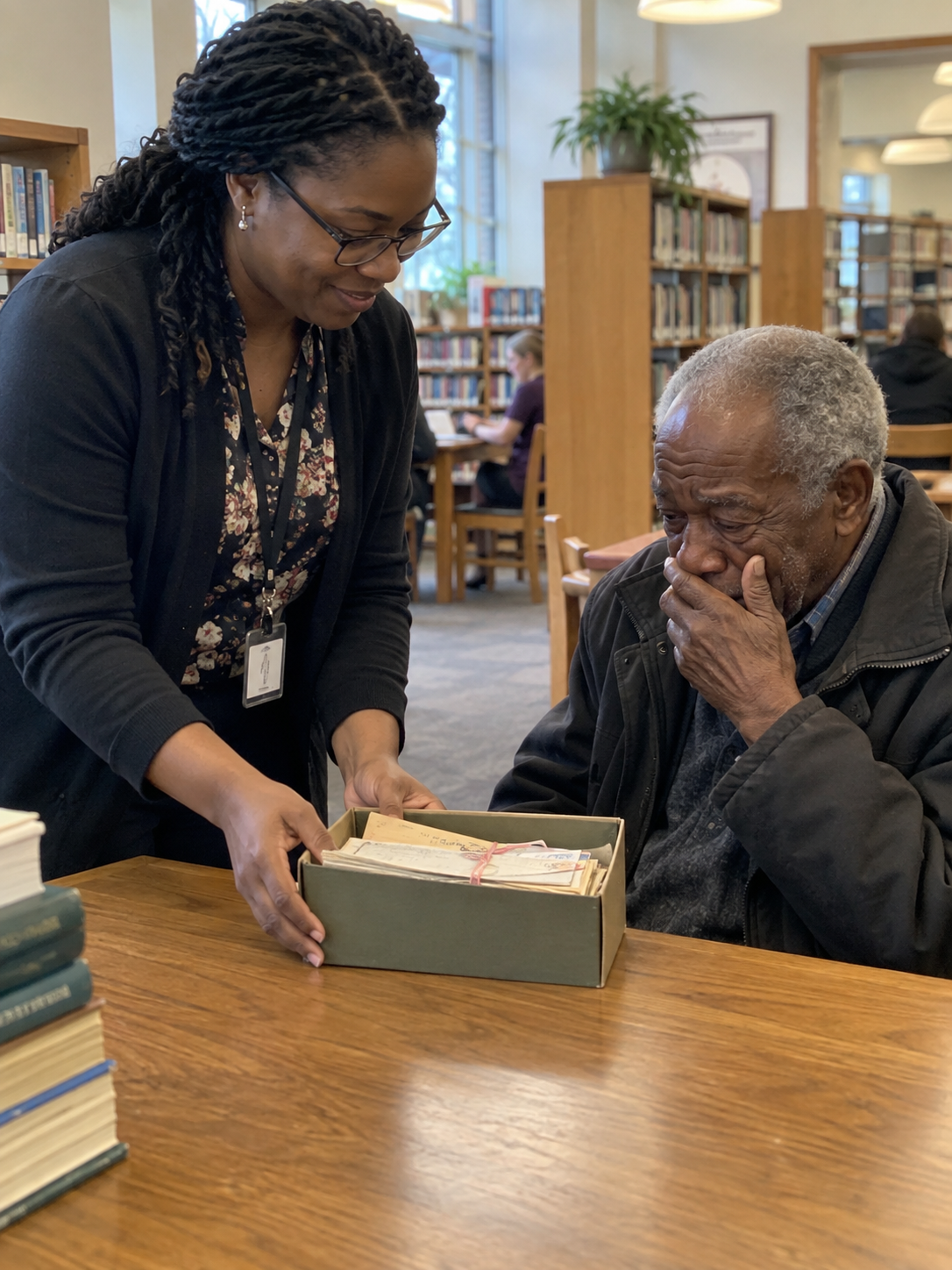
One afternoon, Denise found a narrow box behind a row of old books. It had slipped through a gap between the shelf and the wall. Inside were letters tied with string. The envelopes were yellowed, but the names were still visible.
The letters were addressed to Clarence Hill. Denise recognized the name because he had recently donated several family history books to the library. She did not open the letters. Instead, she checked the public records available to the library and learned that the oldest envelope was more than fifty years old.
When Clarence came in, Denise asked whether he had a sister named Ruth. He became very still. He said Ruth had moved away when they were young and had written for a few years. Then the letters stopped. Their mother told him Ruth wanted a different life, and Clarence assumed she no longer wanted contact.
Denise showed him the box. Clarence held the first envelope but did not open it. His hands shook slightly. He said he had spent decades believing that his sister had forgotten the family, but he had never stopped wondering whether that was true.
They opened the letters together at the library table. Ruth had written about her new job, her apartment, and the small victories of building a life in another city. She described missing Clarence and asked whether their mother was still keeping the blue dishes in the kitchen.
The later letters were never sent. They had been returned because the address on Clarence’s childhood home had changed. Ruth had continued writing anyway. She wrote about her marriage, the birth of her son, and the day she learned that their mother had become ill.
Denise searched old newspaper archives and found a marriage announcement for Ruth. She also found a small article about a community center director with the same last name. The director lived in another state, but the library sent a letter explaining the discovery.
Three weeks later, Ruth’s son called. Ruth herself had passed away several years earlier, but the family still had photographs and a box of letters Clarence had sent. Clarence had never known his sister received none of them.
The families exchanged scans of photographs. Clarence saw Ruth standing beside a Christmas tree, holding the same blue dishes he remembered from their mother’s kitchen. Ruth’s son saw a photograph of Clarence repairing a bicycle outside their childhood home.
They arranged a video call. Clarence spoke slowly at first, but Ruth’s son knew many details about the family. They compared memories, corrected one another, and laughed about the fact that both believed their mother had made the best peach preserves in the county.
The library created a small display about reconnecting family history, but Clarence asked that the original letters remain private. Denise agreed. The display showed only empty envelopes and a note explaining that some histories are not found in official records. They are found when someone takes the time to look behind the shelf.
Clarence continued visiting every Wednesday. He added Ruth’s name to his family notebook and wrote beside it: “She never stopped writing.” That sentence mattered to him more than anything else he had learned.
A box of letters had been hidden for years, but the love inside them had not disappeared. It had simply been waiting for a careful person, a patient librarian, and one brother willing to open the first envelope.


