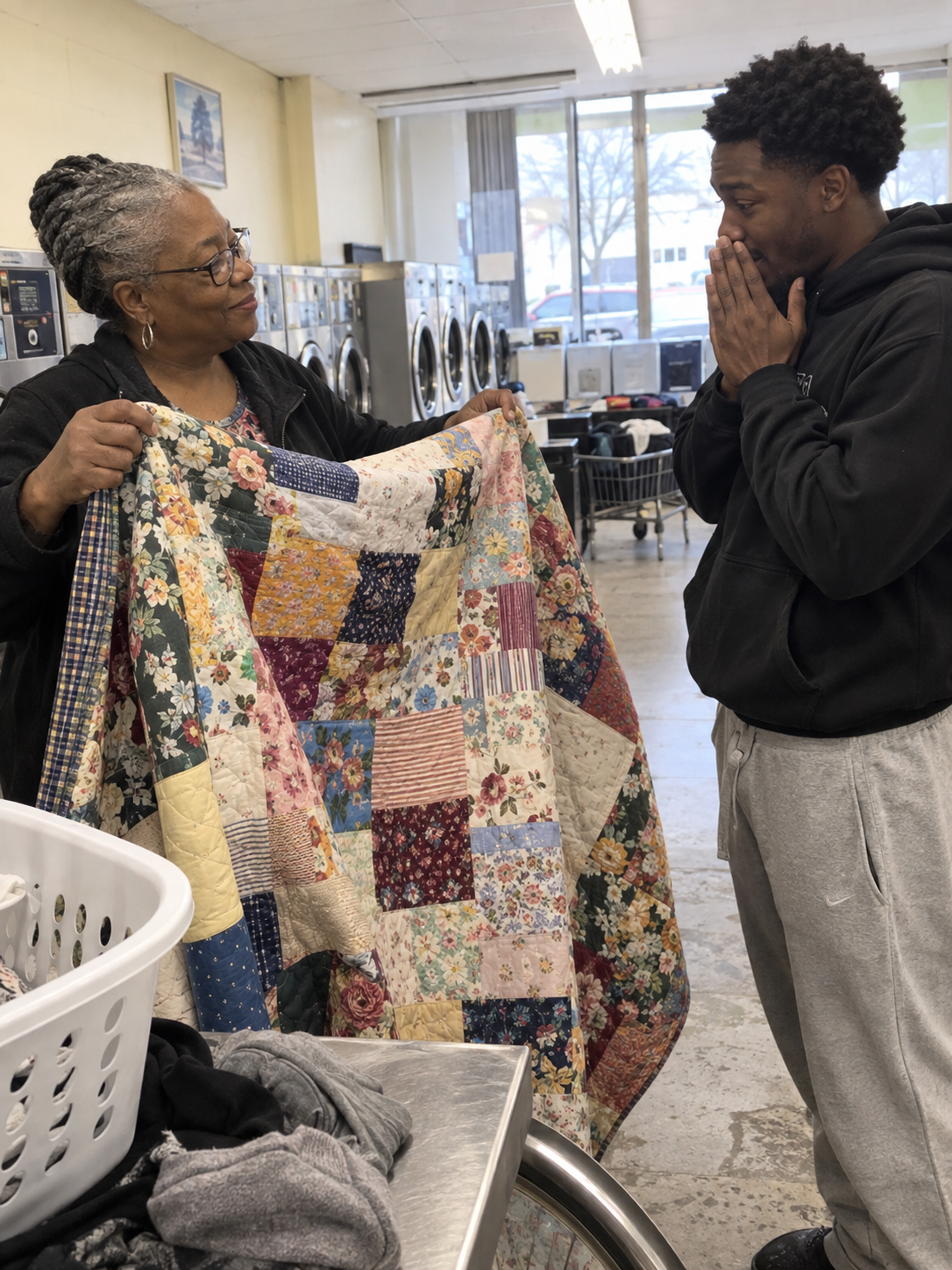
Monica Davis had gone to the laundromat because the washing machine in her apartment had stopped working again. She carried two bags of clothes, a container of detergent, and the kind of tiredness that made every small task feel larger than it should. She expected to spend an hour folding clothes and thinking about nothing in particular.
At the folding table beside her, a young man named Jordan carefully spread out a quilt. It was made from dozens of fabric squares, each one a different color and pattern. Some pieces were bright yellow. Others were faded blue, floral, or striped. Several seams had come loose, and one corner was nearly detached.
Jordan was twenty-four and had learned to sew from his grandmother. She had passed away the previous winter, leaving behind a closet filled with dresses she had worn throughout her life. Jordan could not bring himself to throw them away, so he turned the fabric into a quilt. He had worked on it for almost a year.
The quilt was meant for his mother, who had recently moved into a smaller home. Jordan wanted to give it to her on her birthday, but the quilt tore while he was washing it. He had brought it to the laundromat because he did not know where else to repair it.
Monica recognized one of the floral squares. It was the same pattern her grandmother used to wear on Sundays. She asked Jordan where he found the fabric. He explained that every square came from one of his grandmother’s dresses, but he did not know the names of the people who had owned them before she bought them at estate sales.
Monica reached into her purse and showed him an old photograph. In the picture, her grandmother stood outside a church wearing a floral dress with the exact same pattern. Monica had kept the photograph for more than forty years, but she had never seen another piece of that dress.
Jordan assumed it was a coincidence. Then Monica pointed to a small repair near the edge of the square. Her grandmother had sewn a tiny blue thread into the hem of nearly every dress because she believed it made the clothing easier to identify at the dry cleaner. The thread was still there.
Monica and Jordan sat at the folding table while the machines turned behind them. She told him that her grandmother had donated several dresses to a neighborhood clothing drive after moving into assisted living. Jordan’s grandmother had volunteered at that same drive for years.
The fabric had traveled from one woman’s closet to another woman’s hands, then into a quilt that was being made for a third generation. Neither family had known the connection. Jordan called his mother, but he did not tell her why. He only said that the birthday gift was going to carry one more story than he expected.
Monica offered to repair the torn corner. She had learned basic quilting from her grandmother as a child and still kept a small sewing kit at home. Jordan hesitated because he did not want to impose, but Monica told him that some things were easier to mend when two people remembered how important they were.
They worked together over several evenings. Monica showed Jordan how to reinforce the backing without covering the original stitches. Jordan added a small blue thread beside the floral square. He said it would honor both grandmothers, even though neither woman had ever met the other.
On his mother’s birthday, Jordan unfolded the quilt across her living-room sofa. His mother recognized several dresses immediately. She also recognized the floral square from a picture of Monica’s grandmother that Jordan had printed and placed beside the gift. For a moment, neither of them spoke.
Monica was invited to the birthday dinner. She arrived with a small framed copy of the old photograph. Jordan’s mother held it carefully and said her own mother had once mentioned donating clothes to a neighborhood drive. The two families had been connected by a piece of fabric long before they ever knew one another’s names.
The quilt became the center of every family gathering. People pointed to the squares and shared stories about the women who had worn them. Jordan continued sewing, but he no longer saw it as simply a craft. He saw it as a way of keeping voices, habits, and love from disappearing.
A torn quilt may look like a small problem. But sometimes a small tear reveals how many lives have been stitched together all along. The fabric remembered what the people had forgotten, and two strangers at a laundromat helped the memory find its way home.


