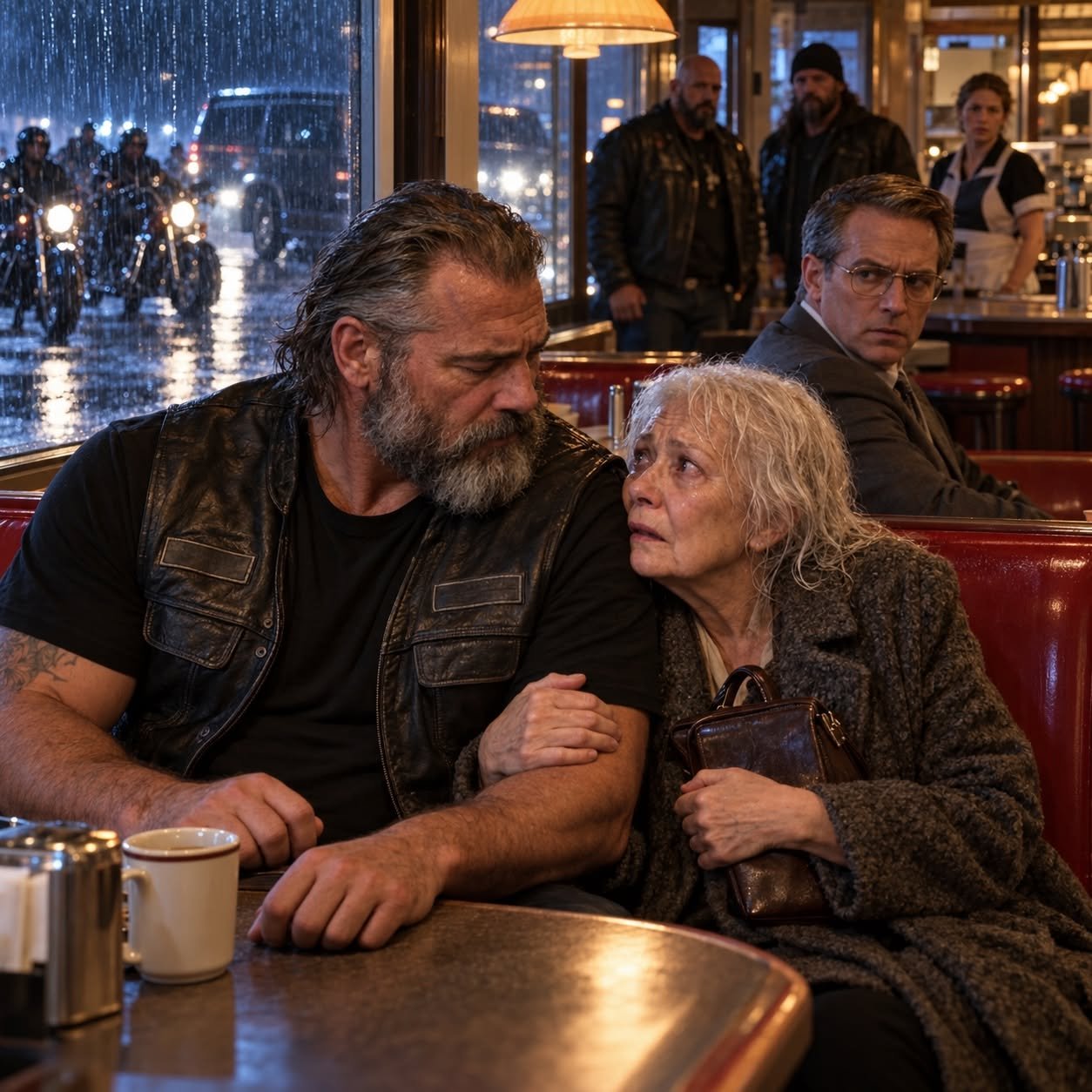
Evelyn Hayes was seventy-five when she signed the papers at her kitchen table, her daughter Melissa watching with tired, pleading eyes. Just a signature, Melissa had said — to help her husband’s business through a rough patch. Mothers sign things for their children. That is what mothers do.
The business did not get through the rough patch. What came instead were gambling debts, forged refinancing forms, and then one cold Tuesday morning, a man at the door with an envelope. The house where Evelyn had raised her family for forty-one years was no longer hers. Melissa would not meet her eyes when Evelyn called. The calls went unanswered after the third week.
All that remained was a battered 1976 red Harley-Davidson she had ridden since her late husband died, and a small brass key from her nightstand drawer. Her grandmother Ada had pressed it into her palm in the summer of 1999, her voice thin as paper. “When you have nowhere else to turn, child, try this door.”
Evelyn had never asked which door. Living in a cheap rooming house on the edge of town, she turned the key over in her fingers every night — until one morning she found the paper: a folded address stub inside the old key’s leather pouch. A block garage, just outside Cottonwood, Arizona.
She rode out at dawn, the desert air sharp in her lungs, the Harley rumbling beneath her like it remembered better days. The building was exactly as the stub described: cinderblock, one steel door, a padlock rusted shut. Evelyn’s hands shook as she lifted the brass key. It turned easily, as if it had been waiting.
The door swung open onto dust and stillness — and a row of shapes under canvas covers, gleaming at the edges where the cloth had worn thin. Evelyn pulled the first cover away and gasped. A motorcycle, deep green, with a number plate that read 7. Beneath it, a plaque in a glass case: ADA WHITCOMB — FIRST PLACE, CALIFORNIA DIRT TRACK CHAMPIONSHIP, 1938. Evelyn sank onto a stool. Her grandmother. The quiet woman who had baked pie and mended quilts had been a dirt-track racer.
Beneath the second cover sat the rarest machine Evelyn had ever heard of — an Indian Four, one of the great four-cylinder motorcycles of the 1930s, almost none of which survived the war years. Trophy plaques lined the walls. Framed newspaper clippings showed a young woman in a leather helmet, grinning beside a number 7 machine. Ada Whitcomb. Her grandmother had lived an entire second life, and never told a soul.
In the back of the garage stood a workbench, and on it a tin box. Inside was a letter in Ada’s careful handwriting, dated the year before she died. Ada wrote that she had hidden the collection because the Whitaker family had tried to take it from her for years — first with lawyers, then with threats. The bikes had once belonged to Ada’s racing partner, Silas Whitaker, who had signed them over to her in writing after a crash ended his career. But the Whitakers, wealthy and proud, could never accept that a woman held what they called their legacy.
“They will come for it, Evelyn,” the letter said. “They will come with money and smiles, and they will tell you it is only business. Remember: what is offered freely is a gift, but what is taken by pressure is a theft wearing a suit. Do not let them rush you.”
A pickup truck pulled up outside. A man in a pressed shirt stepped out, smiling the way men smile when they think the deal is already done. “Graham Whitaker,” he said, extending a hand. He glanced past her into the garage, and his smile tightened. “I understand you’ve come into possession of some old property my family has an interest in. Forty thousand dollars — for the property, including everything inside.”
Forty thousand dollars. To a seventy-five-year-old woman sleeping in a rooming house with nothing to her name, it sounded like rescue. Graham must have seen the flicker in her eyes, because he leaned in. “Very generous, Mrs. Hayes. I wouldn’t wait too long. Property like this can… deteriorate.”
Evelyn told him she would think about it, and that night she called the one person she trusted — an old friend of her late husband’s named Tom Beck, who had run a motorcycle restoration shop in Phoenix for thirty years. Tom arrived the next day with a camera and a flashlight, and let out a slow whistle at the Indian Four. “Evelyn,” he said quietly, “this machine alone — restored — could bring two hundred thousand at auction. The whole collection, with Ada’s championship history? Half a million. Maybe more.”
Evelyn sat on the garage stool for a long time after Tom left. She thought about Melissa, about the signature on the kitchen table, about how quickly forty thousand dollars had almost bought her silence. She thought about her grandmother, a young woman in a leather helmet in 1938, racing before crowds that had never seen a woman win. Ada had hidden all of this not out of fear, but out of patience. She had waited for the right door — and the right woman to open it.
Graham Whitaker returned three days later with a contract and two men in suits. Evelyn met him at the garage door with Ada’s letter in her hand and the restorer’s appraisal in her pocket. “I know what it’s worth, Mr. Whitaker,” she said. “I have Silas’s signature on the transfer papers, dated 1941. Your family has chased these bikes for eighty years. That chase ends today.”
Graham’s smile did not survive the afternoon. He tried kindness, then pressure, then the cold suggestion that an old woman alone in a garage might not be safe. Evelyn lifted her phone and said she would be happy to let the county sheriff decide who owned what. The men left. They did not come back.
Evelyn did not sell a single machine. Instead, she did what Ada had done in 1938 — she took the collection public. With Tom Beck’s help, she opened the garage as a small museum: the Ada Whitcomb Collection, free admission for veterans and schoolchildren. The first Saturday, a line of families stretched down the block. An old man in a veteran’s cap stood before the Indian Four with tears in his eyes. “I never knew women raced back then.” Evelyn smiled. “Neither did I,” she said. “Until my grandmother told me.”
The museum did not make her rich, but it made her something better: rooted. Donations covered the rooming house, then a small cottage of her own, then a little more. She hired a young woman from the reservation to help on weekends, and taught her to tell Ada’s story the way Ada deserved — not as a victim of the Whitakers, but as a champion who had outrun every one of them.
And Melissa? Six months after the garage opened, Evelyn’s phone rang late one evening. Her daughter’s voice was small. “Mama, I saw the article about the museum. I’m glad something good came out of all of it.” Evelyn closed her eyes. Forgiveness is not a door you kick open, she had learned. It is one you unlock slowly, with the right key. “You can come see it,” she said. “The door’s open.”
Evelyn still rides the old red Harley every Sunday morning, past the cinderblock garage where her grandmother’s machines wait under their lights. She is seventy-six now, and she has learned the lesson Ada tried to teach her across twenty-seven years: a key is just brass until you are brave enough to turn it. And the people who try to take what you love will always offer a fraction of its worth — because the worth was never theirs to name.