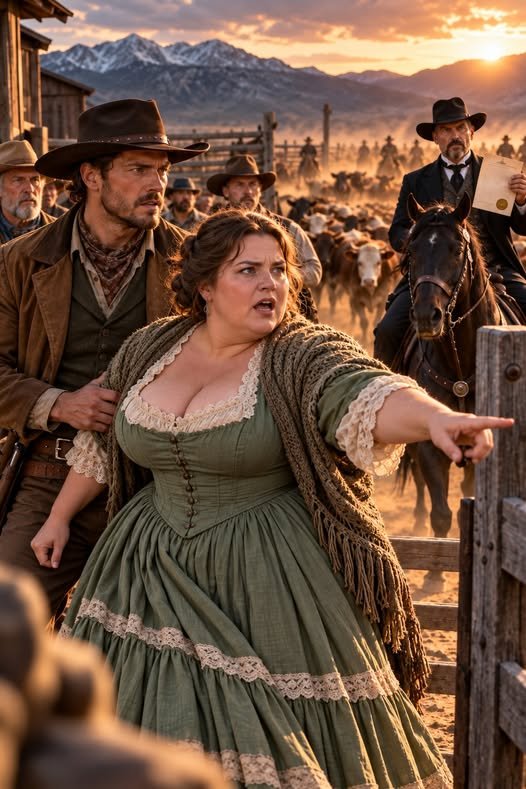
The ranch hands called her “the fat widow” behind her back, and Margaret “Maggie” Thornton heard every word.
At forty-eight, widowed, and carrying nearly 200 pounds on her five-foot-four frame, she did not look like anyone’s idea of a ranch hand. When Cyrus Webb hired her to salt beef for the winter, the men laughed into their coffee cups.
Maggie showed up before dawn anyway, apron tied tight, sleeves rolled up, and worked until her hands were raw. She needed the wages. Cyrus needed someone who knew how to preserve beef through a hard winter. It was a simple arrangement.
Then the fever came.
It started with two steers in the north pasture, staggering, glassy-eyed, dead by morning. By the end of the week a dozen were down. By the end of the month, ranchers across the valley were losing entire herds to a sickness no one could name and no one could stop.
Cyrus called an emergency meeting in his barn. Thirty ranchers crowded in, arguing, blaming one another, proposing everything from prayer to burning the pastures to the ground.
Maggie stood in the back with her arms folded, listening. She had seen this before.
Then she stepped forward into the lamplight and said, “Stop moving the cattle.”
The room went silent. Cyrus stared at her. “What did you say?”
“Stop moving them,” Maggie repeated, her voice steady. “Quarantine the sick where they stand. Burn the dead where they fall. Salt every carcass before it rots, or the fever will travel through the water and take every herd in this valley.”
A rancher named Holt laughed out loud. “You want us to take orders from the woman we hired to salt beef?”
Maggie’s gaze did not waver. “Fifteen years ago, this same fever took my husband’s entire herd. He wouldn’t listen to me either. Then I watched him die trying to save what was left.” She looked around the room. “You can laugh. But I’m the only person here who has seen this before and lived to tell about it.”
Cyrus Webb studied her face for a long moment. Then he did what no rancher in that valley had ever done.
He listened.
“Do what she says,” he told the men. “Every word.”
They grumbled, but Cyrus’s word was law. They quarantined the sick cattle where they stood. They burned the dead. They salted every carcass before it could rot into the creeks.
And slowly — week by week — the fever stopped spreading.
When it was over, Cyrus’s ranch had lost fewer cattle than any other in the valley. The ranchers who had laughed came to Maggie’s work shed with their hats in their hands.
“How did you know?” Holt asked, the laughter gone from his voice.
Maggie wiped her hands on her apron. “Because fifteen years ago, I was the widow who didn’t speak up in time.”
Cyrus, standing in the doorway, finally finished the sentence the story had left hanging that night in the barn. “You think they’re spreading it on purpose,” he said quietly. “Don’t you? The fever.”
Maggie nodded. “The fever doesn’t walk between ranches on its own. Something carries it.”
That was when she told them the rest of what she had learned fifteen years ago — the part her husband had refused to hear.
The fever traveled on ticks. Tiny, blood-hungry ticks that clung to southern cattle driven up from Texas. And this time, Maggie had found the proof: every dead steer in the valley carried the same engorged ticks along its belly and ears.
“Someone drove tick-covered cattle through this valley,” she said. “Recently. In the dark.”
Cyrus’s jaw tightened. He knew every trail and every drover for a hundred miles. Within two days, his men found the answer: a cattle buyer from the south, paid double to move a sick herd through the valley at night, hoping to sell them cheap on the other side before they died.
The buyer was run out of the county. The ranchers who had driven their herds through infected water without knowing it finally understood.
And Maggie Thornton — the woman they had hired to salt beef — was offered a job no woman in the territory had ever held: stock manager for the valley’s cattlemen’s association, at a foreman’s wage.
She accepted on one condition: that every ranch hand in the valley, including the ones who had laughed, would spend one week learning quarantine work under her direction.
“So they’ll know,” she said, “what a widow knows.”
Years later, when the valley’s herds were the healthiest in the territory and young ranchers asked how it happened, the old-timers would point to the work shed and say: “A 200-pound widow saved us all. She gave one command, and every man with a ranch was smart enough — finally — to obey it.”
Maggie never married again. She said she had already been married to the finest teacher she ever knew: loss. And every winter, when the first snow fell, Cyrus Webb himself would ride out to her cabin with a basket of provisions and say the same thing:
“Just checking on my foreman.”
And Maggie would smile, and invite him in, and they would talk cattle until the lamp burned low — two people who had learned, the hard way, that wisdom doesn’t care what size coat it wears.


