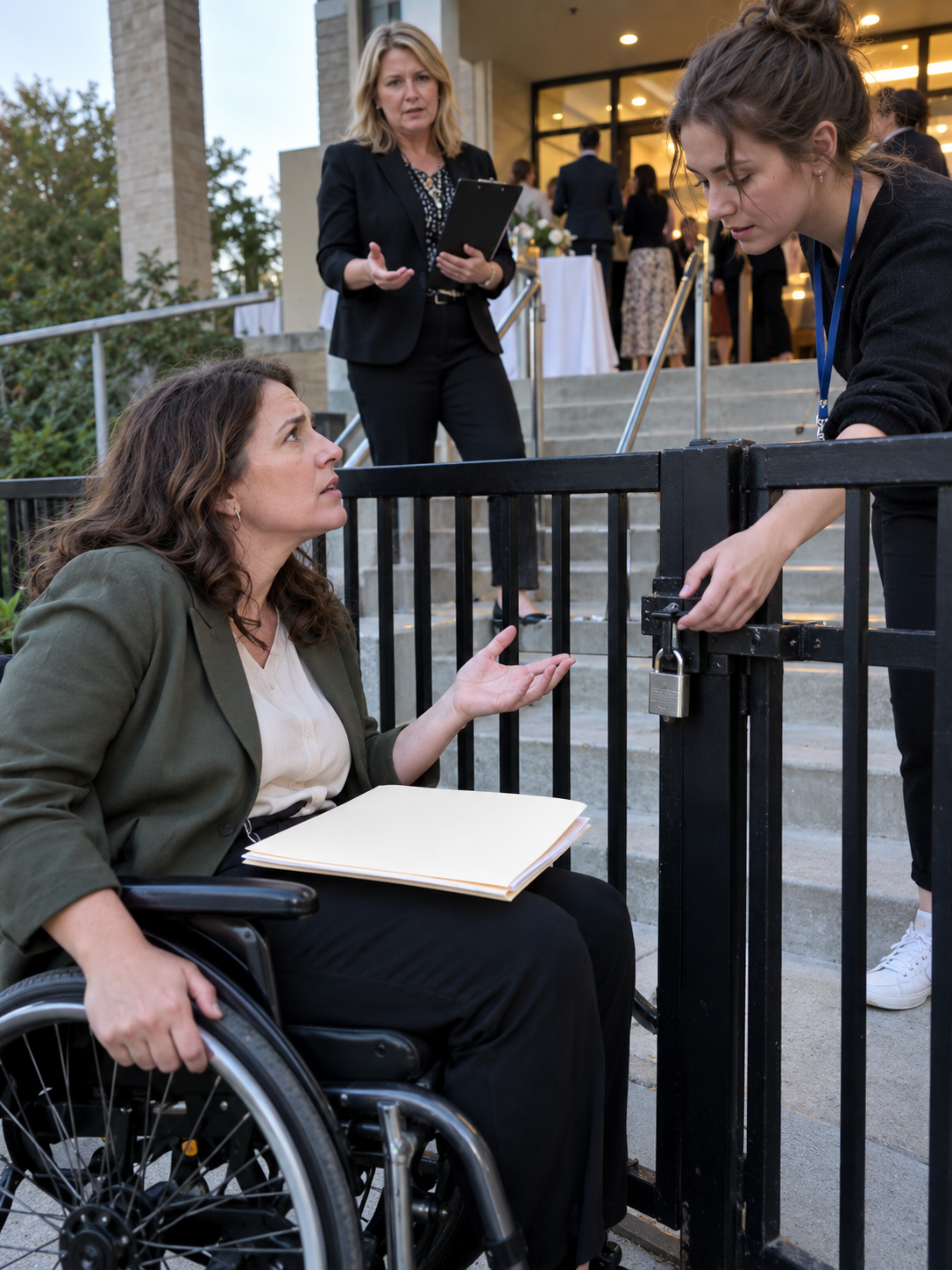
The padlock hung inches from the wheel of Andrea Cole’s chair. Above her, guests were entering the community center for an accessibility fundraiser. Her name was printed in the program as the evening’s featured speaker. She had arrived early, carrying a folder on her lap. Now an organizer stood on the steps explaining that the ramp gate was usually kept locked between events.
Andrea was forty-one and ran a small bookkeeping business from home. She used the center for neighborhood meetings before an injury changed how she moved through town. The fundraiser committee invited her because they wanted someone who understood both the building’s history and the practical barriers people faced. She had agreed after being assured the entrance and speaking area would be ready.
The organizer said the caretaker had the key. The caretaker was setting up chairs across town. Someone suggested bringing Andrea through a loading entrance behind the kitchen. She asked whether it was level all the way to the hall. Nobody could answer. A young volunteer, Maya, stopped arranging flowers and came down the steps to check the gate herself.
Andrea had spent the morning choosing her words carefully. She did not want a speech consisting only of obstacles or a cheerful story that made every obstacle disappear through determination. She wanted to discuss ordinary participation: joining a class, attending a meeting, arriving at the same door as friends. Waiting beneath a locked gate gave every sentence she had prepared an uncomfortable new weight.
Maya called the caretaker and asked for the key location. The organizer told Andrea they could carry her chair up the steps if she was comfortable. Andrea said she was not, and asked them to stop suggesting it. She preferred a safe, usable entrance to being lifted in front of a crowd. The offer might have been well meant; it still placed the risk and embarrassment on her.
Guests began gathering at the top of the steps. Some offered ideas. Others asked whether the speech would start late. Andrea opened her folder and took out a letter the committee had asked her to bring. It was from a retired teacher who stopped attending the center’s reading group after the side entrance became unreliable. The organizer read the first sentence and lowered the page.
The folder contained more than one letter. Andrea had asked neighbors what they needed from the building, with permission to share their comments. A man wrote about leaving an exercise class because he could not reach the room without help. A mother described missing a school meeting held upstairs. A volunteer wrote that she avoided mentioning her own difficulty because staff always seemed overwhelmed already.
Andrea did not read the private details to people on the steps. She asked the organizer to see that the event was repeating the issue it was meant to address. A locked gate, uncertain route, and a request to be carried were not separate unfortunate accidents. Together they told invited guests they could belong only if someone improvised a way to admit them. Maya asked Andrea whether she wanted to wait inside a sheltered area while they checked the route. Andrea said she would rather remain where she could see what was happening. Maya respected that answer. After so many people proposing what should happen to her, Andrea appreciated a question that left room for a preference instead of requiring gratitude for whatever was offered.
The caretaker arrived with the key. Maya opened the gate and walked the entire route with Andrea before guests were directed that way. The ramp itself was clear, but the planned speaking platform had two steps and no accessible approach. Andrea stopped at the front of the hall. She had specifically asked about that platform during the planning call and received a simple yes.
The organizer admitted nobody had checked it in person. They had assumed the portable stage came with a usable ramp. Andrea said she could speak from floor level if every guest could hear and see without her being separated behind a table. Maya moved the lectern aside while the sound technician tested a microphone. The room arrangement changed, safely and plainly, without making Andrea responsible for directing every chair.
Before beginning, the organizer acknowledged what happened at the entrance. She did not describe Andrea as patient or inspiring for waiting. She said the committee had failed to verify its promises and would use the evening to hear specific corrections. Andrea appreciated that. Praise for enduring an avoidable problem could become another way to avoid fixing it.
Andrea spoke about the letters, using only the parts neighbors had agreed could be shared. She explained what reliable access meant in ordinary terms: knowing which door worked, receiving accurate information, and having a seat or space without asking a stranger for a favor. She did not offer technical building advice. She asked the committee to obtain proper assessments and publish the resulting plan. She also asked people planning events to imagine receiving an invitation without knowing whether they could reach the room. That uncertainty changed decisions before anyone saw an empty chair. A person might decline quietly rather than risk another difficult entrance. The attendance list would then suggest there was little demand, hiding the effect of the barrier the committee needed to address.
The audience asked practical questions. Who would check the entrances before meetings? How would visitors learn about a closure? Where could people report a problem without repeating the same explanation to several volunteers? Andrea answered from experience, then directed questions beyond her knowledge to the center’s staff. Being invited to speak did not mean she had become responsible for solving every aspect of the building.
The fundraiser brought in less money than the committee hoped, and the necessary work cost more than a quick gate adjustment. Andrea preferred to hear those facts clearly. The center hired qualified people to assess its routes and facilities, set priorities, and estimate costs. The committee posted dates rather than an empty promise that everything would be fixed soon. Some rooms remained unavailable while work was planned.
Maya volunteered to help check event information against the actual routes before invitations went out. She asked Andrea whether she would review the wording, offering payment for her time from the event budget. Andrea agreed to a limited role. She wanted to contribute without allowing one difficult evening to become an unpaid position correcting everyone else’s assumptions indefinitely. They agreed on a small set of information to verify: the entrance, the route, the room arrangement, and whom to contact if anything changed. Andrea asked that the checks be recorded and shared with everyone on duty. If a visitor arrived after Maya left, the answer should remain reliable. Access could not depend on finding the one volunteer who happened to know.
The reading group met in a ground-floor room during the first phase of work. Andrea called the retired teacher who wrote the letter and asked whether she wanted to attend. The woman said yes, provided she could be told exactly where to enter. Andrea sent a photograph of the open route and the contact number of someone who would be there. Accuracy made the invitation feel real.
At that meeting, nobody made a speech when the teacher arrived. They handed her the book and asked what she thought of the first chapter. Andrea watched her settle into the discussion and felt more hopeful than she had during the fundraiser applause. Participation had become ordinary again. That was what she had tried to describe in the folder of letters.
Months later, the center completed the first set of approved improvements and revised its opening procedures. Staff checked the routes before each event and communicated changes plainly. The old gate problem was resolved as part of that work. Andrea attended the next neighborhood meeting with her folder in a bag, leaving her lap free for a cup of coffee and the agenda. A man carrying a folded walker entered just ahead of her and continued to the meeting without stopping for instructions. Andrea recognized him from a letter in the folder, but she did not call attention to it. He had come to discuss the neighborhood budget. Letting him get on with that seemed a better welcome than asking him to explain his presence.
The organizer met her by the entrance and asked whether the information sent beforehand had been accurate. Andrea said yes. Neither needed to turn that answer into a celebration. A promise had been made and kept. Maya, now coordinating volunteers, was inside explaining the same checks to someone new so they would not depend on a single person remembering last year’s embarrassment.
Andrea kept the letters because the people who wrote them deserved more than being quoted once. She also kept a photograph Maya took after the reading group: books open, coats over chairs, everyone occupied with the argument about a character. The locked ramp had attracted attention. The picture she valued showed what happened when the building finally let attention return to the reason people came.


