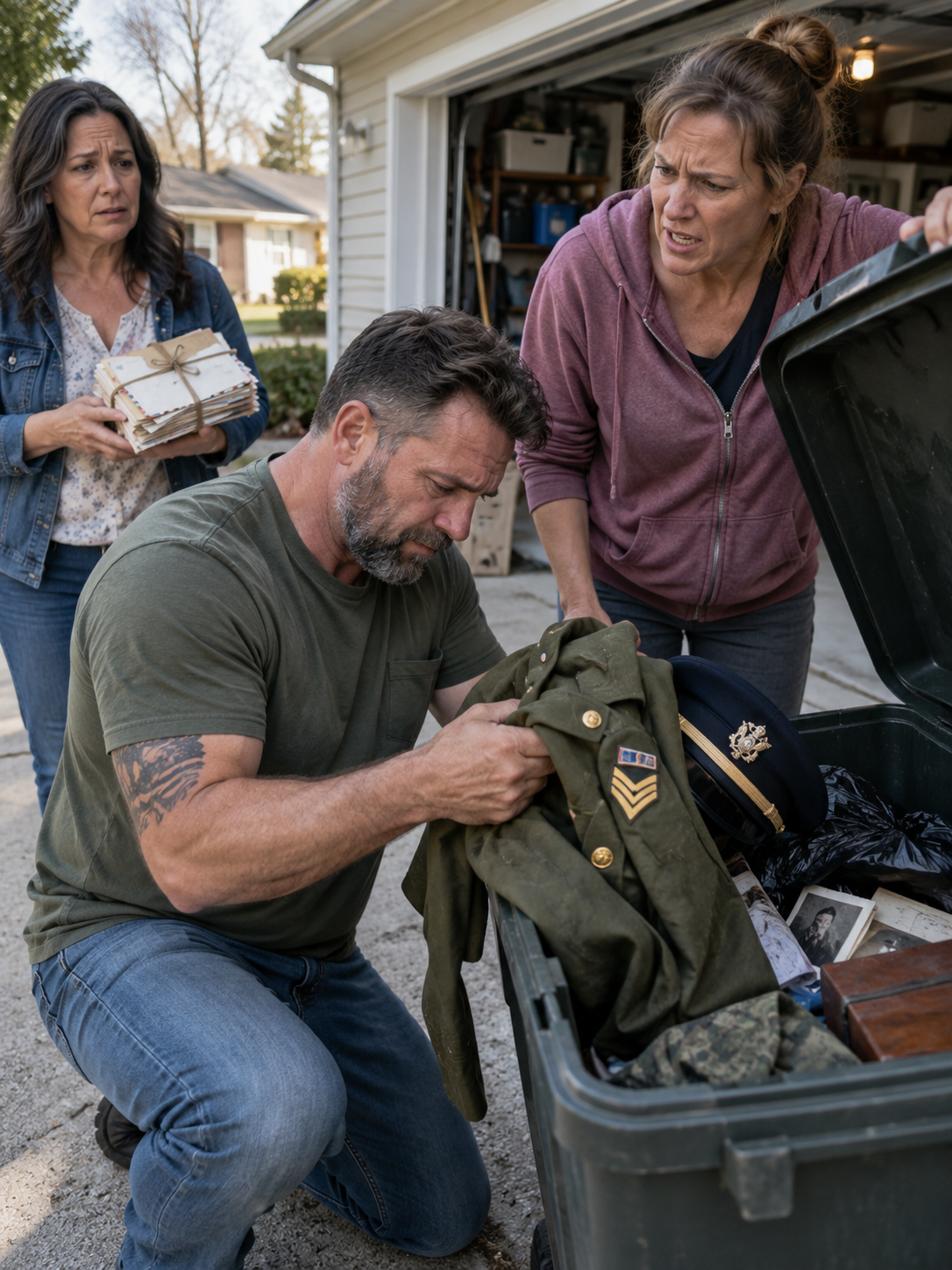
Mark found the olive jacket halfway down the trash bin, beneath a broken picture frame. His sister still held the lid. “You don’t get to come back and play the good son now,” she said. He pulled the sleeve free carefully, recognizing the small repair their mother had made beneath their father’s service patch. Across the driveway, the neighbor stopped with a bundle of letters in her hands.
He had arrived that morning to help clear their mother’s house. The funeral had taken place three weeks earlier, while he was still arranging travel from an overseas job. He had not been told in time to attend. His sister, Leah, believed he had ignored every call. Mark believed Leah had made it clear for years that their mother did not want him near the house.
They were forty-three and forty-six, old enough to have lived separate adult lives and young enough to become children again in a familiar garage. Their father’s uniform hung there in a garment bag after each move. Mark, himself a veteran, had asked for it when their father died. Leah agreed then. Now she said an absent son had no right to choose the things that mattered.
Mark did not answer with a list of transfers or hours worked. He asked why nobody had told him their mother was in the hospital. Leah named the date she had asked her husband to contact him. Mark named the message he received that evening: she needed rest, visitors would upset her, and he should wait. Both siblings paused, hearing the same day described from opposite sides.
Leah’s husband, Paul, had handled much of the family communication because he said he was good at difficult conversations. When their mother needed help, he called agencies, spoke to relatives, and answered the house phone. Leah was grateful to have someone take those tasks. Mark had accepted Paul’s explanations because calling his exhausted sister again felt like adding another demand to her day.
The neighbor, Mrs. Alvarez, walked closer. “Before either of you throws anything else away,” she said, “you need to read these.” The envelopes were tied with kitchen string. Several had been returned by the post office. Their mother’s handwriting ran across each one. On the outermost envelope, Mark saw his name, an old address, and a word that made him lower the uniform: please.
Mrs. Alvarez explained that their mother had asked her to hold the bundle before her last hospital stay. She wanted Mark to see the letters if he ever came to the house. Their mother had grown embarrassed about how long the silence lasted and had not known which part belonged to distance, wrong addresses, or pride. Mrs. Alvarez had never understood why messages through Paul failed to settle it.
They took the letters to the kitchen. Leah filled the kettle, then forgot to switch it on. Mark read the first envelope aloud. Their mother described a rosebush, a roof repair, and a neighbor’s new baby. She asked whether his work was treating him fairly. There was no instruction to stay away. In the final line, she said the chair by the window still felt like his. They recognized the kitchen string from the drawer beside the stove. Their mother used it for parcels and never cut more than she needed. Leah touched the knot before Mark untied it. That tiny familiar detail made the bundle feel less like evidence brought by a neighbor and more like something their mother had just set down before leaving the room.
Leah read a letter dated after the hospital message. Their mother wrote that she hoped to see him when she was stronger and wondered why he had not answered. Mark showed Leah the message on his phone. Paul had said their mother refused contact. Leah sat down, remembering an argument with her husband in which he complained that Mark always returned to receive praise while other people did the work.
There were practical details to check before they could decide what all of it meant. They compared messages, bank confirmations, and dates in their mother’s calendar. Money Mark sent for care had reached the household account. Leah had been told it came from a small insurance payment. Nothing on the kitchen table could explain every year of distance, but enough was clear to require an answer.
Paul arrived while they were still reading. He said he had tried to protect Leah from more disappointment. He thought Mark’s visits would disrupt the routines they had built. Mark asked whether their mother had ever said she wanted him kept away. Paul admitted she had not used those words. Leah looked at him for a long time before asking him to leave the kitchen.
She did not make a decision about her marriage in front of her brother. She said she needed time to understand what her husband had chosen to tell each of them. Paul protested that he had carried the family through a difficult year. Leah answered that helping did not grant him the right to rewrite another person’s wishes. Mrs. Alvarez stayed beside the door until he went. For the first time, Leah understood how delegating every difficult call had left her without a direct view of what people were being told. She had been exhausted, but she did not want exhaustion used forever as an explanation that ended all questions. She asked Paul to send her copies of the records he held and give her space that afternoon.
When the house grew quiet, Leah apologized for the uniform. She did not attach a condition about what Mark should have done differently. She had been hurt and wanted him to feel it. Mark said the years still needed talking about, including calls neither of them made. The letters did not make either sibling blameless. They did make it impossible to keep blaming a mother who had wanted them both.
They retrieved the jacket’s garment bag and the photograph from the bin. The frame was ruined, but the picture could be saved. Their father stood beside their mother on a windy day, both squinting at someone outside the camera’s view. Leah remembered who took it. Mark remembered where they went afterward. For a few minutes, memory became something they shared instead of something used to prove who had cared more.
They spent the afternoon sorting without rushing. Mark took no keepsakes until Leah had seen them. Leah stopped assuming every object he touched was being claimed. They labeled family photographs together, writing names on separate paper rather than on the originals. Mrs. Alvarez returned home after making sure they had eaten. She had brought letters, not a verdict, and let them do the difficult work those letters opened.
In the following weeks, Leah sought advice about her finances and her relationship. Mark stayed nearby long enough to help with repairs and appointments connected to the estate. He did not offer to replace one person directing her life with another. They made lists together, and each kept a copy. When a question concerned their mother, they looked for records instead of accepting the most confident voice in the room. They also wrote down which questions could no longer be answered. Their mother had not recorded every thought, and memories changed when repeated through hurt. Mark found relief in admitting those limits. He had spent years imagining a single conversation that would explain everything. The work in front of them was slower: checking what they could and being honest about what remained uncertain.
The most painful letter came last. Their mother wrote that she missed hearing them laugh together over something foolish. She did not ask them to settle old arguments in one visit. She asked them to have lunch without discussing the house. Mark folded that page and asked Leah whether there was still a diner near the hardware store. There was. They went the next afternoon.
Lunch was awkward. They argued about who forgot a birthday years earlier, then discovered neither remembered the right year. Their mother would have laughed at that. Leah finally did, a small surprised sound over her coffee. Mark did not call the moment healing or try to make it carry too much. It was simply their first lunch together in a long time.
The uniform went to Mark after Leah had its seam repaired. She kept a copy of their father’s photograph. They divided the letters by whose memories appeared inside, then scanned every page so neither lost the whole collection. There were still unanswered questions about Paul’s choices, and they dealt with those separately. Their renewed relationship did not need to become another story told through someone standing between them. Leah found another photograph of Mark holding the wooden boat their father made for him. She sent it without a long message, simply asking whether he remembered the blue paint. He did. A conversation followed about a summer neither had mentioned for decades. These small exchanges began arriving between the harder ones, giving their relationship room to be more than a repair project.
Months later, Mark visited without a dispute waiting in the driveway. Leah opened the door herself. They had lunch, then fixed the loose hinge on their mother’s old kitchen cabinet. The uniform was safe at his home. More valuable than getting it back was learning, while they still had time, that a bundle of undelivered letters did not have to become another generation’s silence.

