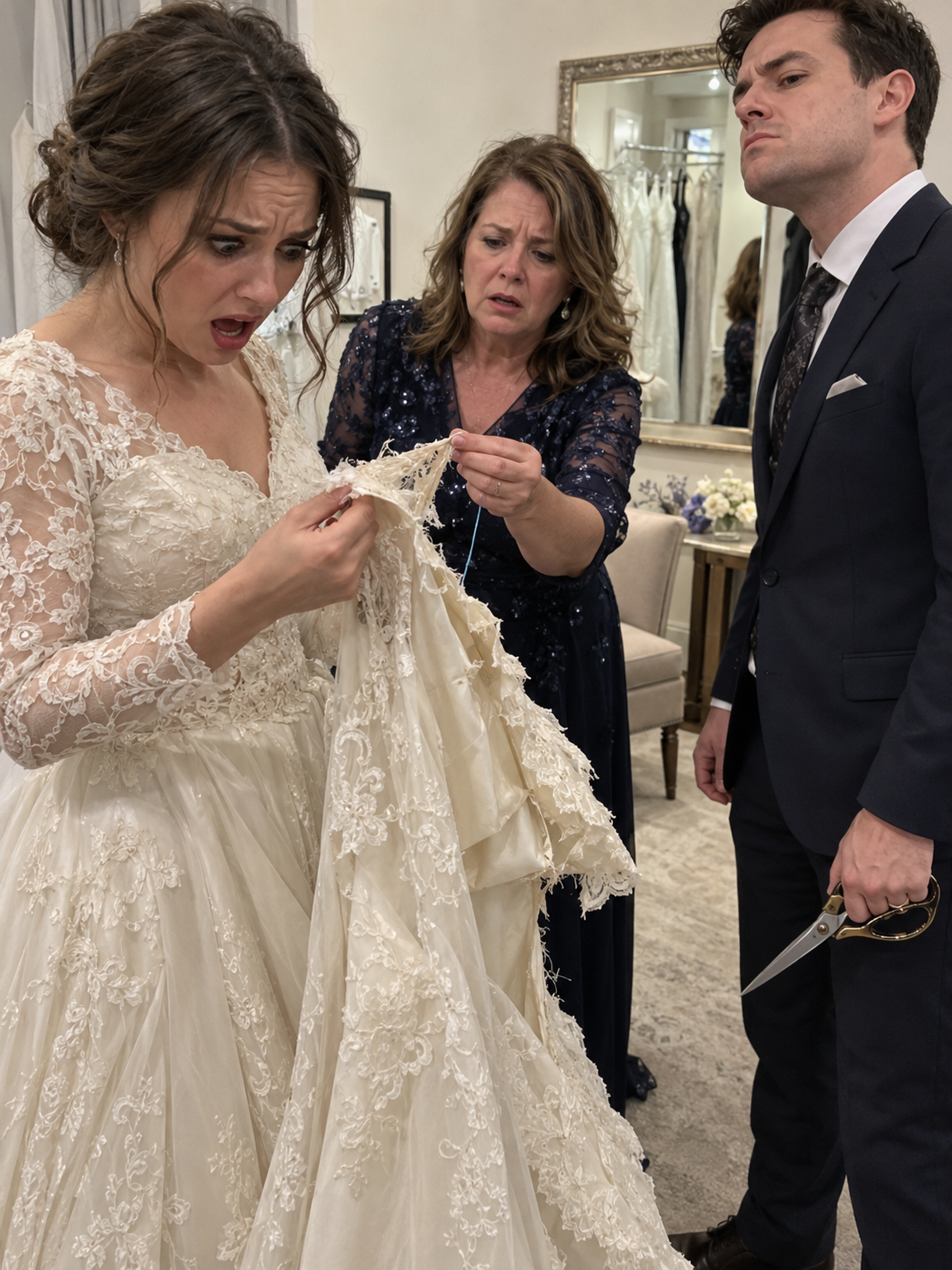
The scissors closed before Lily understood what Adam was doing. One hard snip cut through the ivory fabric her grandmother had sewn forty years earlier. A strip of the wedding dress fell against her shoes. In the fitting-room mirror, she saw her mother turn from the doorway, still holding the little sewing kit she had brought to repair a loose button.
“Now you can stop arguing about wearing it,” Adam said. He lowered the scissors beside his leg as if he had solved an ordinary problem. Lily stood perfectly still. The wedding was nine days away. Until that moment, the worst thing she had expected that afternoon was discovering that the old dress needed another inch at the waist.
Her mother, Beth, crossed the room and took the scissors from him. She did not shout. She placed them on the highest shelf, then stood between Adam and the dress. “You need to leave,” she said. Adam laughed once, looking toward Lily for the familiar little smile that usually softened an uncomfortable moment. This time, she did not give him one.
For months, Lily had described Adam as decisive. He chose restaurants before she finished looking at menus. He answered questions directed at her. When she changed her mind about something, he said she was making life difficult. None of those moments had looked, by itself, like a pair of scissors. Standing in the cut dress, she began remembering them together.
The dress had belonged to Beth, but Lily’s grandmother had made it by hand at a kitchen table. Lily remembered sitting beneath that table as a child, watching a blue thread swing from the sewing basket. Her grandmother had died the previous winter. Wearing the dress was the one wedding choice Lily had made without asking anyone else what they preferred.
Adam said he would pay for a better one. He had already seen a dress online that looked more suitable for the venue his parents wanted. Beth kept her eyes on Lily. “Do you want him here?” she asked. Lily heard the question differently from every question about flowers, seating plans, and invitations. She took one breath and said, “No.”
He waited, apparently expecting an explanation he could argue with. Lily pointed to the door. Adam left after saying they were both being dramatic. Beth locked the fitting-room entrance behind him and returned without touching her daughter. She knew Lily might need space before comfort. For a while, the only sound was the ticking wall clock above the full-length mirror.
Then Beth knelt to gather the fallen fabric. Along the cut edge, a blue seam had opened, revealing a narrow pocket stitched inside the lining. She remembered her mother refusing to let anyone help finish that section. “Hold still a minute,” Beth said. From the pocket she drew a folded piece of paper, yellowed at the corners and small enough to disappear inside her palm.
Lily stepped out of the dress while Beth found the envelope they used to protect old photographs. Neither wanted to tear the note. Beth unfolded it on the cutting table, smoothing the edges with her fingertips. The handwriting was her mother’s. At the top were the words, “For the woman who wears this after you.” Beth had never known the note existed. Beth recognized the paper as a scrap from the notebook her mother used for household lists. A faint penciled measurement crossed the reverse. She had never imagined her mother composing a message while planning the dress. Lily asked whether they could photograph both sides before unfolding it further. It gave them a careful task while neither was ready to talk.
It was not a prediction about a broken engagement. It was a grandmother writing about marriage as she understood it: sharing work, keeping friends, being able to disagree at the supper table, and coming home without fear of another person’s mood. She had tucked the message into the lining because she liked the idea of useful words traveling beside a family’s celebrations.
Halfway down, Lily stopped reading aloud. Her grandmother had written that loving someone did not give them ownership of your choices. Beth read the rest silently, then looked at the torn dress. The note would have mattered even if Adam had never entered the room. With the scissors still on the shelf, it made the next decision harder to avoid.
Lily called her closest friend first. She said what had happened without calling it an accident or a misunderstanding. Her friend asked whether she was safe and offered a spare room for the night. Lily accepted. Then she called the venue to ask what could be canceled. The practical questions steadied her: dates, deposits, names, and which invitations still needed an answer. Her friend arrived with a coat and did not ask to see photographs of the damage before believing her. She helped Lily find her own bag and keys. Beth put the dress into its protective cover, keeping the cut section beside it. They left the room tidy enough that returning would feel like a choice, rather than another crisis waiting.
Adam sent messages saying she was throwing away years over a dress. Lily read them beside her mother and did not reply immediately. The dress was the visible thing he had cut. What frightened her was how easily he had decided her refusal could be removed with it. She saved the messages, put the phone away, and continued making the calls she had chosen to make.
Beth offered to handle the relatives. Lily wanted to tell them herself. Some were kind at once. Others asked whether the pressure of wedding planning had made Adam act out of character. Lily repeated the facts: he had cut clothing she was wearing because she would not choose something else. Saying it plainly spared her the exhausting work of defending everyone else’s preferred version.
Repairing the dress took longer. The cut crossed fabric too fragile to hide under a simple patch. The seamstress suggested remaking the skirt with a shorter, softer shape, preserving the embroidered bodice and the blue seam. Beth thought Lily might never want to see it again. Lily surprised her by asking whether she could help pick the new lining and learn some of the stitches.
On the morning that would have been the wedding, they met at Beth’s kitchen table with the seamstress and Lily’s friend. There were no speeches about being strong. They drank tea, sorted thread, and argued cheerfully about the right shade of ivory. Lily cried once when she found a loose pearl in the sewing basket. Her mother handed her a tissue and kept the space beside her open. The seamstress showed Lily how to secure a thread without pulling the old fabric too tightly. Lily tried three times before the stitch lay comfortably. Each attempt required slowing down and looking closely at what was actually in her hands. She found that concentration welcome after days in which everyone seemed to want an immediate account of how she felt.
The note went into an archival sleeve. They made a copy to sew back into the lining, adding the date and their names beneath the original message. Lily did not add Adam’s name. She wanted the dress to carry more than the record of someone else’s destructive choice. It could also carry the afternoon she chose who stayed in the room and who needed to leave.
Several months later, Lily wore the remade dress to a small family dinner celebrating Beth’s retirement. It was a different length now, comfortable enough to sit in without arranging layers of fabric. Nobody pretended that changing its shape made everything easy. Lily was still untangling shared plans. But when someone asked whether she liked the result, she answered without looking around for permission.
Beth kept the scissors from the fitting room in a drawer until Lily said she no longer minded seeing them. Eventually they returned to the sewing kit, where they belonged beside buttons and spare needles. An ordinary tool had been used to make an ugly decision. Lily refused to let that be the only meaning left in an object her grandmother had used to make beautiful things. Lily also asked her friend to take a photograph of the finished dress on its hanger. She wanted a record that did not require wearing it for somebody else’s occasion. In the picture, the blue seam was invisible. She knew where it was anyway, the way she knew the names of people she could call without preparing an explanation first.
When Lily touched the blue seam, she thought of three women at three different tables, each doing a part of the work. Her grandmother had hidden words in a dress. Her mother had asked the question nobody else was asking. Lily had finally answered it. The dress had been damaged in a moment; the life she chose afterward would be built one ordinary decision at a time.

