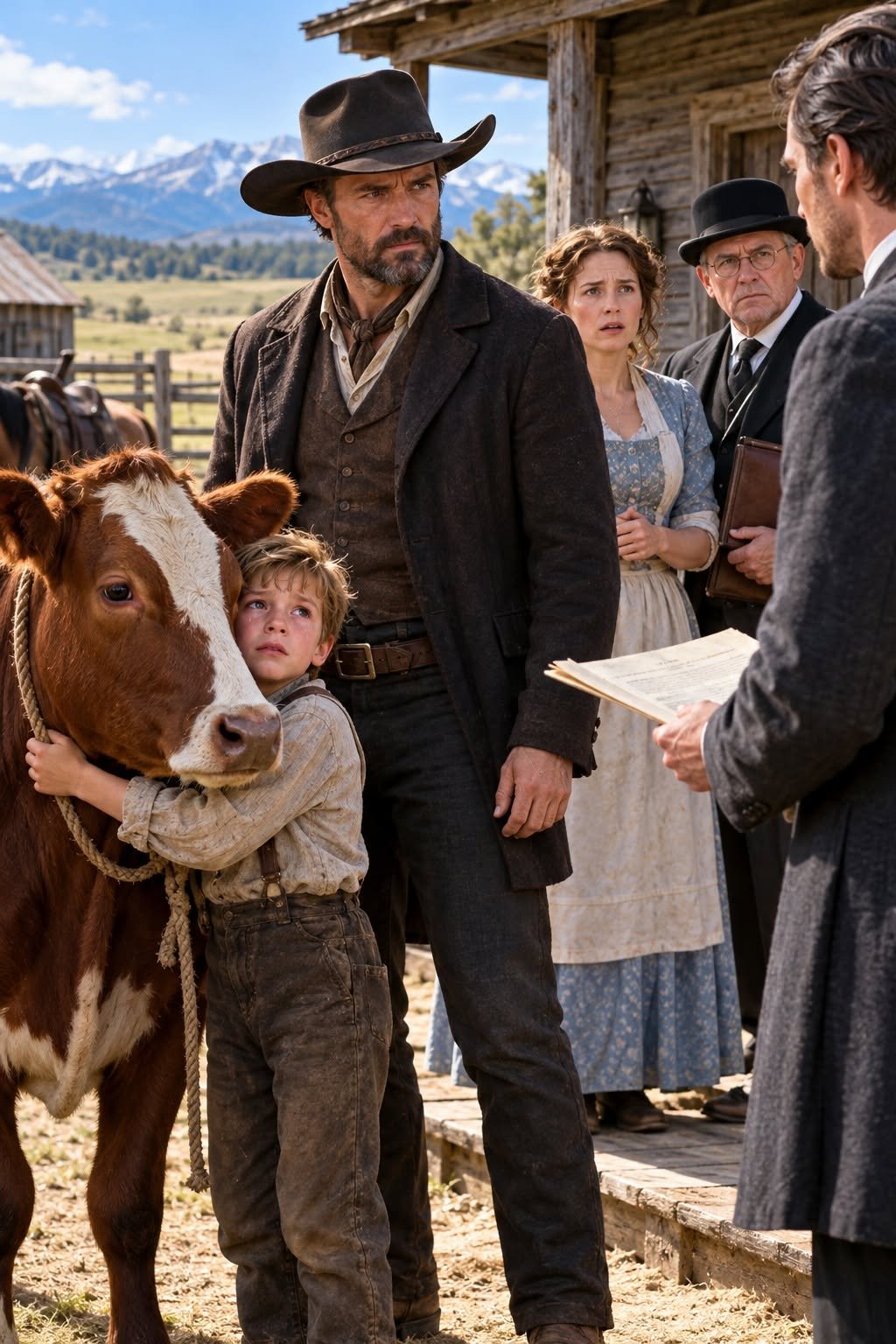
It was a beautiful May morning in 1887. Sunlight washed across the dry hills around Kestrel Flat, Montana Territory. A meadowlark sang somewhere beyond the weathered barn. And Adrien Brandt sat motionless on his horse, staring down at a seven-year-old boy who had wrapped his trembling arms around a cow’s neck and whispered five words that would change three lives.
“Please don’t take her, mister.”
Adrien had negotiated cattle deals worth thousands of dollars without blinking. He owned two thousand head, employed fourteen ranch hands, and controlled some of the finest grazing land in the territory. In thirty-nine years, nothing had prepared him for a child trying to protect the last thing his family had left.
The cow was a red-brown Shorthorn with a white blaze down her face, and a rope hung loosely around her neck though she made no attempt to move. The boy holding her was small for his age, sandy-haired, his boots worn through, his jacket too short at the wrists. His name was Oscar Dunore. The cow — Clover — was his best friend.
“Please,” Oscar whispered again. “She’s a good cow. She never hurts anybody.”
On the porch of the little gray cabin, Rosalie Dunore closed her eyes. She had known this moment was coming. She simply had not imagined it would hurt this much.
A Mother’s Last Stand
At thirty-one, Rosalie was a strikingly beautiful, full-figured woman with soft rounded cheeks, expressive hazel eyes, and thick chestnut hair. Her faded pale-blue dress had been carefully mended at the elbows. Her white apron was worn so thin that sunlight showed through it.
There had been a time when she owned prettier dresses. There had also been a time when she believed her husband would never abandon her. Nearly three years earlier, Curtis Dunore had walked out one September morning carrying a rifle and a saddlebag, leaving a note that said only, “I’m sorry.” No explanation. No promise to return. Just debts, an unfinished homestead, and a four-year-old boy who spent months watching the road.
The divorce came the following year. Rosalie never remarried. Her father had left her 160 acres of stubborn Montana land, a spring, a little barn, and a cabin that leaked whenever the rain came sideways.
She worked every acre she could. She planted vegetables, hauled water, repaired fences, and carried baskets of butter and cheese into town every Thursday. And through every hard season, Clover kept them alive.
The gentle cow gave four gallons of milk a day. That milk became butter. That butter became money. And that money became flour, lamp oil, schoolbooks, and occasionally a little sugar for Oscar.
But spring had brought another bank payment — thirty-six dollars, due June first. Rosalie had twelve. Orin Peabody, the banker in Kestrel Flat, had warned her the payment could not be delayed. So she had posted a notice at the livery stable: GOOD MILK COW FOR SALE. GENTLE. INQUIRE AT THE DUNORE PLACE.
Adrien Brandt had answered. Forty dollars — enough to satisfy the bank and leave a few dollars for groceries. A sensible arrangement. Until Oscar heard about it.
The Night in the Barn
The previous evening, Rosalie had sat beside her son at the kitchen table. “Sweetheart, Mr. Brandt is coming tomorrow.” Oscar looked up from his school primer. “For Clover?” “Yes.” A long silence. “Will she come back?” Rosalie swallowed. “No, honey.”
His small fingers tightened around the book. Then he nodded. “All right, Mama.” He did not cry. He did not argue. That broke her heart more than anything else could have.
Later that night, she found him asleep in the barn beside Clover, one arm draped over the cow’s front leg. She covered him with an old blanket and returned to the cabin, where she opened the tobacco tin holding their last twelve dollars and cried until the lamp burned low.
Now morning had come, and the man with the forty dollars was standing in their yard.
An Offer No One Expected
Adrien dismounted and did something that surprised even himself: he crouched in front of Oscar.
“What’s her name, son?”
“Clover.”
“That’s a fine name.”
Oscar sniffed. “She likes scratches behind her left ear. Not the right one.”
“Left ear. I’ll remember.”
Oscar’s chin trembled. “You’re still going to take her, aren’t you?”
Adrien did not answer. He looked toward Rosalie, who stood perfectly straight on the porch, gripping her apron until her fingers turned white. No pleading in her expression — only the exhausted dignity of a woman who had sacrificed everything she could.
“Mrs. Dunore,” Adrien said quietly, “could I speak with you inside?”
Inside, the cabin smelled of coffee, clean wood, and fresh biscuits. Everything was modest but carefully kept — curtains patched, floorboards scrubbed nearly white, a little stack of schoolbooks beside the stove, a pair of tiny socks drying near the window.
Rosalie poured him coffee. He left it untouched.
“I apologize for my son’s behavior,” she began.
“Don’t,” Adrien said. “Don’t apologize for a boy loving something.”
He turned his hat in his hands. “I came here thinking I needed a milk cow. My ranch has fourteen men, and we haven’t had decent butter or fresh cheese since our cook left in March. The new fellow can turn a perfectly good potato into something resembling saddle leather.”
Despite herself, Rosalie almost smiled.
“I figured buying a cow would solve the problem. But standing out there, I realized something. I don’t need a cow.” He looked directly into her eyes. “I need someone who knows what to do with one.”
The Dairy Plan
“How much milk does Clover give?”
“Four gallons most days.”
“And you make butter and cheese?”
“Yes.”
“Good butter?”
“I’ve never had a complaint.”
“Then I’ve been approaching this backward.” Adrien leaned forward. “Mrs. Dunore, what if I didn’t take Clover at all?”
Her breath caught.
“What if you kept her, and I paid you to supply my ranch? My men need fresh food. You need a dependable buyer. We both have something the other lacks.”
“Mr. Brandt, I couldn’t possibly produce enough for fourteen grown men.”
“Not with one cow.” He paused. “But I have six dairy cows standing idle in my south pasture — bought with a herd last autumn. Wasted, because nobody on my place knows how to manage a proper dairy. And a stone springhouse that hasn’t been used in years.”
“Why are you telling me this?”
“Because I’m beginning to think you could run that dairy better than anyone I’ve hired.”
“Mr. Brandt, I cannot leave my land. And I cannot abandon my son. And the bank—” Her voice faltered. “I owe thirty-six dollars by June first.”
Adrien was silent. Then he reached inside his coat and withdrew a folded sheet of paper. “I drew up a purchase agreement before coming here,” he said. “But I believe we need a different agreement.” He turned the paper over and began writing.
After several minutes he slid it across the table. Rosalie read. Her hand flew to her mouth.
“Forty dollars in advance,” Adrien said. “Against your first deliveries of butter and cheese. We’ll settle accounts monthly after that. And Clover stays.”
Rosalie’s eyes filled with tears. For three years she had survived by refusing to depend on anyone. Now a stranger was offering her something she had almost forgotten existed — a chance.
The Man on the Porch
Then hoofbeats sounded outside. A horse stopped sharply in the yard. A man’s voice called out: “Mrs. Dunore! You’d better come out here!”
Rosalie recognized the voice instantly. Orin Peabody, the banker. Beside him stood a stranger in a dark suit — and Rosalie felt the world tilt beneath her feet. The stranger was Curtis Dunore. Her former husband. The man who had walked out three years earlier with two words on a note.
He smiled as though he had been away a weekend. “Hello, Rosie.”
His gaze moved to Oscar, then Clover, then Adrien. “I hear you’ve been trying to sell things that belong to me.”
Rosalie could not move. Adrien slowly stepped between her and the stranger. Curtis reached into his coat and produced a folded legal document. “I think it’s time everybody learned who really owns this ranch.”
The Truth in the Document
The porch went silent. Oscar had crept up behind his mother and was clutching her skirt.
Adrien did the last thing anyone expected. He held out his hand. “Let me see that document, Mr. Dunore.”
Curtis hesitated — then handed it over, clearly savoring the moment. Adrien read it slowly, his weathered face giving nothing away. Then he read it again.
“Mr. Peabody,” Adrien said at last, “when was this note executed?”
The banker cleared his throat. “September of 1884.”
“And Mrs. Dunore’s divorce was finalized when?”
A pause. “November of 1885.”
Adrien nodded. “And this land — 160 acres — came to Mrs. Dunore from her father, deed recorded in her name alone, in 1880. Is that correct?”
Peabody’s thin mouth tightened. “Yes.”
“Then this document claims an interest in property that was never your client’s to claim, Mr. Peabody. Curtis Dunore signed away every right he had to this land the day the divorce decree was entered. What he’s holding is a quitclaim on his own abandoned share — which the court already extinguished.” Adrien handed the paper back. “You bought a shadow, Mr. Dunore. And the bank bought nothing but your bluff.”
Curtis’s face went scarlet. “Now see here—”
“No,” Adrien said, his voice suddenly hard as iron. “You see here. You walked out on a four-year-old boy and a woman who kept your name spotless after you were gone. You don’t get to walk back in and auction off the roof over their heads.” He turned to the banker. “Orin, you and I do business in this town. I suggest you take your client and his folder back to Kestrel Flat and explain to him what ‘extinguished interest’ means.”
Peabody, to his credit, saw the ground collapsing beneath him. He folded his folder, muttered something about a misunderstanding, and within minutes both men were riding down the trail.
Oscar watched them go. Then he threw his arms around Clover’s neck and laughed — the first real laugh his mother had heard from him in days.
A New Beginning
That afternoon, Adrien and Rosalie signed the dairy agreement at her kitchen table, with Oscar practicing his letters beside them and Clover lowing softly from the pasture.
The forty dollars paid the bank with four dollars to spare. Within a month, Rosalie had six more cows thriving in Adrien’s springhouse dairy — no, in HER dairy, run on her land, on her terms. Her butter became famous across two counties. Oscar rode over to the Brandt ranch twice a week to deliver cheese, and the ranch hands taught him to throw a rope.
By autumn, Adrien was taking his coffee at Rosalie’s table most mornings — not because he needed to, but because he wanted to. And on a crisp October evening, with the cottonwoods turning gold along the creek, he asked her a question that had nothing to do with butter or cows.
She said yes before he finished asking.
At the wedding, Oscar — now eight — stood proudly beside them in a new jacket with sleeves that actually reached his wrists. And when the celebration was over, the boy leaned against his new father’s shoulder and whispered, “She still likes the left ear.”
Adrien Brandt had ridden out that May morning with forty dollars in his pocket and every intention of taking a cow. He rode home with something far more valuable: a wife who could run anything she touched, a son who trusted him, and a cow named Clover who would live out her days in a pasture she had earned.
All because a seven-year-old boy wrapped his arms around an animal’s neck and said, “Please don’t take her, mister.”
Sometimes the smallest voices speak the truest words. And sometimes, the richest man in the valley is the one who learns to listen.