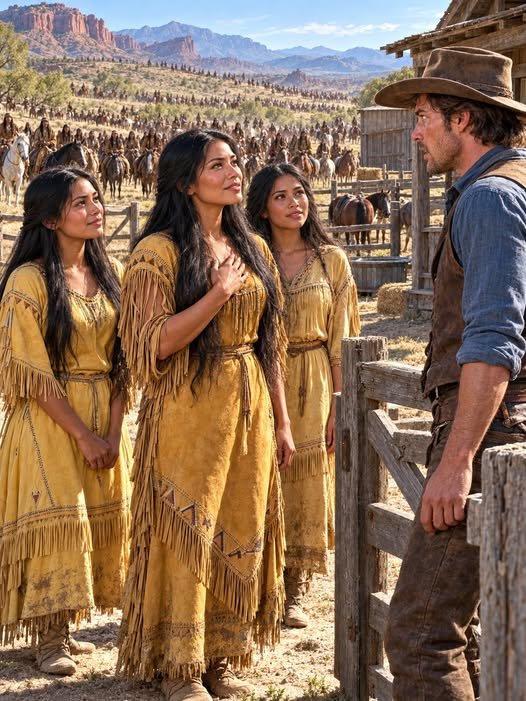
My name is Luther Morgan, and I was thirty-five years old when three Apache sisters arrived at my ranch, exhausted and hungry. I had barely enough food to last another few days. The supply wagon was late. My pantry was nearly empty. But when I saw those three women standing outside my gate, I couldn’t turn them away.
I gave them the supper I’d prepared for myself. They thanked me and rode away. I thought that was the end of it.
It was not.
It happened during the summer of 1888, when the Arizona frontier was suffering through a terrible dry spell. The creeks had shrunk to ribbons. The grass had turned yellow and brittle. Every rancher for fifty miles was counting his supplies and praying for rain.
I lived alone on a small ranch several miles from the nearest settlement. I had twelve horses, a little vegetable garden, and a wooden cabin I’d built with my own hands. It wasn’t much. But it was home.
That evening, I was preparing a simple supper when I heard hoofbeats approaching. I stepped onto the porch.
Three women were riding slowly toward the gate. Their horses looked nearly as tired as they did.
The Sisters at the Gate
The oldest sister dismounted first. She had long dark hair, dusty clothing, and a face that showed how far they’d traveled.
“Can I help you?” I asked.
She hesitated. “We’ve been traveling since yesterday.”
I noticed her younger sisters watching me carefully.
“Are you heading toward the settlement?”
She shook her head. “We’re looking for food.”
I glanced toward my kitchen. There wasn’t much left. A little cornmeal. Some dried meat. Beans. Three pieces of bread. And no certainty about when the supply wagon would arrive.
But I opened the gate. “Come inside.”
The sisters exchanged surprised looks.
I brought them fresh water. They drank slowly, as though afraid to use too much. Then I returned to the stove and prepared the supper I’d been saving — beans and cornmeal, a little dried meat, and the last three pieces of bread.
When I placed everything on the table, the youngest sister looked at me. “You’re giving us all of this?”
I nodded. “You need it more than I do.”
“But what will you eat?”
I smiled. “I’ll figure out breakfast tomorrow.”
For the first time, her expression softened.
They sat down and began eating. Nobody spoke much. But I noticed the oldest sister kept glancing toward the window. The middle sister did the same. Something was troubling them.
Finally, I asked. “Did something happen on the trail?”
The oldest sister lowered her spoon. “We became separated from our people.”
“Are they looking for you?”
“Yes.”
“How many?”
She hesitated. “Many.”
I assumed she meant relatives — perhaps a small group traveling nearby. I didn’t understand why she looked so concerned.
The Bracelet
After supper, I offered them a place to rest. They thanked me, and before sunrise they prepared to continue toward the eastern hills.
At the gate, the oldest sister removed a small woven bracelet from her belongings and held it toward me. “For your kindness.”
I shook my head. “You don’t owe me anything.”
She gently placed it in my hand anyway. “Kindness should be remembered.”
I looked at the bracelet. Its woven pattern was simple but beautiful. When I raised my eyes, she was smiling. Then the three sisters mounted their horses and rode away. I watched until they disappeared beyond the hills.
Afterward, I returned to my quiet cabin. I still had twelve horses to feed. A fence that needed repairing. And a nearly empty pantry. I thought about the sisters once more before sleeping. Then I forgot about them.
Until the following morning.
I woke before sunrise to the sound of restless horses. At first, I thought one of my fences had broken. I grabbed my lantern and stepped onto the porch.
The air was cool. Everything was still.
Then I noticed movement along the distant ridge. One rider appeared. Then another. Then dozens more.
I walked toward the fence. And stopped.
Hundreds of Apache riders were moving across the valley. Their horses advanced slowly through the morning dust.
The Valley Fills With Riders
My heart began pounding. I remembered the oldest sister’s answer. “Many.” Now I understood what she’d meant.
The riders stopped at a respectful distance. Nobody shouted. Nobody rushed forward. They simply waited.
Then three familiar women separated from the gathering and rode toward my gate. The sisters.
The oldest dismounted and walked toward me. I stood motionless, still holding the lantern.
She glanced at the little bracelet tied around my wrist. Then she looked into my eyes. Behind her, hundreds of riders waited in complete silence.
And when she finally opened her mouth, I realized their arrival had something to do with the meal I’d shared the night before.
“My name is Nalin,” she said. “I am the daughter of Chief Tahoma. These are my sisters, Ayasha and little Sani. And behind me rides my father’s people — three hundred strong.”
My mouth went dry. “Why have they come?”
“Because of what you did last night.” Her voice was steady. “My sisters and I were separated from our band during a storm three days ago. We have eaten almost nothing since. When we came to your gate, we were prepared to be turned away. Strangers usually turn us away.”
She gestured toward the waiting riders. “My father has taught our people that a man’s character is revealed not by what he gives when he has plenty, but by what he shares when he has almost nothing. Last night, you gave us your last meal. My youngest sister told the scouts who found us at dawn. The story reached my father’s campfire before the sun was fully up.”
The Chief’s Message
An older man rode forward then, his hair silver, his face lined like canyon rock. He dismounted with the ease of a much younger man and walked to stand beside his daughter.
“I am Tahoma,” he said. “And I have come to tell you what my daughter could not say last night.”
He looked around at my small ranch — the sagging fence, the struggling garden, the cabin I had built with my own hands.
“Luther Morgan,” he said, “you fed my daughters when your own cupboards were nearly bare. In my people’s way, such a man is not a stranger. He is family. And family does not go hungry while we have plenty.”
He raised his hand, and from the back of the gathering, riders led forward a string of horses — twenty fine animals — and others brought bundles wrapped in blankets.
“Twenty horses for your herd,” Tahoma said. “Dried meat, corn, and beans enough to fill your pantry twice over. And this—” He held out a leather pouch. “—is a token of our band. Show it at any Apache camp from here to the border, and you will be received as a brother.”
I stood there shaking, the lantern trembling in my hand. “Chief, I can’t accept all this. I only shared a meal.”
“That is exactly why you must accept it,” Tahoma replied. “You did not share to earn a reward. That is what makes the reward yours.”
Little Sani, the youngest sister, ran forward then and hugged my leg. “You said you’d figure out breakfast tomorrow,” she announced solemnly. “So we brought you breakfast.”
Laughter rippled through three hundred riders, and something in my chest broke open.
A Debt Repaid in Kindness
What happened next I will remember until my dying day. The Apache camped in my valley for three days. Their women helped repair my fence. Their young men mended my corral and dug my garden deeper. My twelve horses became thirty-two. My empty pantry overflowed.
On the third evening, Tahoma sat with me beside my fire. “You live alone,” he observed.
“My wife died of fever four years ago,” I told him. “There’s been no one since.”
The old chief nodded slowly. “Loneliness is a heavier hunger than an empty belly. My people will remember this valley — and the man who shared his last bread in it. You will never be alone out here again. Any rider of my band who passes will stop, share your fire, and leave your woodpile higher than he found it.”
He was right. In the years that followed, Apache travelers stopped at my ranch more times than I can count. They watered their horses, shared their news, and always — always — left something behind: a bundle of dried meat, a woven blanket, a carved toy for a child I told them I hoped to have someday.
The Bracelet’s Promise
I kept the little woven bracelet on my wrist for the rest of my life. Years later, when I finally married again — a schoolteacher widow from the settlement named Clara — I told her the whole story on our wedding night.
She looked at the worn bracelet and then at me. “You know what that bracelet means, don’t you?” she said.
“A thank-you?”
“It means you passed the test most men fail,” she said. “You were generous when it cost you something.”
We hung the bracelet above our fireplace, where our children — two boys and a girl — grew up hearing the story of the three sisters and the morning the valley filled with riders.
Nalin visited once more, years later, grown into a woman of quiet dignity, with children of her own. She stood in my doorway and smiled at the bracelet above the fire.
“Kindness should be remembered,” she said.
“It has been,” I told her. “Every single day.”
Luther Morgan shared his last meal with three hungry strangers and thought that was the end of it. It was only the beginning — of a friendship between peoples, of a ranch saved, of a lonely man folded into a family three hundred strong.
The world tells us to guard what little we have. But sometimes the bravest, wisest thing a person can do is open the gate, set another plate on the table, and trust that kindness — given freely, with no thought of return — always finds its way home.


