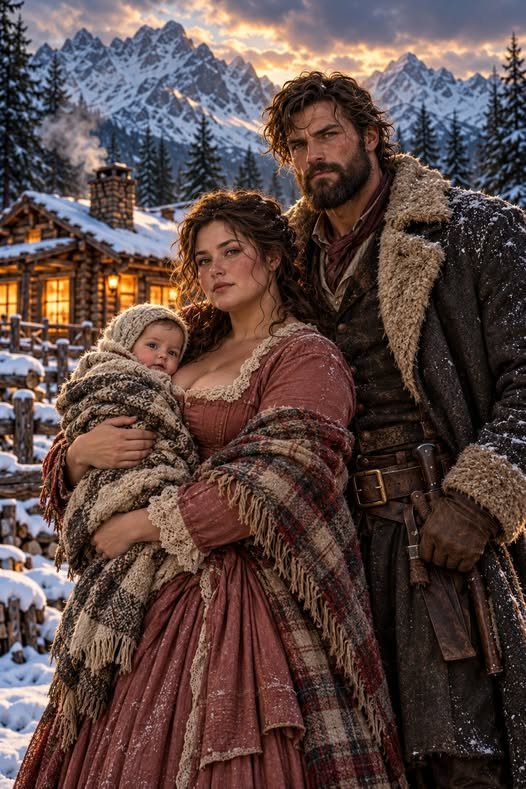
The mountain man had paid one hundred dollars for Mae Walker and her eight-month-old baby.
Now, miles from civilization, he stopped his wagon in the falling snow, reached beneath the seat, and pulled out something enormous.
Mae froze.
For three years, she had learned what happened when a man decided she belonged to him. Her husband had taught her that lesson with drunken fists, cruel words, and nights spent shielding her infant son from his anger.
But Gideon Hale was different.
He was the most feared man in the Colorado mountains.
And Mae had no idea what he intended to do with the woman and child he had just purchased.
Only hours earlier, she had been standing on an overturned whiskey crate in the middle of Misery Bend.
November sleet soaked her threadbare dress. Black mud swallowed the street. Beneath her worn wool shawl, little Samuel whimpered against her chest.
“Forty dollars!” Jeb Cutter shouted.
Laughter erupted from the gathered miners.
Jeb was a narrow, filthy man who smelled of tobacco, blasting powder, and unwashed clothes. Mae had heard enough stories about his isolated cabin to know that forty dollars could buy her a fate worse than the marriage she was escaping.
Beside the crate stood Silas Walker.
Her husband.
Or the man who had stopped being her husband in every meaningful way long before that morning.
He held a whiskey bottle in one hand and a gambling ledger in the other.
“Forty dollars for a hardworking woman!” Silas announced. “She cooks, cleans, washes, and mends. And the boy comes with her!”
Mae stared toward the mountains.
She refused to look at him.
Three years earlier, Silas had promised to love and protect her inside a little Kansas church.
Since then, he had gambled away their wagon, their mule, her wedding ring, and the money she had hidden to purchase medicine when Samuel became dangerously ill.
Last night, he had lost money to men who did not forgive debts.
This morning, he had decided his wife was the last possession worth selling.
The auction was not legal.
But Misery Bend was a mining camp where the sheriff preferred whiskey to justice, and powerful men made their own rules.
Mae pressed her lips against Samuel’s soft hair.
“Mama’s here,” she whispered. “Mama won’t let anybody take you.”
Her voice trembled because she could not promise either of them would survive what came next.
“Forty-five!” Jeb called.
Silas grinned.
“Sold—”
“One hundred dollars.”
The voice came from the far end of the street.
It was quiet.
Yet every man stopped speaking.
The crowd parted.
Gideon Hale stood beneath the gray November sky.
Everyone knew the mountain hermit from Blackstone Ridge. He came into Misery Bend only a few times each year, purchasing coffee, salt, cartridges, and lamp oil before disappearing into the wilderness. The stories surrounding him were terrifying. Some claimed he had killed a grizzly with nothing but a hunting knife. Others whispered that three horse thieves had followed him into the mountains and never returned.
Gideon was enormous, broad-shouldered and powerful beneath a heavy buffalo coat. A dark beard concealed most of his weathered face, while a pale scar crossed his left cheek and disappeared along his jaw.
He approached the crate and looked directly at Mae. Not at her figure. Not at her torn dress. At her frightened face. Then his gaze lowered to Samuel.
“Does the boy stay with her?”
Silas laughed. “Hell, yes! I don’t want him.”
Gideon tossed a canvas pouch into the mud. Gold coins clinked together. Silas dropped to his knees and began counting.
Mae followed Gideon out of Misery Bend without another word. By sundown, the mining camp lay four hours behind them. Snow thickened across the mountain trail.
The mountain man had barely spoken. His silence frightened her. She knew which footsteps meant danger. She knew when to stay quiet. But Gideon was a stranger. And strangers could hide anything.
Suddenly, Gideon pulled the reins. The wagon stopped. Mae’s heart hammered. They were alone in the wilderness. No witnesses. No help.
Gideon climbed down and reached beneath the wagon seat. Mae instinctively curled around her baby.
Then he lifted out a thick fur blanket. He placed it over her shoulders. Warmth surrounded her immediately.
He handed her a canteen. “Drink.” She hesitated. “Water,” he explained. She took a cautious sip. It was clean, cold water. Not whiskey.
“Thank you,” she whispered.
Gideon nodded toward Samuel. “Keep the boy inside that fur.”
The snow reached her ankles. Then her calves. Her boots filled with icy water. Every step became harder than the last. Samuel began crying.
On the third glance back, Gideon stopped. “You’re limping.” “I’m all right.” “You’re not.”
Mae lowered her eyes. “Please don’t be angry.”
Gideon went completely still. For several seconds, only the wind moved between them. Then he said quietly, “I’m not angry.”
Without another word, he lifted Mae into his arms. She gasped. “Please! I can walk!” “You’ll freeze before we reach the cabin.”
He carried her through the snow while the mules followed. Mae had never felt so helpless. Or so confused. A man strong enough to break her bones was carrying her as carefully as if she were made of glass.
At last, a cabin appeared between towering pines. Warm yellow light glowed behind its windows. Smoke curled from a stone chimney.
Inside stood a wide fireplace, a heavy wooden table, shelves of preserved food, and two neatly made beds. Mae noticed something else. A small wooden cradle stood near the hearth. She stared.
Gideon set her gently beside the fire. “Sit.” Mae obeyed immediately.
He brought a basin of warm water and clean cloths. Then he brought a tiny wool blanket for Samuel. Mae could hardly believe what she was seeing. There was enough food on the shelves to last through winter. Enough firewood stacked against the wall to heat the cabin for months. And beside the hearth waited a cradle that looked recently repaired.
Mae’s breath caught. Here it comes, she thought. The price of the gold. The reason he had brought her here.
Gideon looked at Samuel, sleeping beneath the fur. Then he looked at Mae. “There’s something I expect from you,” he said.
Her stomach twisted. She lowered her head. “Whatever you want, Mr. Hale.”
His expression hardened. “Look at me.” Mae forced herself to raise her eyes.
Gideon stepped closer. “From this moment forward, there’s one thing you’re going to do in my house.” Mae trembled. “What is it?”
The mountain man took a slow breath. Then he spoke words no man had ever said to her.
“You’re going to tell me when something hurts. You’re going to tell me when you’re hungry. And if I do something that frightens you, you’re going to tell me to stop.”
Mae stared at him. She had expected an order to obey. Instead, he was demanding that she speak.
“I don’t understand,” she whispered.
Gideon glanced at the bruises visible beneath her torn sleeve. His expression changed. And when he spoke again, his voice was dangerously quiet.
“Mae, before you sleep tonight, there’s something you need to know about the hundred dollars I gave your husband.”
He reached into his coat and removed a folded document. Mae recognized the handwriting on its front. Silas Walker. Her blood turned cold.
Gideon unfolded the paper. Then he said seven words that made her forget how to breathe.
“Your husband wasn’t selling you to me.”
He placed the document on the table. “He was paying off someone else’s debt.”
And beneath Silas’s signature was another name. A name Mae had believed buried forever.
Thomas Blackwood.
Mae’s hands began to shake. Thomas Blackwood had been her father. He had died when she was sixteen, or so her mother had told her. A mining accident, they said. But the document in front of her told a different story.
Gideon watched her face carefully. “Your father didn’t die in a mining accident, Mae. He owed money to the wrong people. Dangerous people. When he couldn’t pay, they came for his family. Your mother paid with her life. You were supposed to be next.”
Mae felt the room spinning. “But Silas—”
“Silas knew,” Gideon said quietly. “He married you to keep you hidden. It worked for three years. But his gambling brought attention. When he couldn’t pay his own debts, they reminded him of the old one. Your father’s debt. They gave him a choice: hand you over, or watch Samuel pay the price.”
Tears streamed down Mae’s face. “So you—”
“I bought your freedom,” Gideon said. “Not you. Your freedom. The hundred dollars settles the debt. That paper is the proof. You’re not property, Mae. You never were.”
Mae looked at the document, then at the cradle by the hearth, then at Gideon.
“Why?” she whispered. “Why would you do this for a stranger?”
Gideon’s scarred face softened. “Because twenty years ago, I couldn’t save my own wife from men like them. I swore I’d never stand by again.”
He stood and walked to the door. “The bedroom is yours. The cradle is for Samuel. I’ll sleep in the barn tonight. Tomorrow, we’ll talk about what you want to do. Where you want to go. The choice is yours now.”
Mae sat by the fire long after Gideon left, holding Samuel close, staring at the document that had rewritten her entire life.
For the first time in three years, she was not afraid.
For the first time in her life, she was free.
And as the snow fell silent outside the cabin windows, Mae Walker made a decision. She would not run. She would not hide. She would stay, and she would build a life where no one could ever sell her again.
The mountains that had once seemed like a prison now felt like a fortress.
And the most feared man in Colorado had turned out to be the only one who had ever truly seen her.


