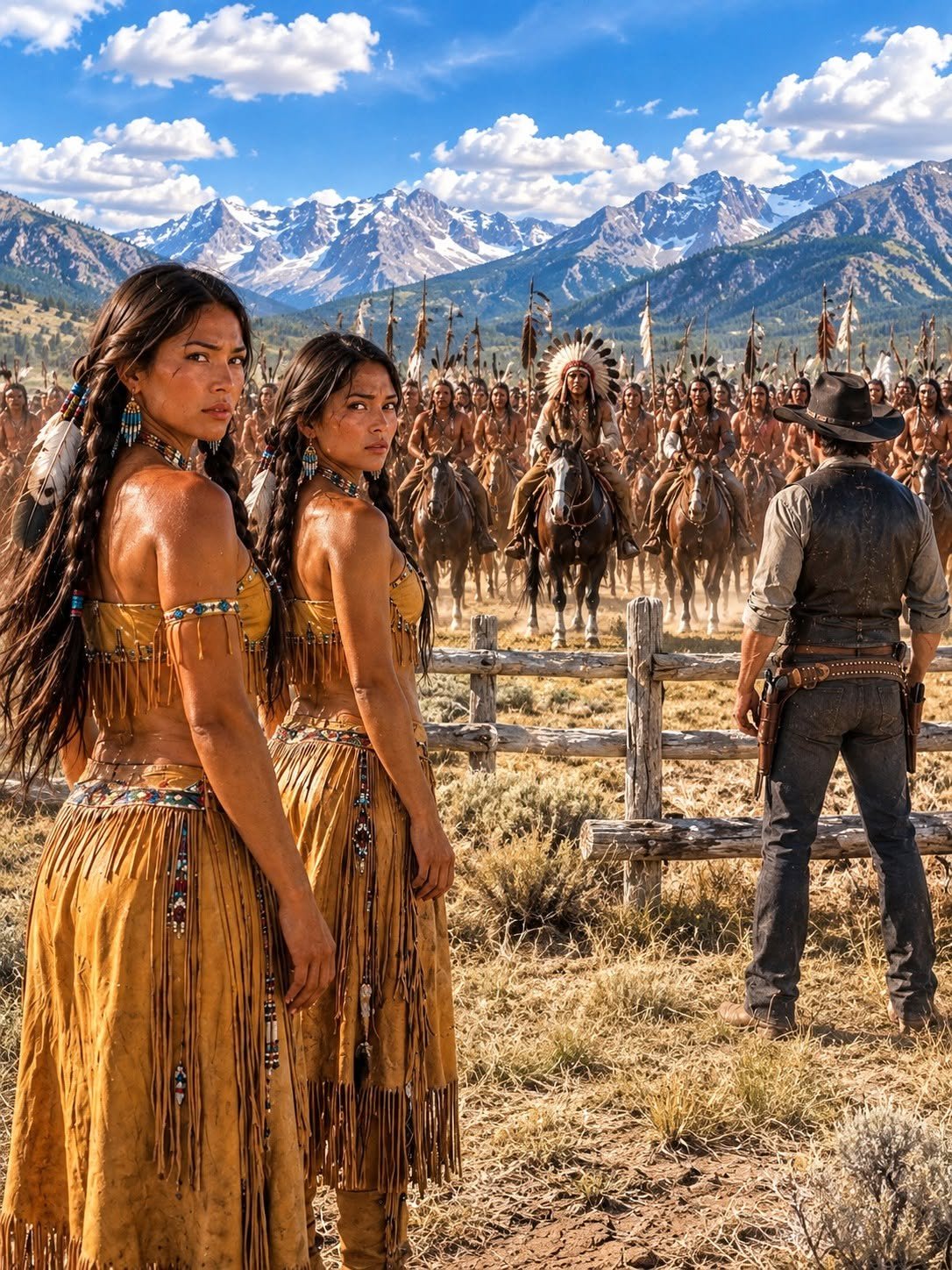
The blood was almost black against the white salt rock. Emmett Cross nearly missed it — but old instincts stopped his feet, and what he found that morning would bring seven hundred Apache warriors to his door by dawn.
Four years alone on the edge of the Wyoming salt flats had trained Emmett’s eyes to notice only what needed fixing. But he had once tracked men for the Texas Border Service, and some things never left him. He followed the blood trail toward a red sandstone outcropping. He should have gone back for his rifle. He didn’t.
That was where he found them. The younger woman lay collapsed beneath the rock, maybe twenty-one, blood soaking the left side of her clothing, breathing dangerously shallow. Between them stood another Apache woman, older — Desta — with a knife at her hip and calculation in her eyes. Emmett raised both hands slowly.
Then something unexpected happened. Desta drew the knife — and lowered it into the dirt instead. Blade down. Handle upright. Then she stepped away from it. “Please help her.” Three words. No threat. No pride. Only desperation.
Emmett moved immediately. He pressed cloth against the wound while Desta spoke softly in Apache, the rhythm steadying her sister’s breathing. “I need to get her to my ranch,” Emmett said. “Three miles. I have clean water, needles, bandages. You can leave the second she’s stable.” Desta met his stare. “I only want her alive.” Desta nodded. That was enough.
At the ranch, Emmett swept everything from his kitchen table and turned it into an operating surface. In proper light, the wound looked worse — torn rather than cleanly cut. He heated water, cleaned his hands, prepared thread and whiskey. For twenty-five minutes, he worked. The younger woman cried out only twice. Desta never stopped talking to her. Finally, the wound closed.
“She needs sleep.” Emmett pointed toward the back room. “You both take my bed.” Desta looked at him sharply. “I’ll sleep here,” Emmett said, nodding toward the kitchen chair. “I’ve slept in worse places.” Only then did she tell him their names. “Desta.” She touched her sister’s shoulder. “Ronnie.”
Near midnight, Ronnie’s fever spiked. For the next hour, Emmett and Desta worked together — cool cloth, water, fresh bandages. Around two in the morning, the fever finally broke. Later, Desta found Emmett staring through the dark window. “You have done this before.” “Yes.” “Did they survive?” Emmett looked at his faint reflection. “No.” His hand brushed unconsciously against the white handkerchief in his pocket — the one embroidered with a small blue M. “I just made sure tonight ended differently.”
Morning came gray and cold. Ronnie appeared in the doorway, weak but clear-eyed. “You closed my wound.” “Yes.” “You touched my blood.” “Yes.” Something in her tone made Emmett set the coffee pot down. “You don’t know what you’ve done.”
“With our law.” Ronnie continued. “I am Biin Fiin — the sacred vessel. I was chosen when I was eight to carry ceremonies, histories, and knowledge that are never written. My body is considered sacred ground. No outsider has touched me since I was chosen.” “Until last night.” “Yes.” Emmett’s jaw tightened. “I was keeping you alive.” “I know.” “Does that matter?” “To me? Yes.” “To the law?” Her silence answered. “The law does not ask why. It asks only whether an outsider touched the Biin Fiin.”
“My father will come.” “With how many men?” Ronnie looked toward the salt flats. “He will not come with men. He will come with warriors.”
Then Emmett saw movement. Dark shapes along the distant ridge. Horsemen. Dozens. Then hundreds. Ronnie whispered: “Seven hundred.” An entire Apache war party had come to find the man who had touched their sacred vessel.
Emmett did the only thing he could. He walked out onto the porch — unarmed, hands open — with Desta and Ronnie behind him. The war party’s leader, a scarred chief named Tahoma, rode forward alone. Ronnie spoke rapidly in Apache, telling her father everything: the wound, the night, the fever, the man who had given up his bed and asked for nothing.
Tahoma listened without moving. Then he looked at Emmett for a long time. Finally, he dismounted, walked to the porch, and did something no one expected: he placed his own knife — blade down, handle upright, exactly as Desta had done — in the dirt before Emmett.
“The law says an outsider who touches the Biin Fiin must answer,” Tahoma said. “You have answered — with your hands, your roof, and your night. The law also says a life debt is sacred. My daughter lives because of you. That debt is mine now.”
He turned to his warriors and raised his arm. One by one, seven hundred riders turned their horses and rode back across the salt flats, leaving Emmett standing on his porch with two Apache sisters, a white handkerchief with a blue M, and a dawn he had not expected to see.
Desta stayed through the winter, helping Emmett mend what four years of solitude had broken. Ronnie returned to her people — but every spring after, she came back to the ranch for one week, bringing ceremonies and stories she was now permitted to share with exactly one outsider. And Emmett Cross, the man who had once tracked men for the Border Service, became known across the territory by a new name: the one the Apache gave him. They called him “He Who Gives His Bed” — and no warrior ever raised a hand against him again.


