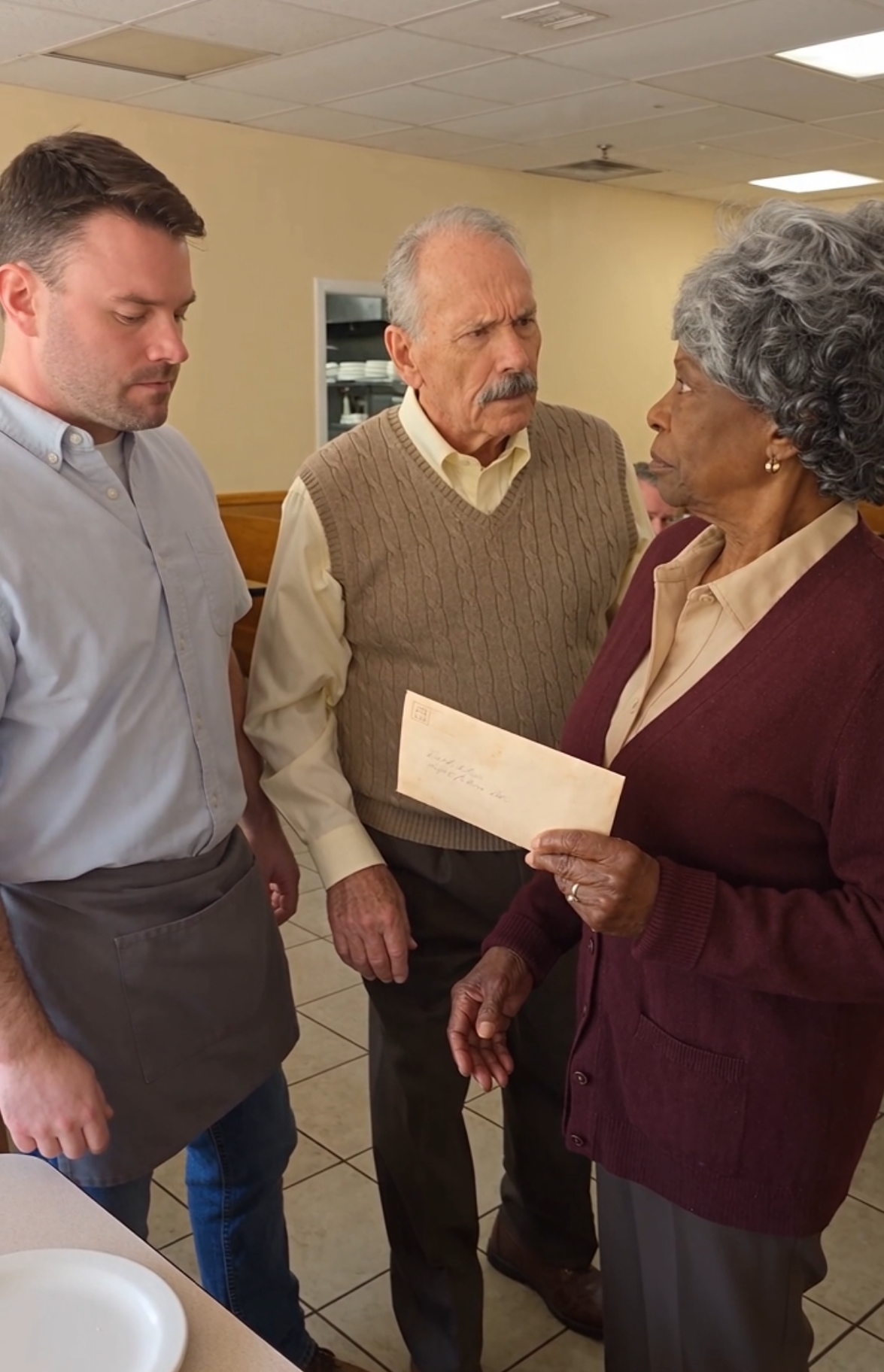
The first thing Evelyn Brooks heard was the scrape of a plate against the table. Then her lunch was on the floor. Mashed potatoes slid across the tile, green beans scattered beneath the nearest chair, and the two slices of meatloaf landed beside her brown shoes. The man standing over her set the empty plate down as though he had simply finished clearing a table. “I told you to leave!” he said. Evelyn, a seventy-three-year-old Black grandmother, kept her left hand closed around the cream envelope she had carried all morning. Her right hand rose instinctively, then settled against the table’s edge. Across the room, a fork stopped halfway to someone’s mouth. Nobody had mistaken what happened for an accident. Daniel Mercer, the restaurant manager, had deliberately thrown her food away, and he expected her to disappear with it.
Evelyn had dressed carefully for this visit: a burgundy cardigan, a clean cream blouse, dark trousers, and the comfortable shoes her granddaughter had helped her choose. The envelope was older than every item she wore. Its corners had softened, and the ink across its front had faded to the color of weak coffee, but she knew every curve of the handwriting. She had checked three times before leaving home that the folded papers were still inside. That morning, her granddaughter Maya had offered to come along. Evelyn had declined because she thought the meeting would be brief and pleasant. She would introduce herself, hand over a piece of family history, and perhaps learn something about a place her mother had mentioned for decades. She had pictured a conversation over lunch. She had not pictured standing beside that lunch while strangers watched it cool on the floor.
The trouble had begun with an ordinary question. Evelyn told the young server that she was there to meet Harold Mercer, the owner, and showed him the short invitation Harold had mailed her the previous week. The server checked with the kitchen, explained that Harold was finishing a delivery, and offered her a small table while she waited. Evelyn ordered the lunch special and tucked Harold’s newer note into her cardigan pocket, keeping the older envelope in her hand. Daniel arrived after the food did. He asked whether she was waiting for someone to buy her meal. She said no. He told her the table was needed, although two nearby tables stood empty. When she explained the appointment, he dismissed it without checking. His eyes moved over her clothes and stopped on the envelope. He had decided what kind of customer she was before listening to anything she said.
“Your father invited me,” Evelyn said after the plate hit the floor. Her voice was quiet enough that Daniel had to listen, but she did not lower her eyes. He looked toward the kitchen doorway, then back at her, irritated that she had mentioned a name he could not simply wave away. “Give me that,” he said, reaching for the old envelope. Evelyn drew it closer to her chest. She had carried it through rain on the walk from the bus stop, protected it while she waited, and held it steady through the humiliation of the spilled lunch. She would not let him take it now. His fingers were still extending when another hand stopped his forearm. Harold Mercer had come out of the kitchen. He stood beside his son, his face tight, and looked from the empty plate to the food below Evelyn’s feet.
“Step back,” Harold told Daniel. The instruction was low and unmistakable. Daniel began to explain that he was dealing with a problem, but Harold was no longer looking at him. His eyes had settled on the envelope. Across its upper front, in faded blue ink, someone had written, “For Lillian Brooks. Keep this safe.” Harold leaned slightly closer, stopping short of touching it. He recognized the long slant of the capital L, the heavy downstroke in Brooks, and the small hook beneath the final letter. His father, Arthur, had written that way on order forms, birthday cards, and the notes he used to leave beside the cash register. Harold had not seen a new piece of his father’s handwriting in more than thirty years. “Where did you get that?” he asked. Daniel’s explanation died halfway through a sentence. For the first time that afternoon, he looked uncertain.
“My mother gave it to me,” Evelyn answered. “She told me to bring it here if I ever wanted you to know what happened.” Harold looked at her face properly then, rather than at her age or her cardigan or the mess his son had made. Brooks. The surname on the letter he had received, the surname on the envelope, and a name from his childhood all fell into place. He had invited Evelyn after she wrote to say that she possessed papers about the restaurant’s early years. Her letter had not described the documents, and they had never met. He had expected a pleasant historical curiosity. Now he was looking at something his father had deliberately entrusted to Lillian Brooks, a woman he remembered arriving before sunrise with flour on her sleeves and a scarf tied around her hair.
Harold asked the server to bring a clean chair and move Evelyn to a table away from the spill. Then he crouched with a dustpan while Daniel stood frozen beside the counter. Evelyn watched the owner collect the meal his son had thrown away. Harold did not summon the youngest employee to remove the evidence while he attended to the important visitor. He cleaned the floor himself, apologized for keeping her waiting, and asked whether she wanted to stay, leave, or call someone. “You can read it,” she said. “Then I want my granddaughter here.” He nodded and offered the restaurant’s telephone. Only after she had spoken to Maya did he sit opposite her. Evelyn placed the envelope between them. Before opening it, Harold said, “Whatever this contains, what happened to you was wrong.” She looked at him for a moment, then loosened the flap with her thumb.
Inside were three items: a folded letter, a receipt for six thousand dollars, and a small black-and-white photograph. The photograph showed the unfinished restaurant entrance, with Arthur Mercer standing beside a younger Lillian Brooks. Between them was a plain wooden sign resting on two paint cans. Evelyn remembered that day. She had been twenty-one, home between shifts at the laundry, and her mother had asked her to take the picture before returning to work. Arthur had been embarrassed about the paint on his trousers. Lillian had laughed and told him nobody expected a man opening a restaurant to look like a banker. Harold lifted the photograph and recognized the doorway before its glass had been installed. He remembered the grand opening, the red balloons, and his father’s proud handshake. He had never been told why Lillian was in that earlier photograph, or why his father had written her a receipt.
The receipt was dated from the spring the restaurant opened. It recorded a loan from Lillian Brooks to Arthur Mercer, with a payment schedule written on the reverse. Six thousand dollars had been the difference between opening the doors and abandoning the lease. Lillian had saved that money while working two jobs and raising Evelyn largely on her own. She had planned to use it as the down payment on a small house. Arthur had come to her after the bank refused him and after two other people withdrew the help they had promised. He had known Lillian through the lunch counter where they both worked years earlier. She had seen him struggle, heard his plans, and chosen to lend him her savings. “She wasn’t giving it away,” Evelyn said. “She was trusting somebody to keep his word. Those are different things.” Harold turned the receipt over and began reading the payment dates.
The letter began with an apology. Arthur admitted that the first payments had been late because equipment repairs consumed the money he expected to have left after opening. He promised to make the loan right and thanked Lillian for allowing him time. Farther down the page, he wrote that he intended to tell Harold exactly what she had done. The restaurant would have a proper account of its beginning, he said, and her daughter would always be welcome at its table. Harold read those lines twice. He had grown up hearing that his father built the place through hard work and stubbornness. That was true, but it was incomplete. The family story left out a woman who had put her own plans at risk to help. Across from him sat that woman’s daughter, whose lunch his own son had dumped onto the floor less than ten minutes earlier.
Evelyn explained that some payments had arrived, then stopped. Her mother kept a small notebook, and the figures in it never matched the full sum promised on the receipt. Later, Lillian learned that Arthur was ill. She did not want to confront him in front of customers, and she kept accepting explanations passed through other people. After his death, she visited once, hoping to speak with Harold. A staff member told her the family was busy and asked her to return another day. She did, twice. Eventually, she stopped making the trip. Evelyn had urged her to push harder, but Lillian was exhausted by then and frightened of another encounter at the counter. “She should not have had to be braver than everyone else just to ask for her own money,” Evelyn said. Harold stared at the letter. He remembered the months after his father’s death, but he did not remember anyone telling him Lillian had come.
“Why didn’t you bring this sooner?” Harold asked, then immediately looked ashamed of the question. Evelyn answered anyway. Her mother had died several years earlier. The envelope stayed in a metal box beneath old insurance papers and photographs, where Evelyn could not bring herself to sort it. Recently, Maya helped her clear a cupboard and asked about the receipt. That conversation finally led Evelyn to write to Harold. “I kept thinking I would be asking for something,” she said. “Maya told me I would be telling you something.” Harold nodded slowly. Evelyn had not come prepared with demands or calculations. She wanted to know whether the promise in the letter meant anything to the family whose restaurant had survived because of it. She wanted her granddaughter to see that Lillian’s life included decisions, work, and courage, not just the sacrifices everyone expected her to make.
Maya arrived before Harold finished reading. She was twenty-eight, wearing her work jacket and carrying nothing except her car keys. At the doorway she saw her grandmother, the old papers on the table, and Daniel standing beside a counter he no longer seemed to control. Evelyn told her what had happened in plain words. Maya listened without interrupting, then asked Harold whether he had seen the food being thrown. He said he had arrived just afterward. The young server stepped forward and confirmed that Daniel had tipped the plate deliberately. A customer at the next table quietly confirmed it too. Maya did not need the envelope to make her grandmother’s treatment serious. “If she had come here with nothing in her hands,” she told Harold, “would you still be having this conversation?” Harold looked at Evelyn before answering. “I would owe her the same apology. And he would face the same consequences.”
Daniel tried to recover his authority by calling the incident a misunderstanding. He said he had thought Evelyn was occupying a table without intending to pay and that the papers made the situation look suspicious. Maya glanced at the meal order still clipped beside the register. Evelyn had ordered lunch. She had waited where the server seated her. She had explained whom she was there to meet. Every excuse required Daniel to ignore something he had been told. Harold asked him to sit down and explain why he had not checked the appointment. Daniel said nothing. “You looked at her and made a decision,” Harold said. “Then you punished her for asking you to listen.” Evelyn did not fill the silence for him. She had spent enough of her life helping other people find gentler words for what they had done. This time, Daniel would have to face the words that actually described his conduct.
Harold removed Daniel from the day’s shift and told him he would no longer manage the dining room while the incident was reviewed. Being the owner’s son would not protect his position. Harold would speak privately with staff about previous complaints and bring in an outside manager to oversee the restaurant during that process. Daniel’s face reddened at the thought of leaving in front of the customers, but his embarrassment did not become Evelyn’s responsibility. Before going, he approached her table and began an apology that included the words “if you felt.” She stopped him. “You threw my food on the floor,” she said. “Start there.” He swallowed and tried again. This time he named what he had done. Evelyn listened, then said she was not ready to discuss forgiveness. Harold told Daniel to respect that answer. He left the room without touching her chair, her papers, or the door beside her.
After Daniel was gone, Harold returned to the old receipt. He asked Evelyn’s permission to have an accountant examine the records she and Maya were willing to share, along with whatever survived in the restaurant’s files. He would pay for the review and provide copies of the findings. He did not declare, over a table, that fifty years of uncertainty had been settled by a dramatic promise. Evelyn appreciated that. She had heard enough assurances made in warm voices and forgotten when the listener went home. Together, they wrote down the next steps, the documents needed, and a date to speak again. Harold gave the note to Maya and kept a copy. “This doesn’t purchase an apology,” he said. Evelyn slid Arthur’s receipt back into its envelope. “Good,” she answered. “Because an apology isn’t something you get to buy.”
A few weeks later, the review found a remaining balance and enough records to show which payments had actually been made. Harold and Evelyn agreed on repayment after considering those findings together. The money arrived through the arrangement they had written down, and Maya helped her grandmother check every confirmation. Evelyn used part of it to repair her roof and set some aside for unexpected expenses. She did not announce that the payment had erased everything. It could not return the house her mother hoped to buy, the years of uncertainty, or the dignity Daniel tried to take from her at lunch. Still, something concrete had happened. Harold had followed through when doing so required more than an emotional moment. For Evelyn, that mattered more than any speech he might have given in front of the customers.
Harold also asked whether the family could include Lillian in a new display about the restaurant’s beginning. He offered to describe her as its greatest benefactor, but Evelyn shook her head. “Say what she did,” she told him. “You don’t need to make her into somebody else.” The final display included a copy of the photograph, the date of the loan, and a short account approved by Evelyn and Maya. It explained that Lillian Brooks’s savings helped the restaurant open and that her contribution had gone unacknowledged for too long. Other early workers and supporters appeared beside her, with room for their families to add corrections. Evelyn kept the original papers. The envelope would not become a decoration owned by the same business that had once failed to listen. Her granddaughter placed it in a protective sleeve at home, preserving the faded blue handwriting without hiding it away again.
Evelyn did return to the restaurant, but not because Harold asked her to prove she had moved on. Maya wanted to see the finished display, and Evelyn decided she wanted to be there when her granddaughter read it. They came on an ordinary afternoon. The server welcomed them, offered available tables, and took their order without a special announcement. Daniel was not running the room. Harold greeted them briefly, then left them to enjoy their meal. Maya stood beside the photograph for a long time before returning to the table. “She was younger than I am now when she started saving for that house,” she said. Evelyn nodded. They talked about Lillian’s work, her favorite songs, and the way she always wrapped leftover bread for a neighbor. For once, the conversation about her mother had room for an entire person, rather than a single story of what she endured.
When Evelyn’s lunch arrived, the plate was placed gently in front of her. Nothing about the food was extraordinary. What mattered was that nobody expected her to earn the right to sit there by producing a remarkable envelope. She looked at Maya, unfolded her napkin, and began eating. Back at home that evening, they opened the protective sleeve once more so Maya could copy the last line of Arthur’s letter into the family history she was assembling. Evelyn watched the familiar handwriting and thought of her mother keeping those papers safe through years when nobody asked what they meant. Daniel had seen an old woman holding an envelope and assumed there was nothing worth hearing. Harold had recognized the handwriting and finally listened. Evelyn hoped the lesson would last beyond her own return: the next person through that door deserved respect before anyone learned their name, opened their papers, or discovered what their family had done.


