Three Apache riders sat their horses in silence and watched the stranger pack his belongings beside Rincon Wash. The oldest, perhaps twenty-two, had stopped his horse twenty feet from the small fire. No weapon was raised. No angry words were spoken. But the meaning was unmistakable all the same.
This place belonged to their people. The stranger needed to leave.
Callum Dray slowly set down his coffee, looked at the three riders, and nodded. “All right.”
He had been traveling through the territory for nearly two years, a quiet man from the green eastern hills where rain softened the ground and trees grew thick. The desert was harder and less forgiving, but Callum had learned to respect it. He traveled with a dependable roan horse he had ridden for six years and a mule carrying his traps, cooking supplies, a canvas shelter, and his rifle. He was not looking for trouble. He was simply following game trails toward water.
One late afternoon those trails had brought him to Rincon Wash, where cottonwood trees shaded a creek that ran clear over pale stones. He had built his small fire, put his kettle on, and prepared his supper. Then he had noticed two riders across the creek — Apache men who sat on their horses and studied him without a word. He had nodded once and returned to his cooking. When he looked again, they were gone.
That evening he had heard distant voices beyond the cottonwoods, horses moving, people talking quietly. A camp nearby. He had seen no reason to interfere.
The next day another Apache man had appeared on the opposite bank — perhaps thirty, with the quiet confidence of someone trusted by others. He had watched Callum without speaking, and Callum had watched him in return, and neither had made a threatening movement. Callum understood that the visitors were trying to determine what kind of man he was. He had no intention of giving them a reason to fear him.
Now, with three young warriors watching his every move, Callum packed without hurry and without complaint. He rolled his blankets, stored his cooking equipment, and poured water over the fire until the ashes were completely cold. Then he opened one of his bags and took out his remaining dried venison — enough food to last him several days. He wrapped it carefully and placed it on a flat stone beside the extinguished fire. Beside it he set a small sack containing the last of his coffee.
He offered no explanation. He simply mounted his horse and rode upstream.
Two miles northwest, beneath a red-rock outcrop, he found a small spring filling a clear pool. Deer tracks surrounded the water. It was a good place to hunt, and a good place to be alone with his thoughts. As far as Callum was concerned, the matter was finished. The Apache had asked him to leave, and he had respected their wishes. Nothing more needed to be said.
But the following morning, Callum rose before sunrise and studied the tracks around the spring. A doe and her yearling had visited in the night. A mature buck had passed through as well. He found a concealed place to wait, and waited with a patience most men never learn. Hours passed. The sun climbed. Still he remained, motionless as the rocks around him.
Eventually the deer came, and Callum hunted successfully, taking a doe and a young buck. He dressed the animals with care and loaded the meat onto his mule. There was far more than he needed for himself.
As he secured the final load, he looked toward the creek below and thought of the three riders, the quiet warning, the venison he had left on the stone. Then he made a decision that could easily have been misunderstood — and turned his horse back toward Rincon Wash.
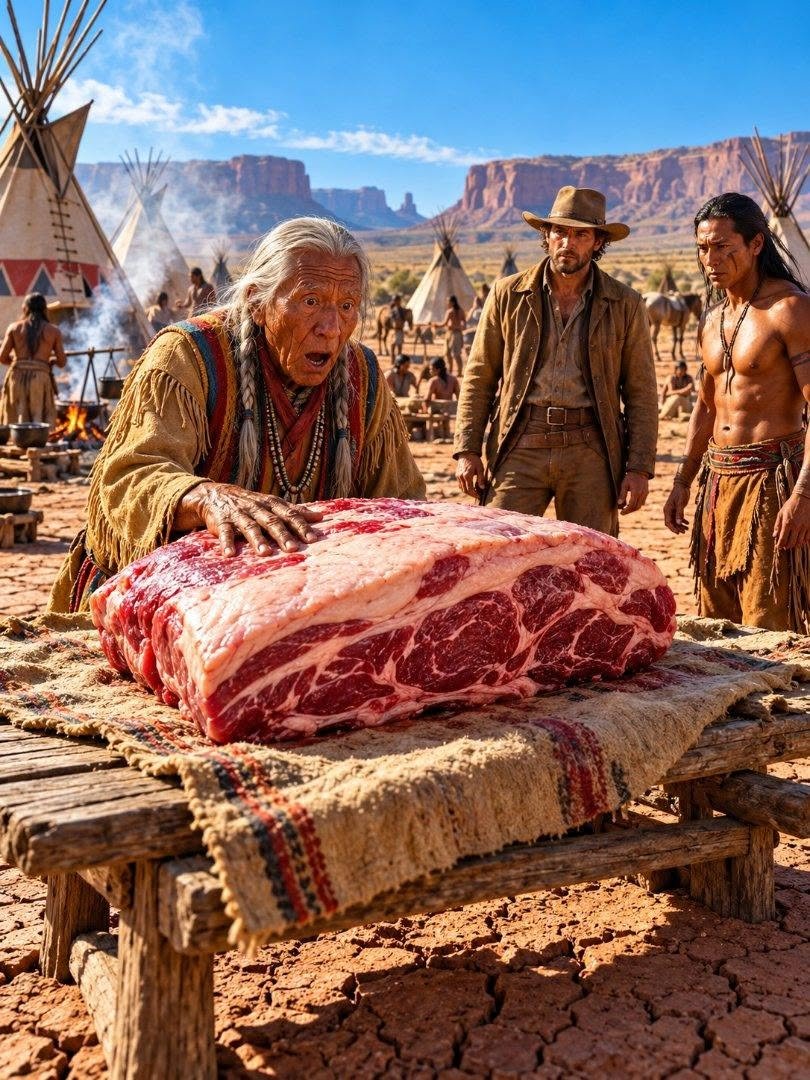
He approached the creek slowly, the mule following with its heavy load of fresh meat. When the camp came into view among the cottonwoods, several warriors stepped forward, hands near their weapons. Callum stopped at a respectful distance, dismounted, and unloaded the meat onto the same flat stone where he had left the venison the day before. He laid it out neatly — the choicest cuts, enough to feed many families.
Then he did something none of them expected. He stepped back, placed his open hands where they could see them, and waited.
An older man emerged from the camp — a leader, judging by the deference the others showed him. He walked to the stone, examined the meat, and looked at Callum for a long, searching moment. Then he did something that changed everything: he cut a strip of the meat, ate it, and nodded.
It was acceptance. It was trust, offered and received without a single word spoken.
What followed in the days after, the old traders would talk about for years. The leader — whose name Callum learned was Taho — invited the stranger to sit by the campfire. Through signs and the few words of Spanish they shared, they began to understand each other. Callum learned that the camp’s hunters had been struggling; game had been scarce near the creek that season, and children had gone to bed hungry. His meat had arrived like rain after a drought.
Callum stayed three days. He repaired a broken rifle stock for one of the young warriors — the same young man who had ordered him to leave. He showed the camp’s hunters the spring beneath the red rocks, a water source they had not known existed. In return, they taught him which plants held water in the dry months and how to read the desert sky for weather. On the third evening, Taho placed his own hand on Callum’s shoulder and spoke words Callum would remember for the rest of his life. The trader who later translated them said they meant, roughly: “You came as a stranger. You leave as a brother.”
Callum rode on when the time came, because the wandering life was in his blood and the mountains were calling. But he returned to Rincon Wash every autumn for the rest of his life — always with coffee, always with something to share, and always welcomed at Taho’s fire. The young warriors who had once ordered him away grew into men who greeted him as family. Their children knew him as the white-haired man who brought stories from the eastern hills and who never, ever came empty-handed.
Years later, long after both men were gone, a Navajo trader named Six Killer would tell this story around campfires and trading posts. He was known for remembering details other men overlooked, and whenever someone asked how the unusual friendship had begun, he always returned to the same small moment.
A piece of meat left on a stone. A man who obeyed without a fight. And the quiet understanding that respect, freely given, is the one gift that always finds its way home.
Callum Dray never owned land in that territory. He never built a cabin or raised a fence. But among the people of Rincon Wash, his name was spoken with honor for two generations — because he had understood what so many never learn: that the strongest thing a man can do when told to leave is to leave with grace, and the bravest thing he can do after that is to come back bearing a gift.


