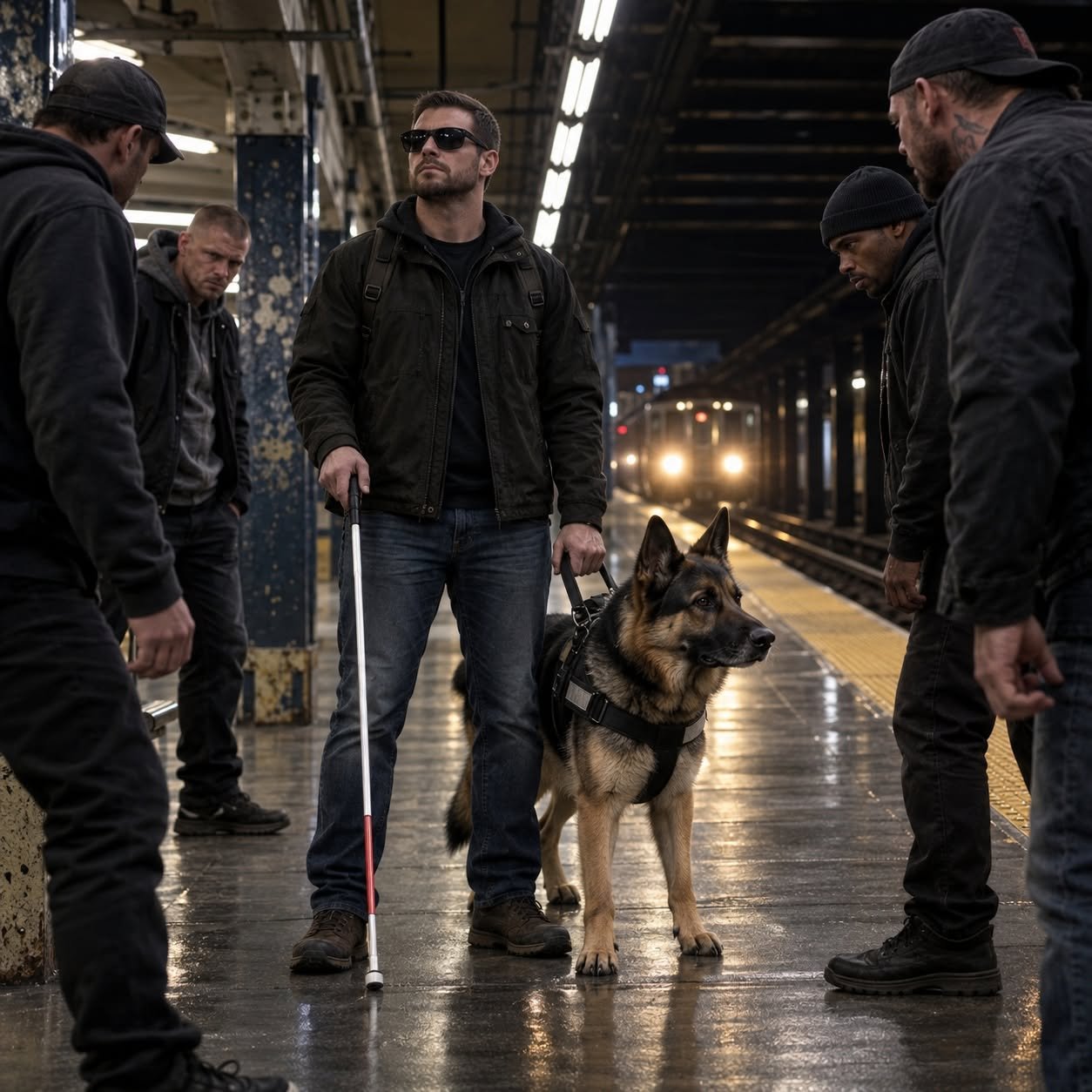
The Blind Veteran, His Dog, and the Four Men Who Picked the Wrong Station
The first man laughed when he saw Ethan Cole’s white cane. The second one called his German Shepherd “easy money.” The third asked how much a blind guy could possibly have in his wallet. And the fourth man made the mistake that changed everything. He reached for Ethan’s dog. Ethan was thirty-six years old that winter, medically retired from the Navy, and completely blind. People always ask what blindness feels like. They expect him to say darkness. But darkness isn’t the hardest part. The hardest part is how quickly strangers decide darkness has made you helpless.
Seven years earlier, Ethan had been riding in a military convoy overseas when an explosion changed his life in less than a second. When he woke up, he couldn’t see. He remembered asking the medic to turn the lights on. Nobody answered. That silence told him before any doctor did. The dog lying beside his hospital bed days later was named Atlas — a German Shepherd, a military working dog. Atlas had been with their team during the explosion, and while people were trying to reach the damaged vehicle, he had apparently grabbed the back of Ethan’s vest and pulled him far enough away to keep me alive. Atlas carried scars on one hind leg. Ethan carried his where nobody could see them.
Years later, after both of them retired, Ethan fought through enough paperwork to make Atlas his. Technically, Atlas became his service dog. The truth was simpler. Atlas was his partner. His eyes. His alarm system. And on bad nights, the only living thing that understood why Ethan sometimes woke up ready to fight a room that wasn’t there. That December night, Atlas and Ethan were coming home from visiting Ethan’s old teammate Marcus at a veterans center in Chicago. It was almost midnight. The station beneath Roosevelt Road was mostly empty. Ethan could hear a vending machine humming twenty yards away, water dripping from a pipe, a train moving somewhere deep underground.
Atlas guided him toward the platform. Then he stopped — not gradually, completely. The harness tightened in Ethan’s left hand. That was their first language. “What is it, buddy?” Ethan lowered his voice. Atlas’s breathing changed — slow, controlled, alert. Then Ethan heard footsteps. Four sets. Coming down the stairs. One heavy. One dragging slightly. Two quicker. Young men, talking loudly because they thought nobody dangerous was listening. “Place is empty.” “Perfect.” Then one of them saw him. “Well, look at this.” The laughter started. Ethan had heard that tone before. Not in Chicago. Everywhere. The tone of people who had already decided you couldn’t stop them.
Surrounded
Atlas shifted closer against Ethan’s leg. Ethan whispered, “Stay.” The footsteps spread out — one to his left, two in front, one lingering near the stairs. They thought they were surrounding him. What they didn’t understand was that Ethan didn’t need faces. He had distance. Shoes. Breathing. Echoes. The small sounds nervous people make when they believe they’re being quiet. The leader stopped a few feet away. “Late night for you, man.” Ethan kept his voice neutral. “Train should be here soon.” “You might miss it.” His friends laughed. Ethan smelled alcohol, cheap cologne, cigarette smoke.
“What do you want?” “Wallet.” Ethan sighed. “My transit card is in there.” “Funny.” “I wasn’t joking.” Someone moved closer on Ethan’s left. Atlas gave a low warning sound. The laughter stopped for a second. “Control your dog.” “He is controlled.” “Doesn’t sound like it.” “He’s telling you to stay where you are.” The leader stepped closer. “Your dog talks?” “Better than some people.” Bad decision. Ethan heard irritation replace amusement. Then a small metallic click — something folding open. He didn’t need to know exactly what it was. His body remembered the sound of danger long before his mind finished naming it. Atlas felt the change in Ethan through the harness. His entire body became still.
The man said, “Wallet. Watch. Phone.” Ethan didn’t move. “And maybe the dog.” For the first time, anger broke through his calm. “What did you say?” “That shepherd’s worth money.” Another man laughed. “You can’t even see him anyway.” Ethan’s hand tightened around Atlas’s harness. That dog had stayed beside him through surgery, nightmares, physical therapy, the first morning he’d tried crossing a street without sight and nearly turned around because he was too afraid. He had stood there waiting. Never judging. Never rushing. The man in front of Ethan had no idea what he had just threatened.
“You need to leave,” Ethan said. The leader laughed. “You think you’re giving orders?” “I’m giving you a chance.” One of the others moved closer. “You hear this guy?” Ethan heard fingers reach toward his cane. Another hand brushed Atlas’s harness. And something old woke up inside him. Not rage. Training. Calm. The kind of calm that arrives when fear has already had its turn. He let his cane fall. It struck the concrete with a sharp clatter. The four men went silent. Ethan straightened. Atlas waited beside him. The leader’s confidence wavered. “Hey, man…” “You have no idea what that dog is,” Ethan told him. “And you have no idea who I used to be.”
The Word He Promised He’d Never Use Again
Someone grabbed at Atlas again. That was the moment the night changed. Because there was one command Atlas had not heard since they left the military. One word Ethan had promised himself he would never need again. He turned his face toward the man reaching for him. And quietly said it.
What happened in the next eleven seconds, the station security cameras recorded in full — and the transit police watched it three times before they believed it. Atlas moved like something out of a training film the four men had never seen: disarming, disabling, controlling, never mauling, never out of control for a single second. When it was over, two of the men were on the ground holding wrists they’d rather not discuss, one was backed against a pillar with his hands very visibly empty, and the fourth — the leader — was sitting on the concrete with Atlas’s nose one inch from his face, having discovered that stillness is a survival strategy.
Ethan picked up his cane, recalled Atlas with a single soft word, and stood waiting when the transit police arrived four minutes later. The officers took one look at the scene — four young men, one blind veteran, one calm German Shepherd sitting at attention — and asked the question everyone asks: “What happened here?” The leader, still on the ground, answered before Ethan could. “We tried to rob him,” he said. “It was a mistake.” It was the most honest thing he’d said all night.
What the Cameras Showed
The footage made the local news, then the national news. Not because a veteran fought off muggers — though the internet loved that part — but because of what the cameras caught in the eleven seconds before it started: Ethan Cole, blind, outnumbered four to one, giving four young men every possible chance to walk away. “I’m giving you a chance.” The clip of him saying it, calm as still water, was played millions of times. Veterans’ groups called him. The Navy called him. A reporter asked if he felt like a hero. “I feel like a guy who missed his train,” Ethan said. “Atlas is the hero. I just hold the harness.”
But the story didn’t end at the station. One of the four men — the youngest, nineteen, the one who’d been lingering near the stairs — wrote Ethan a letter from county lockup. It said he’d joined the others because he was broke and stupid, that he’d never been so scared in his life, and that the blind man’s voice saying “I’m giving you a chance” had stayed in his head ever since. He asked if Ethan hated him. Ethan wrote back. He said hate was too heavy to carry on a platform at midnight, and that second chances were the only thing he’d ever seen work — on dogs, on men, on himself. They corresponded for a year. When the young man got out, Ethan and Atlas met him at the gate. He’s a veterinary technician now. He says Atlas interviewed him first.
Atlas’s Platform
Two years later, the Chicago Transit Authority renamed the waiting area at the Roosevelt Road station “Atlas’s Platform” and installed a bronze plaque: “For the dog who never left, and the man who taught a city that darkness is not helplessness.” Ethan brings Atlas there every December, on the anniversary. They stand where the cane fell. Commuters stop to shake Ethan’s hand. Kids ask to pet Atlas, who endures it with the dignity of a general.
Ethan still can’t see the plaque. He doesn’t need to. He runs his fingers over the raised letters the way he once read Atlas’s breathing in the dark — slowly, completely, trusting every sound and every silence. “People think blindness took something from me,” he tells the school groups that visit. “It gave me Atlas. It gave me back my training. And one night in December, it gave four young men the most important lesson of their lives: that the person you’ve decided is helpless might be the most dangerous person in the room — not because he wants to hurt you, but because he’s already decided to give you a chance, and you’d better take it.”
Atlas is ten now, gray around the muzzle, retired twice over and working still, because some dogs don’t know how to quit and some men don’t know how to let them. On bad nights, Ethan still wakes up ready to fight a room that isn’t there. And Atlas is still there beside him — breathing slow, controlled, alert — the first language they ever shared, and the only one they’ve ever needed.


