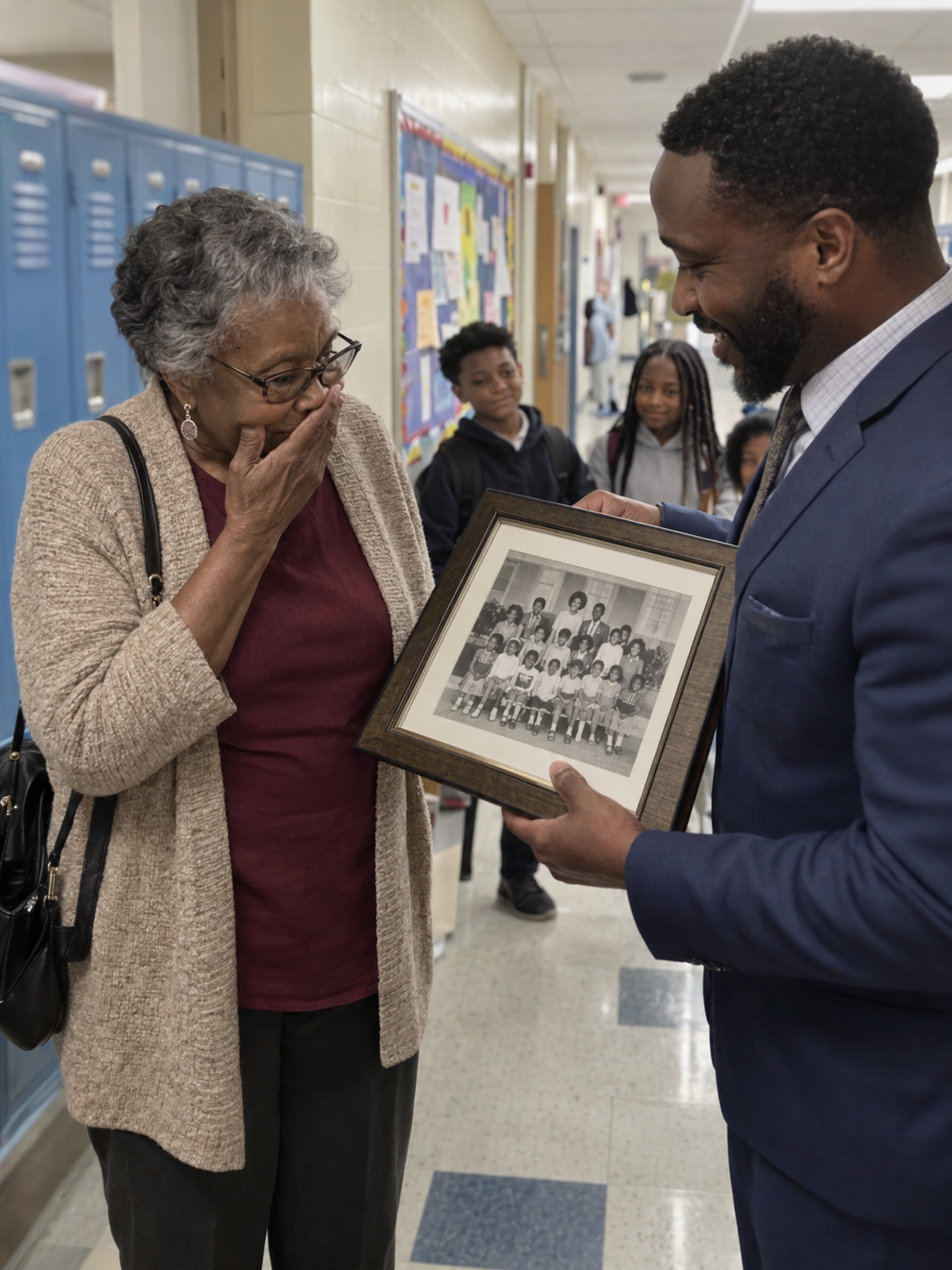
Mrs. Laverne Mitchell had taught third grade for thirty-eight years. She could remember the names of hundreds of students, though she sometimes forgot where she had placed her reading glasses. Her former school invited her to visit after the hallway was renovated, and she almost declined.
The school had changed since Laverne retired. The windows were larger, the floors were brighter, and the old wooden lockers had been replaced. She wondered whether the building would still feel familiar without the smell of chalk and paste that had once followed her from room to room.
Principal Daniel Brooks met her at the entrance. He was younger than many of Laverne’s former students, but he had heard stories about her from teachers who had stayed. He told her that the school had found something while moving a cabinet in the main office.
Laverne walked slowly down the hallway. Children passed with backpacks and bright shoes. Some looked at her with curiosity. Daniel stopped outside a classroom and asked her to wait for a moment.
When he returned, he carried a large wooden frame. Inside was a black-and-white class photograph. Laverne recognized her younger self immediately. She stood behind twenty-three children, wearing a dress with a white collar and holding a small book.
Laverne believed the photograph had been lost. It was taken during her first year of teaching, when she was twenty-four. She remembered that one child had cried before the picture and another had refused to remove a baseball cap.
Daniel told her the frame had been donated by a former student named Curtis. Curtis was now a grandfather and lived nearby. He had kept the photograph in a closet for more than fifty years.
Curtis had found the school’s renovation announcement online and contacted Daniel. He said Laverne was the first teacher who told him he was not bad at reading. He had simply never found a book that felt like it belonged to him.
Laverne touched the glass over Curtis’s face. She remembered him as a quiet boy who drew trains in the margins of his worksheets. She had given him a book about a young engineer, and he later became a railway mechanic.
Daniel had invited several former students without telling Laverne. They entered the hallway one at a time. Some were gray-haired. Some walked with canes. One woman had brought a grandson who was now in the same third-grade classroom Laverne had once taught.
They told stories about Laverne’s classroom. She kept extra gloves for children who came in cold weather. She placed books on the floor so students could read during recess. She wrote letters to parents when a child showed an unusual talent.
Laverne remembered none of these things as extraordinary. She said she had only done what the children needed. The former students disagreed. They told her those small choices had shaped how they saw themselves.
Daniel placed the photograph on a table and asked the former students to stand behind it. The current children gathered nearby. Laverne looked from the old faces to the new ones and realized that teaching had not ended when she left the classroom.
Curtis gave her a copy of the photograph. On the back, he had written a sentence for her: “You taught us how to keep going before we knew we needed the lesson.” Laverne read it twice.
Before leaving, she read one page from a children’s book to the students. Her voice was softer than it had been in the classroom, but every child listened. The principal placed the framed photograph in the school library where anyone could see it.
Laverne believed she had spent her life giving books and encouragement away. That afternoon, a group of former students returned something she did not know she had left behind: proof that a teacher’s ordinary days can become another person’s lifelong memory.


