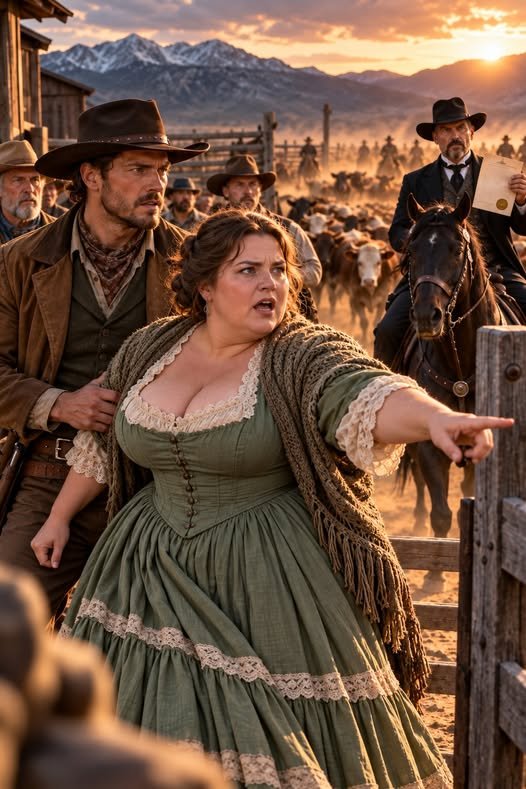
The winter of 1887 came down hard on the Colorado Rockies, and Amily Ward ran through it with three armed men on her trail and a terror in her chest that had nothing to do with the cold.
The stagecoach had been attacked at dusk on the mountain pass. Amily, the only passenger, had fled into the pines while the driver fought for his life. She didn’t know if he lived. She knew only that the men wanted the strongbox — and that they had seen her face.
She stumbled onto Harlon’s cabin near midnight: a low log hut with smoke in the chimney and lamplight in one small window, the loneliest-looking place she had ever been grateful to see.
The door opened before she knocked. The man who filled it was enormous — six and a half feet of beard and flannel, with eyes that took her in the way a man takes in a wounded animal: carefully, and without judgment.
“Please,” Amily gasped. “Men — with guns — they’re behind me—”
“Get in,” he said.
His name was Harlon Beck, and he had lived alone on that mountainside for eleven years, trapping and cutting timber, speaking to almost no one. He gave Amily his chair by the fire, wrapped a wool blanket around her shoulders, and put a tin cup of hot coffee in her hands without asking a single question.
“I’m too big,” she whispered suddenly, tears cutting clean tracks through the grime on her face. “I know what you’re thinking. I’m too big to hide, too big to run. I’ve heard it all my life.”
Harlon looked at her for a long moment. “Ma’am,” he said, “I’ve carried hundred-pound timber up this mountain in January. Size never shamed anybody in my cabin. Drink your coffee.”
Then he crossed the room, bent down, and lifted the corner of the great bearskin rug by the hearth. Beneath it was a wooden hatch with an iron ring.
“In case they come,” he said simply, and opened it.
Warmth rose up through the opening like a breath. Below the hatch, stone steps descended into a cavern carved into the mountain itself, where a natural hot spring steamed in the lamplight — a hidden pool of clear, warm water, veined through the rock, invisible to anyone who didn’t know the cabin’s secret.
“Hot spring,” Harlon said. “The mountain’s got a warm heart. Nobody knows but me. You go down there if they come. There’s air and water and a ledge to sit on. I’ll close the hatch and lay the rug back, and they’ll never find you.”
Amily stared at him. “Why would you do this for me?”
“Because you’re here,” he said, as if that settled it. “And because no woman should be hunted like a deer in my mountains.”
She had just descended the steps, marveling at the warm water lapping the stone, when the knock came — three heavy blows that shook the cabin door.
“OPEN UP, HARLON. WE DIDN’T COME JUST FOR THE WOMAN.”
The voice was cold and familiar with cruelty. Harlon’s face changed — recognition, and something harder. He pulled the hatch shut, laid the bearskin rug smooth over it, and set his chair squarely on top. Then he took his rifle down from the wall.
“Stay quiet, stay warm,” he murmured toward the floor. “Whatever you hear.”
He opened the door. Three men stood in the snow with lanterns, rifles slung low. Their leader was a lean man with a scar through his lip — Cole Drummond, and Harlon knew him, all right. Five years earlier, Drummond’s gang had burned a timber camp down the valley and left two men dead. Harlon had testified at the trial that sent two of them to prison.
“Harlon Beck,” Drummond said, smiling with his scar. “Heard you turned hermit. We’ve come for the woman from the stage — she saw our faces. And we’ve come for you, too, witness. Two birds.”
“There’s no woman here,” Harlon said.
“Then you won’t mind us looking.” Drummond stepped forward — and stopped when Harlon’s rifle came up level with his chest.
“You’ll mind leaving,” Harlon said.
For a long moment nobody moved. The lantern light flickered on the snow. Then Drummond laughed. “Three guns to your one, old man.”
“Count again,” said a voice from the floor.
The bearskin rug had shifted. Amily Ward stood in the open hatch, waist-deep in the stairwell, holding Harlon’s old cap-and-ball pistol — the one he’d kept loaded under the hearthstone for eleven years and never told a soul about. Her hands were steady. Her eyes were clear.
“You burned that timber camp,” she said to Drummond. “The driver of my stage told me about it before — before you shot him. He said a man named Harlon testified and you swore revenge. So this was never just about the strongbox. It was never just about me.”
Drummond’s smile died. “Girl, you don’t know what you’re—”
“I know exactly,” Amily said. “I’m the witness now, too.”
What happened next happened fast and was over faster. Drummond went for his gun; Harlon’s rifle spoke once, and the lantern in Drummond’s hand shattered, spraying oil and darkness. In the confusion, one of the men fired wild into the cabin wall. Amily’s pistol roared from the hatch — she aimed at the snow at their feet, and the blast of it, echoing off the mountain, was enough.
The three men ran. They ran from a mountain man with a rifle and a woman rising out of the floor like judgment itself, and they didn’t stop running until they were off Harlon’s mountain. The territorial marshal picked up Drummond’s gang two weeks later in Leadville, with Amily’s testimony and Harlon’s added to the charges.
That night, after the danger had gone down the mountain with the men, Harlon built up the fire and Amily sat beside him, wrapped in the blanket, both of them shaking a little with what had almost happened.
“You were magnificent,” Harlon said quietly.
“I was terrified,” Amily admitted.
“Those two things live in the same house,” he said. “I know. I’ve lived there.”
In the spring, when the passes cleared, Amily Ward did not go back east as everyone expected. She stayed on the mountain — first in the cabin’s spare room, then, the following autumn, as Mrs. Harlon Beck, married by a circuit preacher in front of six trappers and one very proud former stagecoach driver who had survived his wounds after all.
She never again apologized for her size. Harlon built her a chair wide enough to be comfortable and strong enough to last, and when she laughed — which was often, in the years that followed — the whole mountainside seemed to laugh with her.
Folks in the valley still tell the story of the night a woman came up out of a mountain man’s floor with a pistol in her hand and faced down Cole Drummond’s gang. But Harlon always corrected them on one point.
“She didn’t come up out of my floor,” he’d say, with that slow mountain smile. “She rose up out of that warm spring like the mountain itself sent her. And the mountain,” he’d add, looking at his wife, “has excellent judgment.”