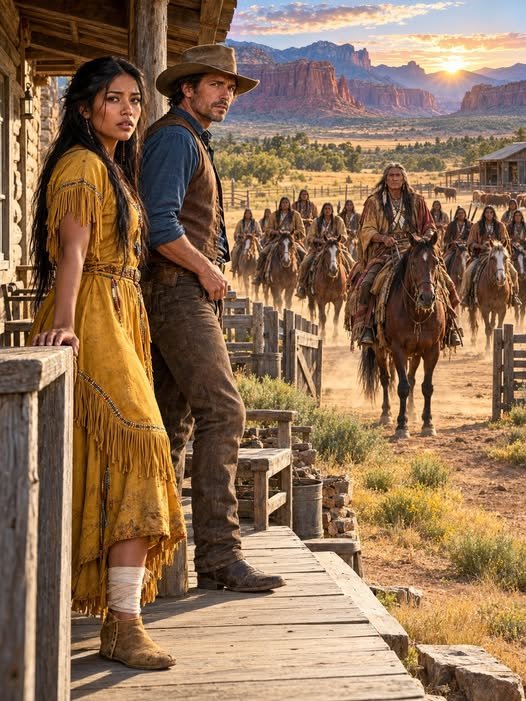
October 1887. The aspens had gone gold above Red Elk Creek, and Walter Harlow counted out forty silver dollars into Gideon Mercer’s palm as if he were selling a mule. His daughter Cora, eighteen, stood beside the wagon with her shawl pulled tight, and did not cry. She had done her crying the night before, into her mother’s old pillow, and there were no tears left to spend.They rode up into the pines in silence. Gideon’s cabin squatted against the mountain like something the mountain had coughed up — low roof, smoke-stained logs, a yard full of stumps. And in the doorway, when the horses stopped, stood three children with eyes like cornered foxes. The oldest, a girl of eight, held a shotgun twice as tall as her temper.”That’s Mary,” Gideon said. “She’s eight. The boy is Samuel, six. The little one is Ben, he’s three.” Mary did not lower the gun. “Papa says you’re the woman he bought,” she announced. Samuel hid behind the doorpost. Little Ben stared at Cora’s face and then, without a word, offered her a pinecone.That first night, Cora lay on the cabin’s only bed and listened to the wind tear at the shutters, waiting for the thing she had been sold for. It never came. Gideon spread his bedroll on the floor across the doorway, his rifle beside him, his back to the door — between her and the night, between her and everything. She slept before dawn, confused and, for the first time in weeks, unafraid.The cabin was a ruin of grief. For three weeks Cora scrubbed: she hauled water from the creek, boiled the bedding, scraped three seasons of soot from the hearthstones. The children watched her like wild colts — first from the doorway, then from the table’s far end, then from her elbows. Mary surrendered the shotgun to the peg above the door on the ninth day, and Cora pretended not to notice the tears the girl blinked away.Gideon never explained himself. He split wood until his shoulders steamed in the cold air. He mended her broken shoe-sole with leather from his own trapping pouch, stitching by lamplight while the children slept. He set a tin cup of hot broth outside her door every morning before he left for the trap line, the way other men leave flowers.But the question gnawed at her. Why would a man pay forty dollars — a fortune on the frontier — for a girl, and then sleep on the floor? She had heard stories in town about men like him, and none of them ended with broth at the door. “Why did you buy me?” she asked one evening. He only looked at the fire. “Ask me when you’re not afraid of the answer,” he said.In the fourth week he took her to the trading post at Pine Hollow for flour and salt. The whole store went quiet when Gideon Mercer walked in with the Harlow girl on his arm. Then a voice cut through the silence like a rusty saw. “Well, well. The mountain man brought his purchase to town.” It was Silas Boone, a freight trader with a red face and mean hands, and he caught Cora’s wrist in a grip like a trap.”Let’s have a look at what forty dollars buys these days,” Boone sneered, twisting her arm. The room held its breath. Cora tried to pull free and could not. Boone’s grip tightened, and his other hand rose —He never finished the motion. Gideon’s hand closed around Boone’s wrist, and the big trader’s face went white. Gideon did not raise his voice. He never raised his voice. “Let go of her,” he said, very quietly, and Boone let go as if the wrist had been burned. The store was so silent you could hear the stove ticking.”She’s bought and paid for,” Boone blustered, rubbing his wrist. “You of all men can’t preach at me, Mercer.” A few men chuckled, ugly and nervous. Cora felt every eye in Pine Hollow on her face, and shame rose in her throat like smoke.Then Gideon reached inside his coat and drew out a paper, folded small and soft with carrying, creased at the edges like something read a hundred times by lamplight. He unfolded it slowly, so the whole store could see the red wax seal at the bottom, and the signature of Judge Amos Pritchard of Clear Creek County.”I paid forty dollars,” Gideon said, “to get her away from the man who was selling her. Now —” he turned, and his eyes found Cora’s, steady and sad “— let’s tell her what that forty dollars really bought.”The judge’s clerk had written it in a careful hand, and Gideon read it aloud, every word. It was a Deed of Free Guardianship: for the sum of forty dollars, Walter Harlow relinquished all claim upon his daughter Cora Harlow, and Gideon Mercer accepted her not as wife, not as servant, not as property of any kind — but as his ward, under the protection of the county, free to leave his roof at the end of one year with ten dollars of her own and a letter of character. “She was never bought,” Gideon said. “She was ransomed.”Then, in front of them all, he told the rest. Two winters past, his wife Elara had taken fever while he was three days out on the trap line, and by the time he got home the children were alone with her body, Mary holding that same shotgun at the door to keep the coyotes off. He had buried Elara under the white pine and buried his heart with her, and the children had gone wild as brushfire while he drowned in a bottle. “Then last spring,” he said, “I heard Walter Harlow was selling his girl to whoever’d pay — and I remembered what it felt like to come home too late.”Cora stared at him. All those silent weeks suddenly stood plain: the bedroll across the door, the broth, the mended shoe. He had not been keeping her in. He had been keeping the world out, until she was strong enough to choose.Boone tried to laugh, but the sound died alone in the room. Old Mrs. Abernathy, who ran the post, took the deed in both hands and read it twice, and then she did something nobody expected: she curtsied to Gideon Mercer, deep as a girl. One by one, the men took off their hats.On the ride home, Cora held the deed in her lap. “You could have told me the first night,” she whispered. “No,” Gideon said. “You needed to see who I was before you heard what the paper said. Paper’s cheap. A man has to prove it.” She looked at the three small faces waiting in the doorway — Mary already running, Samuel waving both arms, Ben holding up a pinecone like a crown — and she understood she had already chosen.A year to the day, she walked into Judge Pritchard’s office with ten dollars in her pocket and the letter of character in her hand — and a marriage license application in the other. “You’re free to go anywhere,” the judge said, smiling. “I know,” said Cora. “That’s why I’m staying.” Gideon married her that Sunday under the white pine where Elara slept, with Mary holding the ring box like it was a shotgun and Samuel crying louder than the baby.People in Clear Creek County still talk about the day Gideon Mercer unfolded that paper in Pine Hollow. They say some men spend forty dollars to own a person, and one man spent forty dollars to set one free — and the free one, being free, chose him anyway. That is the whole of the story, and there is not a finer one in these mountains.