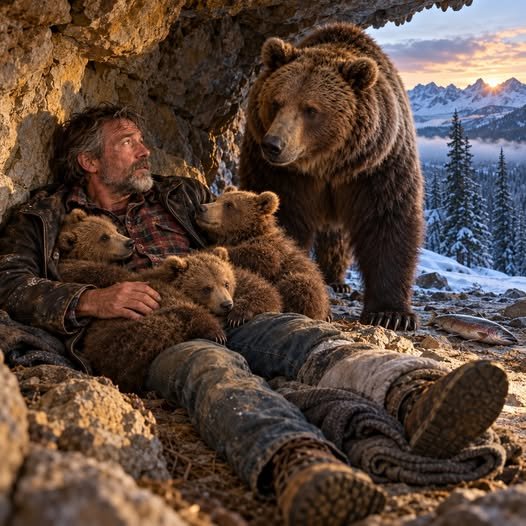
Frank Harlan woke with something breathing against his neck. Something warm. Heavy. Then a small paw settled across his chest, and in the gray light of the cave entrance, he counted three bear cubs sleeping against him.
He couldn’t stand. He could barely breathe. And somewhere outside, their mother was coming home.
In the fall of 1982, Frank was fifty-one years old and convinced there was nobody left who needed him. He had spent his life fixing engines and riding motorcycles with men he called brothers. Before that, he had been a soldier.
Over the years, the funerals began outnumbering the weddings. Eventually, Frank left for good — rode north from California with a bedroll, a few tools, and no particular reason to return.
Outside Red Lodge, Montana, his front wheel found a rain-carved channel in an old logging road. The bike pitched sideways. He went over the handlebars and landed hard enough to knock the world silent.
His left leg wouldn’t support him. There were no houses, no traffic, and nobody knew which road he had taken. He had wanted to be somewhere nobody could find him. Now he was.
He dragged himself uphill to a limestone outcrop and crawled into a shallow cave. When he woke, the cubs were there — one against his injured leg, one beneath his jacket, the smallest tucked beneath his chin.
Then the light at the entrance disappeared, and a bear stood in the opening. Enormous. A healing wound marked one flank.
Frank kept his hands still and shut his eyes. Something landed beside his feet — part of a fish. The bear lowered herself along the wall behind him, close enough that her warmth reached his back.
For eleven days, she allowed him to remain. He drank water dripping near the entrance and stayed warm between her and the cubs while snow closed the mountain around them. He began to believe he might live.
On the eleventh morning, a rifle shot cracked across the valley.
The bear sprang up. Below, two men were climbing toward the cave. One raised his rifle. The other pointed directly at the entrance.
And the animal that had kept him alive stepped forward to meet them.
Frank would later learn their names: Dale Kovic and his teenage son, Marcus. They were poaching — a bear out of season meant a fine that would ruin them, so they had come to finish what Dale’s first shot had started. That healing wound on the bear’s flank was Dale’s work from a week before.
What Dale had not expected was a man in the cave.
“Don’t!” Frank shouted, dragging himself toward the entrance on his elbows, his broken leg screaming. “There’s a man in here! You’ll hit me!”
Dale froze. Marcus lowered his eyes.
But the bear did not wait for their decision. She charged out of the cave with a roar that shook snow from the pines — not at the men, but past them, drawing their aim away from the entrance, away from Frank.
Dale fired in panic. The shot caught her high on the shoulder. She stumbled, caught herself, and kept coming. Dale fired again and missed. Marcus grabbed his father’s arm.
“Stop! There’s a person in there, Dad. Stop!”
The bear veered off into the trees, the three cubs tumbling after her. Dale stood shaking, and in that moment the poacher understood what he had almost done — nearly killed a man to cover up killing a bear.
Marcus was the one who climbed into the cave. He was the one who splinted Frank’s leg with branches and his own belt, who built a fire, who stayed with him through the night while Dale went down the mountain for help.
The bear survived. The second shot had only grazed her; the first wound — Dale’s — was already healing. A wildlife officer who came with the rescue team tracked her to a den two ridges over, the cubs piled against her, alive.
Dale lost his hunting license for life and paid a fine that took him three years to clear. He never poached again. Every fall, he sends a donation to the Montana wildlife fund in an envelope with no return address.
Frank’s leg healed. In the hospital in Billings, with his leg in traction and his ribs taped, he did something he had not done in eighteen months.
He called his daughter.
She answered on the third ring. There was a long silence. Then she said, “Dad?” — and Frank Harlan, who had faced down a bear and lived, wept like a child.
She drove through the night to reach him. They talked until dawn — about the eighteen silent months, about the grandson Frank had never met, about the cave and the bear who had shared her fish with a broken stranger.
The following spring, Frank rode back to that mountain — on a new bike, with his leg strong and his daughter riding behind him. They hiked to the ridge above the cave and waited.
At dusk, she came: the great bear, her cubs now yearlings, ambling along the treeline. She stopped. She looked up at the ridge for a long moment.
Frank’s daughter squeezed his arm. “Does she remember you?”
The bear huffed once — a sound Frank would swear was recognition — and moved on into the pines with her young.
Frank never told the story for glory. He told it for one reason: because for eleven days, a wild animal had shown him what he had forgotten — that a life is worth keeping warm, even a life its owner has given up on.
He keeps a photograph on his mantel now. Not of the bear — he never got one. It’s a photograph of his daughter and grandson, taken the day he finally came home.
On the back, in his rough handwriting: “She used the last of her strength to show me why she had let me stay. So I came home to show them why they should let me stay, too.”


