Nora Callaway had crossed half of America to marry a stranger, and nothing about the Greer ranch was what she had expected.
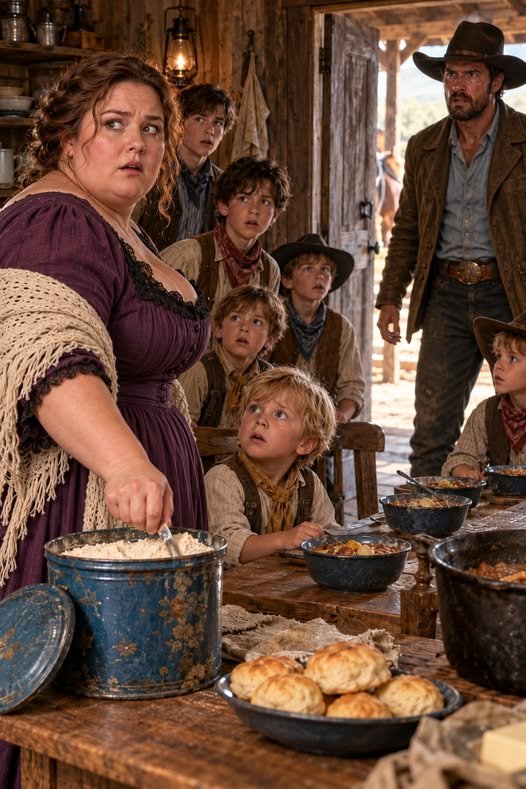
She had imagined a wedding. Instead she found a four-year-old boy standing on a stool beside a blazing stove, stirring a pot of burning beans with a spoon nearly as long as his arm.
His name was Ru. He was making supper for his five brothers, who had not eaten since morning.
Nora did what any woman with a working heart would do. She rolled up her sleeves, rescued the beans, found flour for biscuits, and fed six starving boys at a table set with six empty places.
Then Harlon Greer walked through the door.
He did not smile at the clean kitchen. He did not thank her for the steaming food. His face drained of color, and his voice shook as he asked the question that froze the blood in Nora’s veins.
“Please tell me you didn’t use the flour from the blue tin.”
She had. And Thomas, the eldest boy, whispered the words that turned the kitchen silent: “Pa… that’s the tin Ma told us never to open.”
Nora’s hands began to tremble. She looked at the six boys, at the half-eaten biscuits on their plates, and felt the floor tilt beneath her.
“What was in the tin?” she whispered.
Harlon sank into a chair like a man twice his age. “Rat poison,” he said. “Years back, we stored strychnine in that tin. Their mother found it before any of the boys could touch it. She warned them never to open it. And I—” His voice broke. “In all the grief after she passed, I forgot. I forgot to throw it away.”
Thomas was already on his feet. “The doctor,” he said. “I’ll ride for the doctor.”
“No.” Nora’s voice came out sharper than she intended. “No one rides anywhere yet.” She was thinking, thinking hard, the way she had learned to think in Sorrow Creek when there was no one else to do the thinking. “Harlon. When did your wife die?”
“Two years ago. Fever.”
“And in those two years, has anyone opened the blue tin?”
The boys shook their heads. Thomas said, “Ma’s word was law in this house.”
Nora walked to the pantry on legs that did not feel like her own. The blue tin sat on the highest shelf, its lid dented, its paint worn. She lifted it down with both hands.
It was nearly full of fine white powder.
“Before anyone panics,” she said, “let me ask one question. Harlon, did your wife ever hide things in tins? Money? Letters?”
Harlon stared at her. “What?”
“Just answer me.”
He rubbed his face. “She… yes. She kept her buttons in a coffee tin. Her mother’s brooch in a tea tin. She said a woman’s treasures are safest where no one thinks to look.”
Nora set the blue tin on the table. Six boys and their father gathered around it like mourners at a grave. Slowly, Nora worked the lid loose.
Inside, wrapped in a faded handkerchief, lay a gold wedding band, a stack of worn dollar bills, and a folded letter in a woman’s careful hand.
Harlon made a sound like a man punched in the chest.
“That’s her ring,” he whispered. “She was buried without it. I thought— I thought we’d lost it.”
Nora unfolded the letter with shaking fingers, and read it aloud:
“To whoever opens this tin: if you are reading this, then I am gone, and you are hungry enough to need what is hidden here. The poison that was in this tin is at the bottom of the river, where I threw it the week I found it. I kept the warning on the tin because a mother’s warning is obeyed even when she is gone, and I needed a place no curious boy would ever open. Inside is my ring — sell it if you must, though I hope you won’t — and forty-seven dollars I saved egg by egg. Feed my boys. And Harlon: forgive yourself. You were a good husband. Let someone love them the way I did.”
No one spoke. Then Ru, four years old, climbed into Nora’s lap and wrapped his arms around her neck.
Harlon Greer — the towering cowboy who had not rested properly in years — put his face in his hands and wept.
The poison had never been in the tin. The flour was only flour. The biscuits were only biscuits.
That night, after the boys were asleep with full stomachs for the first time in longer than any of them could remember, Harlon found Nora on the porch.
“You saved them before you even married into this family,” he said quietly.
“I only made supper,” Nora said.
“No.” He took her hand. “You did what their mother asked. You fed her boys.”
They were married three days later in the front yard, with six boys standing witness and Ru holding the ring — Ma’s ring — that Harlon slipped onto Nora’s finger.
Nora never forgot the words in that letter. She kept the blue tin on the pantry shelf, empty now, as a reminder: a mother’s love does not end at the grave. Sometimes it waits, patient and quiet, in a tin on the highest shelf — until the right woman comes along to open it.
The boys laugh every time. Nora just smiles, and serves the biscuits.
And every year on their anniversary, Harlon tells the story the same way: “She traveled west to marry a stranger. Instead, she married a family. And the first thing she ever cooked for us nearly gave me a heart attack.”


