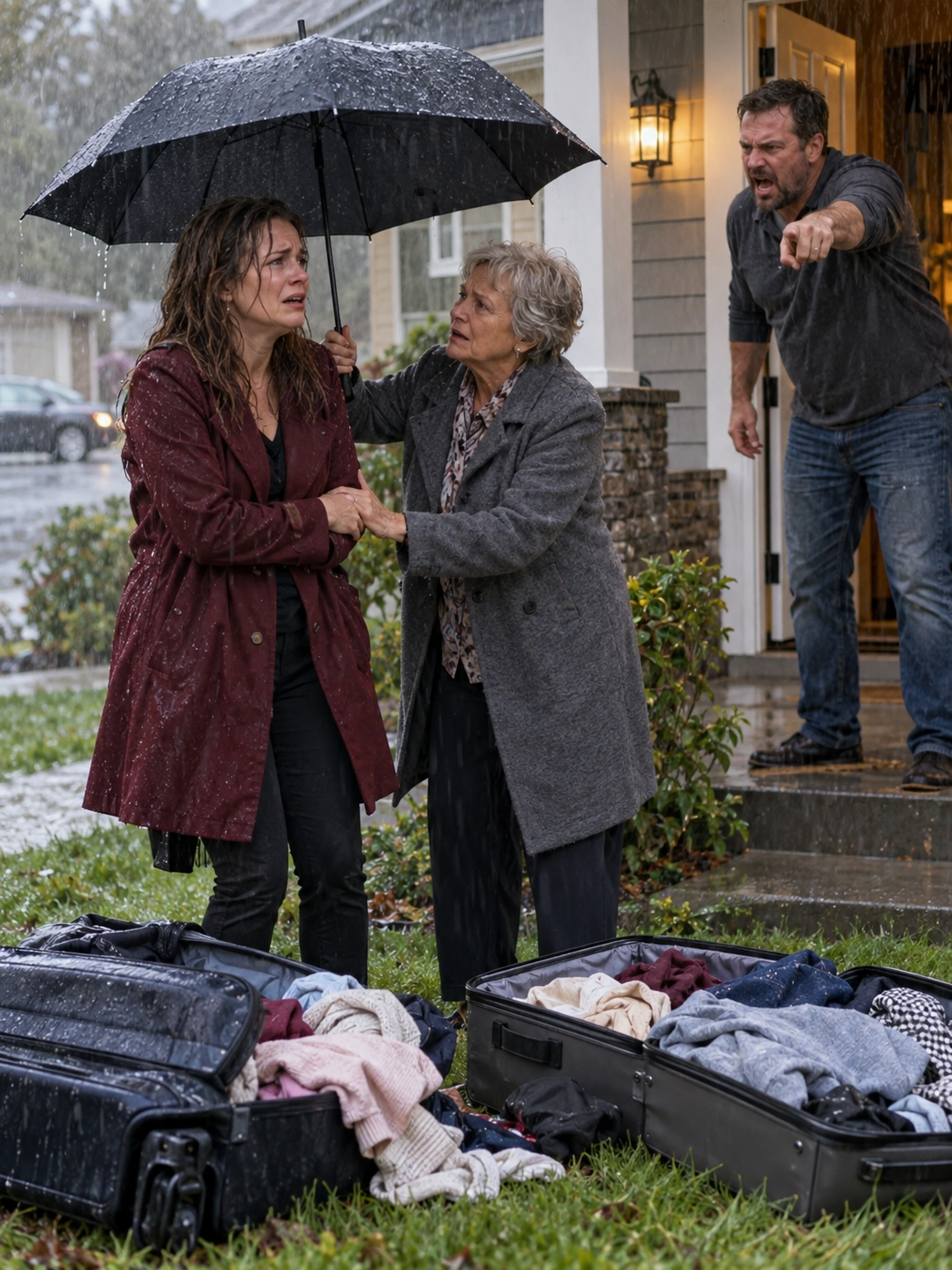
Rain was filling the open suitcase before Claire reached the lawn. Her sweater lay across the wet grass, one sleeve trailing toward the gutter. From the porch, her husband pointed at the street and told her to call someone. Then his mother opened the front door behind him, looked at the scattered clothes, and walked outside carrying a single umbrella.
Claire was forty-five. She had come home from a late shift to find the locks changed and two cases by the steps. That afternoon, she had told Daniel she wanted to separate. She expected a difficult conversation about belongings, bills, and where each of them would stay. She had not expected him to turn the front lawn into an answer while she was still at work.
“She made her choice,” Daniel told his mother. Evelyn did not answer him. She crossed the lawn, opened the umbrella over Claire, and asked whether anything important was still inside. Claire thought first of her passport and the notebook containing her late father’s recipes. The clothes could be washed. She could already see brown water spreading through the cardboard box that held the notebook.
Evelyn had lived in the house’s small downstairs room since a fall the previous winter. Claire had driven her to appointments, learned which tea settled her stomach, and listened when she worried about becoming a burden. Daniel sometimes praised his wife for being patient. Now he stood dry under the porch while the woman who had done that work knelt in the rain.
Claire did not ask Evelyn to choose sides in their marriage. She asked her to watch the suitcases while she called her sister. Her phone screen was too wet to recognize her thumb. Evelyn held the umbrella lower, shielding it with her sleeve. On the porch, Daniel said they were making a scene. A neighbor had already come to her window because he was shouting.
Evelyn looked up at her son. “Go inside and bring her the rest of her things,” she said. He told her she did not understand what had happened between them. She answered that she understood what was happening on the lawn. Claire stared at the umbrella handle in Evelyn’s hand, the same hand she had steadied on the clinic steps only three days earlier.
The neighbor, Mrs. Patel, came out with two clean laundry baskets. She did not ask for the history of the marriage. She asked which items were wet and which could be lifted without falling apart. Claire found herself grateful for the plainness of the question. Together they moved the clothes beneath Mrs. Patel’s carport, where the rain could no longer keep ruining what was already difficult.
Daniel brought a box to the door and left it there. Evelyn carried it out, checked that Claire’s passport was inside, and wrapped the recipe notebook in a towel. Then she turned back toward the house. “I’m getting my overnight bag,” she said. Daniel’s expression changed. He had assumed his mother’s presence beneath his roof meant she would remain beneath his version of events.
Evelyn had not planned to leave that evening. Her medication was upstairs, and she needed time to climb safely. She asked Daniel for her cane. He said she was being manipulated. She repeated the request until he handed it over. Claire waited by the carport with Mrs. Patel, uncertain whether to protest that Evelyn should not make her own life harder because of this. At the top of the stairs, Evelyn paused beside the photograph of Daniel as a child. She remembered teaching him to apologize when he knocked over another child’s things. It disturbed her how easily people excused the same behavior once the belongings belonged to a spouse. She took her medication bag from the dresser and checked it twice before coming back down.
When Evelyn returned, she carried the small case Claire had bought for her clinic visits. “I don’t want you staying somewhere that doesn’t feel safe for you,” Claire said. Evelyn answered that she had a daughter with a guest room and a driver willing to collect her. She had made a call while upstairs. At seventy, she still knew how to decide where she would sleep.
Claire’s sister arrived first. They photographed the condition of the soaked belongings so Claire would not have to rely on memory later, then loaded everything into the car. Nobody tried to settle property arrangements in the driveway. Claire said she would arrange another time to collect what remained, with someone accompanying her. She wanted the next step planned rather than shouted across a lawn.
Evelyn’s daughter arrived soon afterward. She listened while Evelyn described the evening, then helped her into the passenger seat. Daniel stood in the doorway, asking whether everyone was leaving him. Evelyn said she would speak with him when he could discuss what he had done without blaming the people who had watched it happen. She did not slam a door. She fastened her seat belt.
At her sister’s kitchen table, Claire spread out the damp recipe pages. Some ink had run, and one corner stuck to the towel. She began to cry over a list of ingredients for soup. Her sister knew the tears were larger than the notebook. She warmed a pot of water and let Claire name what she could still read while they separated the pages carefully. They placed each page on clean paper and wrote its number in pencil on a separate list. Claire’s father had added little notes about who liked each dish. One line mentioned a neighbor who always asked for extra pepper. Recovering those ordinary names helped Claire remember that her family history existed beyond the house she had just been told to leave.
Over the next week, Claire made appointments, found advice about the practical steps of separating, and arranged the collection of her remaining belongings. She did not assume every angry message needed an immediate response. Her sister kept the spare room ready and made no demand that Claire decide the rest of her life by Friday. Quiet became something she could use to think, rather than something waiting to break.
Evelyn called on the third morning. Claire expected an appeal to reconsider, but Evelyn asked about the notebook. She remembered her own copy of one recipe and offered to write it out. They talked about seasoning and whether Claire’s father had used celery leaves. It was a relief to have a conversation that acknowledged the marriage without making every sentence serve the argument about it.
Daniel later apologized for putting the cases outside. Claire heard him, but she did not treat an apology as an instruction to return. She said future arrangements needed to remain respectful and specific. He wanted to discuss everything at once. She preferred written plans for the next collection. This was the first time she noticed how much energy she had spent managing the pace of his feelings. Evelyn mailed the recipe rather than dictate it over the phone. Her handwriting was large, and she added a question mark beside an ingredient she could not quite remember. Claire liked that honesty. The page arrived without advice about whether she should miss Daniel, forgive him, or begin again. It offered one useful thing and trusted her to choose the rest.
Evelyn eventually moved into a small apartment near her daughter. She continued seeing her son, setting her own boundaries about their conversations. She also continued calling Claire. Neither relationship required pretending the lawn had never happened. Claire did not ask Evelyn to deliver messages, and Evelyn did not make herself an intermediary. Their friendship had earned a place of its own through years of ordinary care.
The notebook dried unevenly. Claire copied the surviving recipes into a new book and left the stained original in a box with family photographs. On the first page of the new one, her sister wrote out the soup from memory. Evelyn contributed another dish. The finished book held several hands, which felt appropriate for something rescued by people bringing baskets, towels, rides, and time.
Months later, Claire bought a secondhand table for her new apartment. Evelyn and Mrs. Patel came for lunch, and Claire made the soup. They talked about a neighbor’s garden and a film nobody entirely liked. Rain started against the windows during dessert. Claire noticed it without feeling she needed to hurry outside to save anything. For a while, she simply listened to it from her own kitchen. Claire had worried the apartment would feel temporary for years. Setting three places at the table changed that feeling more than buying furniture had. Evelyn asked where the cups belonged, and Mrs. Patel helped wash up. Nobody needed Claire to justify the arrangement. It was a home because she was living in it and could invite people to stay for another cup.
What she remembered most from the lawn was not Daniel pointing at the street. It was Evelyn stepping off the porch before she had all the details, holding an umbrella over the person being hurt in front of her. She had not solved a marriage. She had made one clear choice about one visible wrong, and given Claire enough shelter to make the next choice herself.


