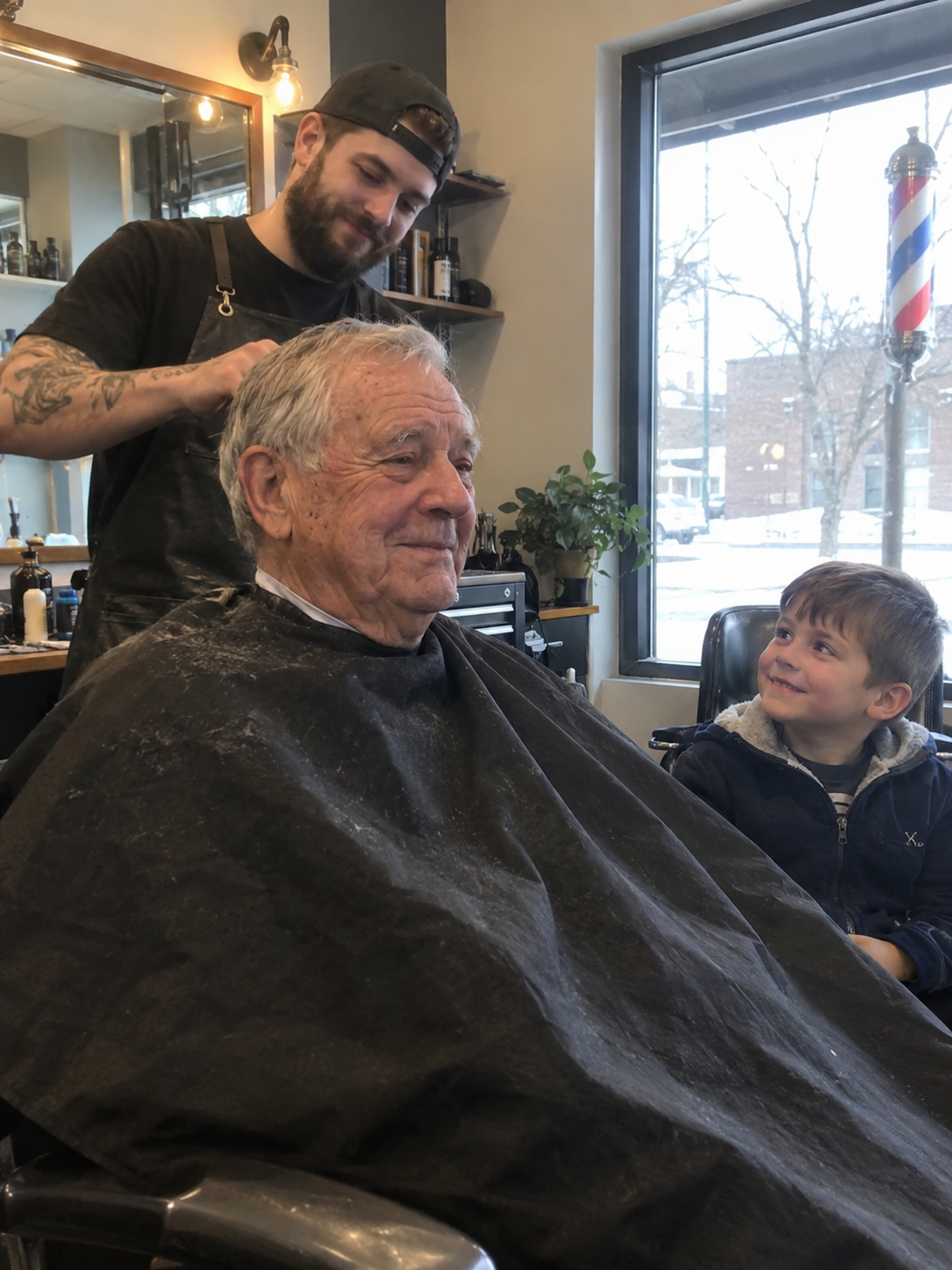
The Haircut He Thought He Couldn’t Afford
The shop was busy that Saturday morning, but one customer sat quietly near the door with his cap in his hands. The day had started normally, which is often why moments like this are easy to overlook.
The setting was barbershop in Cedar Rapids, Iowa, where a retired mechanic named Walter, a young barber named Eli, and Walter’s grandson crossed paths during an ordinary day. Everyone involved had arrived with a routine, a responsibility, and a reason to keep moving.
At the center of the moment was a simple problem: Walter had stopped getting haircuts after his pension check became tight. It was not the kind of difficulty that announced itself loudly; it had been growing quietly over time.
It would have been easy for everyone nearby to keep moving and let someone else handle it. Most people would have understood the situation only after slowing down long enough to see the person behind it.
But the person who noticed did not treat the problem as an inconvenience. That pause mattered because being noticed can feel almost as important as being helped.
Eli quietly gave him the chair, trimmed his hair, and refused payment. The decision was made quickly, but it was not careless; it came from paying close attention.
The help began quietly, without an announcement or an expectation of praise. Nothing about the gesture was performed for an audience, and that made it feel especially sincere.
For the person receiving it, the kindness meant more than the practical solution itself. For someone already carrying worry, a calm response can make the whole problem feel less frightening.
The detail that made the moment unforgettable was that Walter had once fixed neighbors’ cars for free, and Eli had heard about it from his grandfather. The object or task seemed ordinary, yet it carried years of personal meaning for the people involved.
That history was not visible to everyone in the room, but it gave the gesture a deeper meaning. Memories often hide inside familiar things, waiting for one thoughtful person to recognize them.
One conversation led to another, and the ordinary setting suddenly felt more personal. Once the story behind the moment came out, the people nearby understood why the kindness felt so personal.
They were simply responding to a need in front of them. The setting stayed busy around them, but their attention remained focused on the one thing that truly mattered.
As the moment continued, the people around them began to notice what was happening. No one needed a speech or a dramatic promise; the next helpful step was already clear.
Some offered a smile, some stepped aside, and some quietly gave the two people more time. That kind of response is easy to underestimate until you are the person who needs it.
The turning point came when the barber shop filled with old stories and a fresh sense of dignity. The small crowd did not turn the moment into a performance, and the people involved were grateful for that privacy.
By the end, He came in worried about money and left looking like himself again. What happened next gave the day a new direction without changing its ordinary surroundings.
The result was not a grand rescue or a public celebration. The practical answer solved the immediate problem, while the human connection lasted much longer.
It was a small change in someone’s day, made possible by attention and patience. By then, the people involved were no longer strangers passing through the same place.
That is why the moment stayed with everyone who saw it. The memory stayed because it offered a simple reminder that people still look after one another.
On a hard day, kindness can restore more than an appearance. It was the sort of kindness that does not require wealth, perfect timing, or special permission.