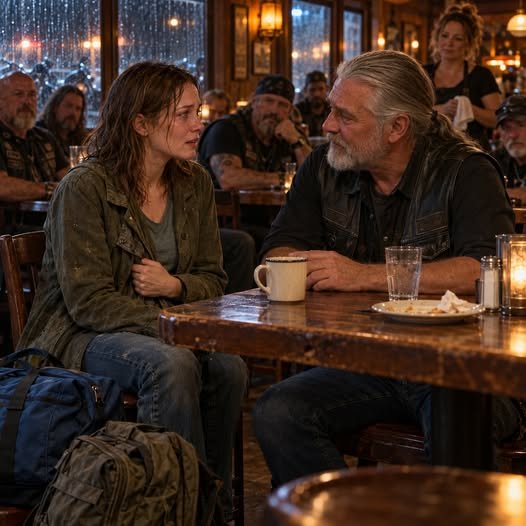
The rain had already soaked through her socks when Hannah Mercer saw the red sign glowing across the highway. THE SWITCHBACK. A low brick building with motorcycles lined up under the awning, and through the windows, the unmistakable sight of people eating.
She had eleven dollars, wet feet, and nowhere to sleep. That was enough to make any warm room look like mercy.
Eleven Dollars and Everything She Owned
Hannah was thirty-four that night, though the truck-stop mirror earlier that day had suggested otherwise. For six months she had been following work around eastern Tennessee — motel laundry, diner kitchens, a week cleaning rental cabins until the woman who hired me decided her nephew needed the money more. Everything she owned fit in a backpack and a blue duffel with one working zipper.
That afternoon, a motel manager outside Cleveland had told her he couldn’t give her another shift. His wife was doing the rooms now. He let her keep the sandwich she’d packed from the employee refrigerator. By evening, the sandwich was gone. So was the daylight.
She pushed through the door of the Switchback into the smell of fried onions, damp leather, and beer. The laughter hit her first — from a table beside the entrance. The sole of her left sneaker had separated at the toe, and the wet rubber flapped when she walked. One man nudged another. “Rough night?”
A second one asked whether the bar had started letting people pay with spare change.
Hannah pretended she hadn’t heard. Six months of pretending had made her fluent.
“Cheapest sandwich you have, please. And coffee,” she told the woman behind the counter.
“Grilled cheese is six.”
She counted out the bills before anyone could wonder whether she had them. The woman took eight dollars and pointed toward a table near the back. “Coffee refills are free.”
Hannah thanked her harder than the sentence deserved.
The Memory of Better Days
Her chair had a split in the vinyl. She set her backpack on the seat beside her and kept the duffel between her feet. Across the room, gray-bearded men in leather vests leaned over a pool table. Someone fed money into the jukebox. At the center booth sat a broad man with silver hair pulled back at his neck. People kept stopping to speak to him — the way people stop to speak to someone who matters. He looked at her once, then went back to listening.
Hannah wrapped her hands around the coffee. Four years earlier, her husband used to complain that she held mugs instead of drinking from them. “You know it works better on the inside,” he’d say. She could still hear his voice clearly when she wasn’t trying.
They had rented a little house outside Knoxville. He repaired commercial refrigerators. She worked at a dental office. On Fridays, they bought groceries and argued over which terrible movie to watch. Then a driver crossed the center line in the rain. Her husband never came home. Hannah did, eventually — with a cane, a stack of bills, and instructions about lifting things.
People brought casseroles at first. Later, they brought suggestions. Move somewhere smaller. Find something positive. Get back into a routine. She tried. But appointments took hours out of workdays. Pain made standing difficult. The savings disappeared before she understood how quickly they could. She sold the house’s contents before leaving it. The last thing she carried out was his coffee mug. It broke two months later in a bus station. She kept the handle, wrapped in a sock inside her backpack.
The Scar
The bartender brought her sandwich cut diagonally, with a handful of chips she hadn’t ordered. Hannah ate slowly, hoping the rain would ease. At the entrance table, someone laughed again. She couldn’t tell whether it was about her. After a while, that stops mattering. You begin supplying the words yourself.
When her plate was empty, she checked the time. The gas station would stay open all night. If she bought something small, maybe the clerk would let her sit until morning. She stood and lifted her duffel. A sharp pull caught beneath her ribs. She lost her grip, and the bag struck the floor. As she bent after it, her shirt snagged on a jagged piece of the chair back. Fabric pulled upward. She freed it quickly — but not before the long scar along her left side showed.
The silver-haired man was suddenly standing. He came toward her so fast she backed into the table.
“I’m leaving,” she said.
He stopped immediately. “No. Please.”
His eyes moved from her face to the place where she’d pulled her shirt down. Then he looked at the thin wedding band she still wore.
“Was his name Ben?”
The jukebox kept playing, but Hannah couldn’t hear the song anymore.
“How do you know that?”
His mouth tightened. “Your car was blue. There was a yellow blanket on the back seat.”
She couldn’t move. He took one careful breath. “And you kept telling me he was afraid of the dark.”
The Worst Night of Her Life
The man was called Ray Calloway, and he was the president of the Ironwood Riders. Four years earlier, before the club and the silver hair and the booth that everyone orbited, he had been a volunteer firefighter riding with the rescue squad outside Knoxville — the first responder who reached her car in the ditch that rainy night.
He told her what she had never been able to remember: that she had been conscious, pinned beside her husband, and that she had kept talking to Ben the whole time they worked to free them. She had told Ray that Ben was afraid of the dark. She had begged him not to let Ben be alone in it. Ray had held her husband’s hand through the wreckage and promised her he wouldn’t leave him.
“He wasn’t alone,” Ray told her now, his voice rough. “I stayed with him the whole time. I never left.”
Hannah sat down hard in the broken chair. Four years of grief had taught her every shape of that night except this one — that a stranger had kept a promise she didn’t even remember making him keep.
The men who had laughed at her shoes were standing now, silent. One of them — the one who’d made the spare-change joke — looked at the floor like it had personally offended him.
What the Riders Did Next
Ray didn’t offer her charity. He knew better. He offered her a proposition, the way his club offered everything: straight, with dignity attached.
The Ironwood Riders ran a garage two towns over — custom work, restorations, honest rates. Their office manager had quit the month before, and the books were a mess, and they needed someone who could organize an avalanche and answer a phone without flinching. The pay wasn’t grand. The apartment above the garage, though — small, clean, dry — came with the job, and nobody would ask her to be grateful for it.
Hannah stared at him. “Why are you doing this?”
Ray glanced at her scar, at her ring, at the duffel between her feet. “Because that night, you asked me for one thing. I’m still paying it back.”
She started the following Monday. The books were worse than advertised. She fixed them in three weeks. She learned the riders’ names, their coffee orders, which ones were lying about being fine. The man who had laughed at her shoes showed up on her second day with a new pair of work boots in her size and no explanation whatsoever. She wore them.
The Handle
On her first evening in the apartment above the garage, Hannah unpacked the backpack. She unwrapped the sock and held the broken handle of her husband’s coffee mug — the last thing she had carried out of their little house.
She didn’t cry. She set it on the windowsill, where the morning light would find it. Then she went downstairs, where twenty men in leather vests were arguing about a carburetor, and she laughed for the first time in longer than she could measure.
Ray looked up from the workbench. “What?”
“Nothing,” she said. “It’s just loud in here.”
“Get used to it.”
She did. The Ironwood Riders became the loudest, most overprotective, most infuriating family she had never asked for. They taught her to change her own oil. They showed up — all of them, engines rolling — at her first Thanksgiving in the apartment, carrying so much food she had to borrow tables. When her back seized up that winter, three of them took turns driving her to physical therapy and pretended it was no trouble at all.
Home
A year after the night at the Switchback, Hannah stood in the garage office with the books balanced to the penny and a birthday cake the club had ordered with her name spelled wrong. Ray raised his coffee — he had given up stronger things years ago — and said the thing he said every year on the anniversary of the crash, the thing he had started saying the night she walked in with eleven dollars:
“To Ben. Who was never alone in the dark.”
Some people walk into a biker bar with nothing. The lucky ones walk out with a family.
And Hannah — who had once counted her life in miles walked and dollars left — raised her own cup and finally believed it. She had been found, not by luck, but by a man who had kept a promise across four years and a rainy highway, and who had recognized her by a scar and a wedding band and the name of the husband she still loved.


